When I got home this evening I was glad to see my vote-by-mail ballot waiting for me. I had mailed in the application only a few days ago and was worried I wasn’t going to get the ballot before leaving town on Thursday for three weeks, thus missing the election. And I always vote. Always. We had a special election a couple of months ago and I purposely booked my flight for a couple of hours after polls opened so that I wouldn’t miss the chance to vote. That wouldn’t work this time, though, and given the frequency of my travels the past year I figured it was better to file for a permanent absentee ballot, despite my preference for tradition: going to the polling place, lining up with people, discussing politics and local issues, greeting the polling-place workers, and proudly leaving with a sticker on my lapel that reads “I voted.” Yes, I am corny about my vote. So I was pleased to see that the ballot had arrived.
What surprised me was how relatively complicated it was to fill out. Remember the infamous “butterfly ballot” that was the excuse some people gave for seating George W. Bush after the election that Al Gore won? Thousands of surprised seniors, many of them liberal Jews, learned that they had accidentally voted for Pat Buchanan for president. Here’s why:
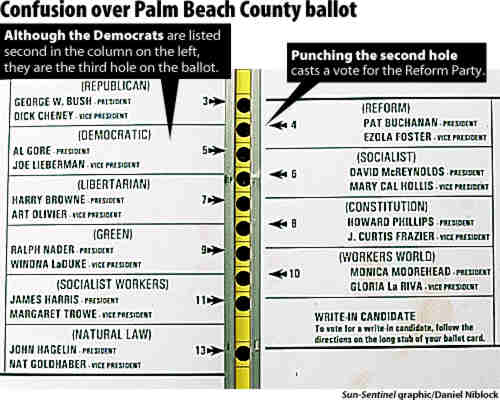
Gee, wonder why they got confused. The GOP apologists said that people who couldn’t understand their ballot shouldn’t be allowed to vote anyway, but look at that image, and then imagine you’re in your 80’s and you know perfectly well whom you want to vote for. But because of the layout you vote for someone diametrically opposed to most of what you’re trying to support. (Which wouldn’t have mattered if the state had counted all the black votes in other districts… but that’s a separate story.)
Now let’s take a look at California’s absentee ballot kit. Here’s an example (yes, taken from 2008, but the components are the same):
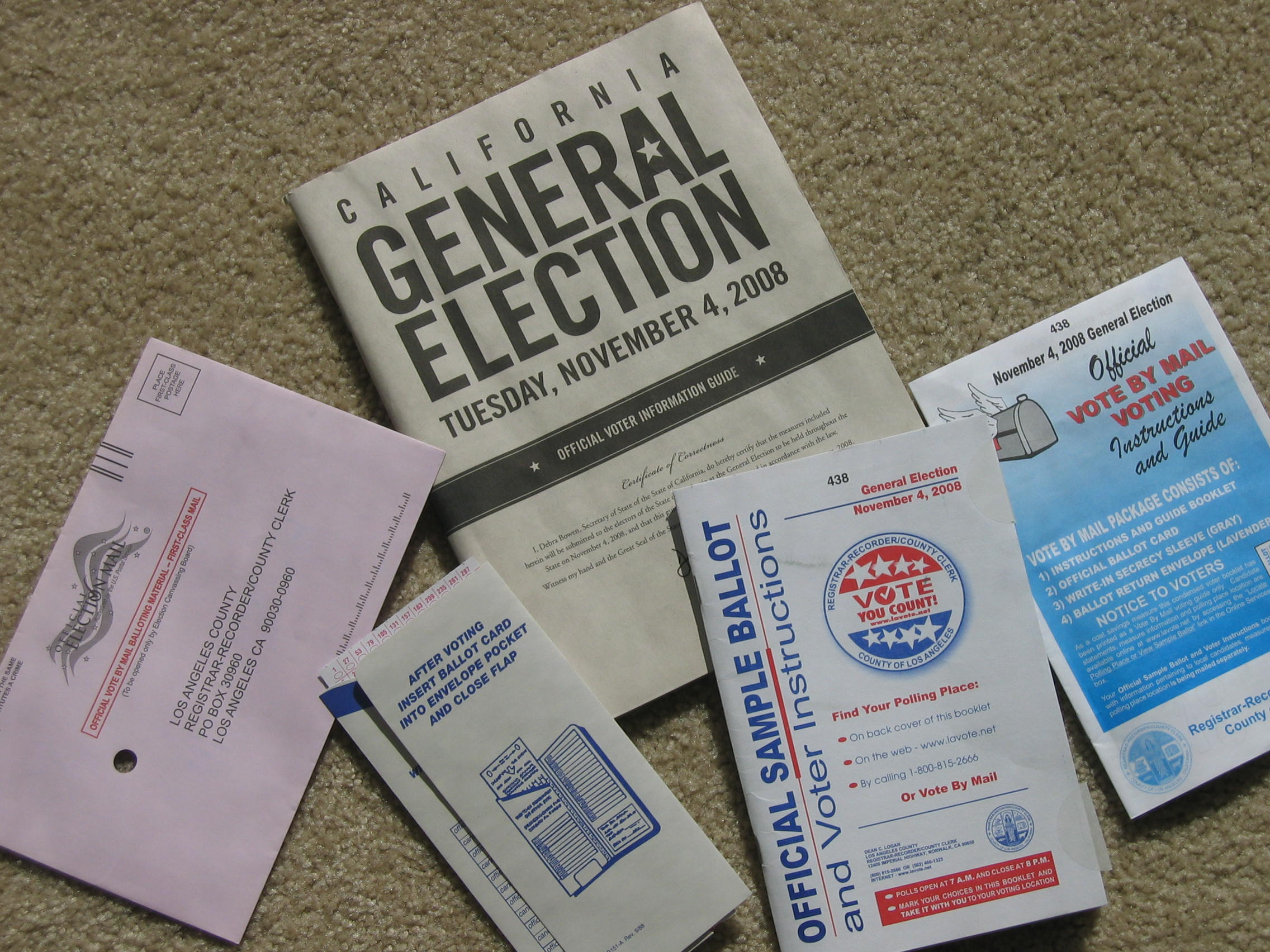
You get a general election guidebook, mailed separately. Then you get the kit, which includes, from left to right, the envelope in which to mail it back, the “privacy sleeve” for you to insert your completed ballot, your actual ballot (tucked in this case inside that privacy sleeve), your voting instructions and sample ballot containing the candidate names and issues on which you’re voting (plus a numbered bubble next to each option, and the Vote By Mail instructions and guide. I opened this up, looked over all of this and — was confused. A few facts before we go on:
- I’m 47, not 87.
- I read, and write, for a living.
- I am a delegate for one of the two major parties, and in this state.
- I have three college degrees.
- I’m a reasonably intelligent person.
To me, the first indication that this might be confusing to a great number of people was that I actually had to read the instructions. I know that they are there to be read, but how often does anyone have to read instructions any more? I didn’t read them for my iPhone (which should be far more confusing than a ballot). I didn’t read them for setting up my home computer. Have you read them for your microwave oven or your coffeemaker or your refrigerator? But to vote, you need to read the instructions — not to grow informed about candidates and issues, but to fill out the form. That seems wrong. And it is mandated mostly because the candidate names and issues are on one booklet of paper, and the ballot is a separate piece of paper with just numbered bubbles in it. And those numbered bubbles aren’t printed in the same array as the representative numbered bubbles in the official sample ballot. Also, the back of the pink return envelope has three places to sign it — I signed it on the left side only, which seems to be correct, but the two options on the right side seemed like viable choices as well before I studied it more carefully. All of this left me wondering how many of these would be left uncounted because of a technical foul — signing the wrong side, let’s say — or how many of these would result in votes that are counter to the wishes of the voter. But then, I was also left wondering this: How many of these just won’t get delivered? Because, you’ll note, it requires a stamp. If someone is mailing in a ballot, should we really require the postage? If members of Congress have the franking privilege, could we at least extend it to voters when they mail in their ballots?
I’m now a permanent absentee voter. Unless I go through the process of changing that status, I’ll be dealing with these ballots every time. That prospect makes me miss the voting booth. It also reminds me again how far behind our public institutions are; surely there must be a viable secure way to vote online, and if there isn’t, we should develop one. Until then, we’ll be seeing more and more of these mailed ballots — some elections are mail-only (including some here in Burbank), and in some areas of California, all elections are done by mail. That may be good for the post office, and good for voters, like me, who can’t make it to the polling place. But the only way we’ll know it’s good for democracy is if the format is simple.