Lee Wochner: Writer. Director. Writing instructor. Thinker about things.


Blog

Archive for the ‘Writing’ Category

Who wants something?

Saturday, November 4th, 2006

protagonist.jpgLast week in my Saturday playwriting workshop we were talking about how to identify the protagonist. Ellen immediately piped up: “I usually look at who wants something.”

That’s exactly right.

But I added, “In a good play, everyone wants something.”

The Prestige of being Priest

Monday, October 30th, 2006

The other night my son Lex and I went to see “The Prestige,” which we enjoyed greatly. On the way to the movie, I said to him, “It was written by Christopher Priest, a comic-book writer.” I recounted for him some of Priest’s comic books, most notably Black Panther.

When the credits rolled on the movie, I was surprised to see that Priest had not in fact written the script; rather, the film is based on the novel by Christopher Priest. Hm. I didn’t know that he was a novelist, but he most certainly was a scriptwriter, so why hadn’t he scripted it? And when had he become a novelist?

At home, still puzzling this over, I jumped on the internet and found Priest’s website. The site seems equally devoted to three areas: comic books, beautiful nude black women, and a religion he has joined. I share his interest in two of these things and, because my tastes are catholic I am completely nondenominational. It doesn’t matter if you’re focusing on Marvel or DC, or Asian or caucasian or Latino, etc. They all have their place.

(And I’m sure that right now every friend I have is clicking through to that website.)

In reading Priest’s lengthy bio, which stretches back into the 1970’s at Marvel, I started to feel that something was odd. After all, who was Christopher Priest? In my mind he was a guy who had started writing comics just over 10 years ago — that’s when I first noticed him anyway, and I’ve been reading Marvel comics since Stan Lee was personally writing them. How could he have been writing all these Marvel comics without my having noticed?

Then I come to this paragraph: “It was about this time Jim Owsley became Christopher Priest. He never discusses the true reasons behind his name change, but insists every story you may have heard about it is absolutely true.”

Then, after Googling “Owsley changes name to Priest,” I discovered that there was another Christopher Priest, also a writer, and also a writer in genre (science fiction). I read a bit about the controversy, then found this, from a guest-of-honor speech to WorldCon in August, 2005, written by the “original” Christopher Priest:

A few years ago I discovered that a young comics writer called James Owsley had changed his name to mine. It was a deliberate act, and he knew of my existence. The only reason he’s ever given in public for this irrational act is his belief that the name “Christopher Priest” is cool. In fact, he said “co-o-ol.” At first I thought it was a joke, then I thought it must be an error, and then at last I thought it was time for me to do something. When I contacted his publisher, an Owsley enthusiast called Brian Augustyn, I was told that the decision was made. It wouldn’t now be reversed, and it was “Chris”‘s inalienable right to call himself anything he liked. I should, in fact, praise the Lord for the good fortune of being born with such a co-o-ol name. When I pointed out, with good reason, that the worlds of science fiction and comics are perilously close to each other, and often confused with each other in the minds of certain people, I was told that the sheer excellence of Chris’s writing would permanently set him apart from everyone else. Including, presumably, me.

Since then, “Chris” and I have been regularly and routinely muddled up with each other. Enter my name in Amazon.com and you’ll see what I mean. A search in Google, or any other search engine, produces the same result. I often receive e-mails intended for him — I assume he often receives mine.

So without much effort this impostor has been not only irritating but seriously annoying. For several years I tried to take a tolerant, amused line on the problem, thinking that he’d get tired of the gag after a bit, but he shows no sign of it. Now, twice in the last twelve months, I have heard comments that publishers have had unpleasant experiences working with “Christopher Priest” and don’t want to work with “me” again. So as well as him being irritating and annoying, his professional incompetence is damaging me.

I’m not amused any more. My message is this. If you hear my name mentioned in any context, please remember what I’ve said and ask yourself if you’re sure which one of us it is. Beyond that, if anyone here has the least influence on him, please use it.

I don’t bear him any ill-will. All I want him to do is change his name back. He’s done it once, so there’s no great difficulty in doing it again. In fact, I suggested this during my conversation with his publisher. I even proposed a new by-line for him. I said, “Why doesn’t he call himself … ‘Harlan Ellison’?”

Mr Augustyn said, “That’s not a co-o-ol name.”

Then I went to bed.

In the morning, wanting to learn a bit more about “The Prestige,” I dropped “Christopher Priest” into Google again and found this site. And as soon as the photo of a blue-eyed white man came up, I finally discovered that “The Prestige” was written not by the comic-book writer but was based upon a novel by the British author — and that said British author is entirely correct: People are going to confuse the two of them. I had — for days.

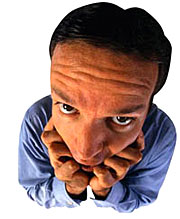
The photo on the left of the comic-book writer Christopher Priest is the only one I can find on the web. The photo on the right of the rather haunted-looking Christopher Priest is liberally applied — perhaps in an effort to distinguish himself from the other Christopher Priest.

If you were a somewhat unknown writer who had struggled all his life to make a name for himself and had lately seen it coming to fruition, gaining guest of honor status at the world’s foremost science fiction convention, having your novel turned into a film as good as “The Prestige,” how would it feel to find yourself being confused with another genre writer who had taken the same name as you, and seemingly while knowing of your existence?

Years ago I discovered another Lee Wochner on the web. This Lee Wochner was Leland P. Wochner, he lived in Illinois, he was 70 years old — and he was a plumber. Not a writer. I remember the relief in discovering this.
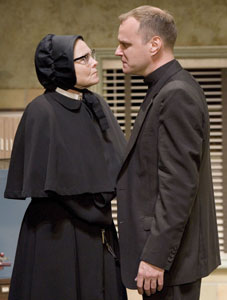
Needed desperately

Saturday, October 28th, 2006

Mark Chaet sent this in. Make me wonder just what he was looking for that led him to this….

It also makes me realize:  these zombies are seeking the essential one thing they don’t have (a fully functioning brain — which doubles as housing of the soul, life force, personality, and so forth). Now, they say they want to eat them — so once they get what they seek, they’re using it for impure purposes. They don’t realize that their expressed desire (to get brains to eat) does not reflect their true desire (to be alive again).

So what is this? Another good example of subtext.

Not so Funky

Thursday, October 19th, 2006

Well, I’ve checked Funky Winkerbean every day since, and there’s been no further mention of “the day I’d never forget” (and no further appearance of that character), so I’m chalking it up to an acid trip by the artist.

In the meantime, I’ve talked myself out on the Funky junk — brought it up in my class at USC on Monday night, brought it up last night in my workshop (and I think I’ll spare my Saturday workshop), and generated alarmed stares from my family, who somehow don’t see the incredible importance of correctly depicting the timeline of comic books as cultural markers.

But it is important. Verisimilitude is part of what lends power to literature. Art doesn’t have to be literal — witness Guernica — but it benefits from being specific. Funky may not be art (clearly), but it even fails as pop art because its interior universe is so wrong that everything is called into question.

It’s better to get it right. Asking the right questions — who, what, when, where, why, how — of the universe you’re creating leads you to new and interesting answers. Not asking the questions leads to cliche, sentimentality, and weakness.

Get yer story straight

Monday, October 16th, 2006

funky061015.jpgDidn’t realize I had so much in common with Funky Winkerbean. I can relate to this origin story, from the 10/15 Sunday strip: “After (reading that first comic book)… the world was never the same!”

Except certain things about the execution of this strip fill me with doubt. For one thing, the comic he’s rhapsodizing about doesn’t belong with the other comics it’s shown with.

The comic he’ll never forget — Action #242 — debuted in July of 1958 and introduced both Brainiac and the bottle city of Kandor. But shown alongside it is an issue of Archie’s Mad House — and that title didn’t debut until 1959. I know that sometimes comics distribution was spotty and slow, and perhaps the Action #242 hung around unbought, but how to explain the Captain Marvel #1, which debuted in 1968 — a full 10 years later?

You’ll also note that the cover price of Captain Marvel #1 was 12¢. In 1968, comics went to 15¢ (making this one of the last 12¢ issues). When had they last been available for 10¢? Try 1962. The cash register in panel five shows a sale of 10¢, which is correct for Action #242, but again, it’s displayed alongside a comic from 10 years later that would have cost more.
In the background of the same panel, one sees a poster for the community Halloween Party, meaning that this is set in October. The issue of Captain Marvel shown would have been distributed in August — so this particular issue would have been pulled and replaced twice in this timeframe.

So… what year is it supposed to be here? Or are we supposed to think that the drugstore (and its distributor) kept comics lingering on the same spinner rack for Ten Years?

Also, whether it’s the 50’s, or the 60’s, what era is this kid’s weird clothing ensemble from? One could charitably say late 60’s / early 70’s, in vogue with the then-counterculture, except in panel 3 it looks as though his jeans are either cuffed or rolled. (Rather than no cuffs, and flared.)

Along a similar line, note the druggist’s eyeglasses. They don’t look 50’s. Or 60’s. They appear to be from the 1970’s.

Why is any of this important?

Because all of the details are wrong, they make the entire story unbelievable. This mishmash of bad facts leads me to only two possible conclusions: The narrator is either a liar manipulating an unseen audience member, or he’s seriously brain-damaged. Ordinarily, I don’t follow Funky Winkerbean. But now I’m going to, just to see which theory is true.

The third potential scenario would take us outside the strip: that the cartoonist didn’t care enough to get it right.

Worry

Saturday, October 14th, 2006

WorryThis week several of the playwrights I work with started to worry. Again.
I understand. I do. I was briefly paralyzed by writer’s block in 1991. Every play I was writing not only was not as good as Beckett or Ionesco or whomever, it wasn’t even as good as the last play I’d written. My interior refrain, “If only I was still writing that other play. That was a good one….”

You’ve got to set aside the worry. It’s a distraction. If you’d like, after you’ve done some writing, you can pick it back up. But at least write yourself out first.

As Jordan E. Rosenfeld says in this month’s Writer’s Digest, “Show me a famous painter who went to the canvas and came away with something like the Mona Lisa. Art doesn’t happen that way. If you want to get off the Procrastination Express, resist the temptation to revise and edit as you go.”

I’d add to that, set your worry aside while you’re in the process of writing.

How did I stop worrying about the play I wasn’t writing and focus on the one I was? By telling myself I wasn’t leaving the room until I had finished the draft, and by telling myself that I was free to let this play be as good or as bad as it was going to be.

The play I wound up with was actually pretty good. It got produced soon thereafter in both Los Angeles and New York and both times got huge laughs. (Good thing: It’s a comedy.) Is it “Waiting for Godot”? No. But it was never going to be. In fact, it was never going to be anything at all until I allowed myself to write it.

Trust

Wednesday, October 11th, 2006

trust.JPGTrust yourself and follow your characters. If you have strong characters, they will speak to you. Listen to them.

If you don’t listen to them — to their inner thoughts, to the subconscious that drives them and that even they cannot knowingly heed — then you fill their lives with something less than a truthful portrayal, and then you are writing melodrama.

It’s hard to listen. It’s easier to talk. The same goes for playwriting. It’s easier to be wilfull and stuff words where they don’t belong and where they will sound hollow. It is even easier to throw up your arms in defeat. It’s harder to be open. But it’s also better.

Comedy or drama, the strength of a play is in its veracity. You get there by listening hard and letting go.

If it doesn’t add, it subtracts

Tuesday, October 10th, 2006

Playwriting doesn’t work like mathematics.

In math, two plus one equals three.

In playwriting, having an extra character often leads to a negative outcome.

That’s because a character you don’t need – a character that isn’t essential to the scene, that doesn’t bring any additional insight or conflict or entertainment value – winds up detracting from the scene. Worse, that extra character cheats other, important characters out of additional opportunities.

One of my students was writing a smart, fresh and funny play about a hometown guy who finally has a chance with the high-school princess. For reasons we don’t know, she’s returned home from the big city and is seeing with new eyes that our protagonist has qualities we all admire: a humble, centered, decency. We sympathize with him when the other mechanics at work tease him and root for him when the pretty woman’s interest in him arouses the envy of others. When he takes her out for dinner, he’s honest about what he can afford and what he can’t. In every way, he reflects simple human goodness.

Imagine how disappointed I was, then, when we read the scene where we learn why the prom queen has returned: Our man isn’t in the scene. Instead, we learn through the introduction of a new character, the woman’s father, that she has returned to care for him as he recedes farther and farther into Alzheimer’s disease. We get a full scene of his ranting about Commies or Nazis or insurance investigators and such, and her trying desperately to deal with it. This is followed by a scene with her relating what just happened to our hero, her new would-be boyfriend, and his sympathizing and sharing his own world of hurts.

It may have accomplished the goal of explaining – but nobody goes to the theatre for an explanation. They go for entertainment and they go for enlightenment.

When I asked the class to restructure the scene minus the father, it didn’t take long for everyone to realize we didn’t need that character. With the father in the scene, we miss our protagonist, we’re subjected to a scene that fills us with grave doubts (we all had a hard time buying the reality of the father’s ranting), and the end result is a scene of confession and sharing – not exactly high drama.

But without the father, and with the scene rebuilt to focus around the two leads, we were back in the realm of dramatic tension. Our hero goes to pick up the woman for a date but she’s flustered and apologetic – something’s wrong and she can’t go. She tries to put on a brave face, but our hero pulls the facts from her (which by the way highlights his compassion and all his other positive traits.) Her father’s sick – it’s really bad. It can’t be that bad, he says. (And here, as we hear only glimmerings of the old man’s condition, our mind is free to fill in something even more stark than we would have seen.) There is tension in what is not said – her real problem – until it is said; there is tension in what is not shown – the extent of the old man’s dementia; and there is tension in what this means for the relationship on the doorstep of what would have been their first date.

Any character that doesn’t add to the tension somehow or other in the play is a character that winds up weakening that tension. Sometimes when you add one, you’re actually subtracting from the whole.

Best note ever?

Friday, October 6th, 2006

After a rehearsal run-through for my play “All Undressed with Nowhere to Go,” the director gave the actors notes. Insightful, intelligent, penetrating notes that impressed me and made my head spin. Then he turned to me: “Anything to add?”

I looked up and said to the actors, “Do it better.”

And y’know what? Next time — THEY DID. Maybe that’s all they needed: “Do it better.”

I said it on a lark — and it got a big laugh (the desired response) — but it worked. Sometimes we need to know what “better” means; we need more guidance. But other times, we only need to hear that whatever we just did didn’t work and we need to do it better.

I know I have that feeling often when I look back on what I’ve written. “This could be better,” or, more often, “This needs to be better.”

And then I do it better.

Write. Then edit.

Thursday, October 5th, 2006

After 16 years of teaching writing, both at the University of Southern California and other institutions of higher education as well as in private workshops, I don’t believe that writing can be taught. And I say that to my classes and workshops.

What I do believe can be taught is craft. (What will play, vs. what will not play – and why. And how to make something more playable.) And what I do believe can be given is encouragement of what is good, because playwriting like all writing can be frustrating and lonely and every writer’s world is full of discouraging voices including his own.

It is that latter discouraging voice – your own – that is most potent. That is the one that will stop you in your tracks. It is the one that tells you while you are writing it that the play you are writing does not work, cannot work, will not work, and that you are fooling yourself in writing it and will make a public fool of yourself if it is ever presented before an audience or even read by someone else.

You cannot listen to that voice and write anything. Including, some days, your own name.

Better to just write.

Write without the worry and write certainly without that voice in your head. Write with the freedom of impulse, in the way basketball stars effortlessly sink ball after ball when they slip into a non-thinking zone. Write as though you are on a well-provisioned sailing craft with no fixed destination and no end to your days and no storm clouds on the horizon. Write with the pulsing thrum of your blood.

Give yourself the freedom to create and you can. And then, later, in the harsh reality of the after-writing, look again at what you have written, switch on the critical voice, and edit.

Because you cannot write while you edit, and you should not edit while you write.