Lee Wochner: Writer. Director. Writing instructor. Thinker about things.


Blog

Archive for the ‘Writing’ Category

A difference of opinion

Monday, May 14th, 2007

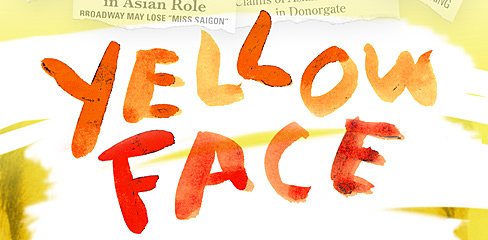
yellow_face.jpgThe other night I saw what I thought was the most remarkable play I’ve seen in perhaps 10 years. (Since I saw the premiere production of “How I Learned to Drive,” a play I now teach.) It was “Yellow Face,” by David Henry Hwang, now playing at the Mark Taper Forum here in Los Angeles. Even though I had to get up at the inconceivable time of 5 a.m. the next morning for USC commencement, there I was at 11 p.m. on the plaza of the Music Center declaiming the wonders of the play for Dorinne Kondo, the friend/colleague who invited me, and Tim Dang, artistic director of co-producing company East West Players. I’m going to write more about this play when I have more time, but let’s put it this way:  I wondered aloud how long it would be before “Yellow Face” is published, because I’d like to read it and I might put it into the syllabus of one of my classes.

Today I had lunch with another colleague, a playwright whose work I respect. She’s smart and talented. She wanted to know if I’d seen “Fat Pig” at the Geffen. (Answer: Not yet.) I brought up “Yellow Face,” preparing to launch into full shared excitement. Her reaction:  She left at intermission. “I don’t like plays about writers writing about writing,” she said.  That line was especially ironic to me because in 1992 I wrote a play that specifically satirized a form of novels I loathe:  writers writing about writers who write about writers. (The specific novel that first got me on this rant was “The Dean’s December” by Saul Bellow.) To me, “Yellow Face” was about many different wonderful things, interwoven and unified. To her, it was a play about the playwright writing this play (which, granted, it is on the surface). We saw the same play (well, she saw only half) and arrived at completely different conclusions.

I’ve grown used to having disagreements about art. (And even higher forms, like comic books.) But “Yellow Face”  is precisely the sort of play I go to the theatre hoping to come across — surprising, funny, moving, troubling; something that makes me challenge my own notions of what is right behavior and what is wrong behavior. To me it seems so ambitious, and so successful on its own terms, and so important, that it is unequivocally great. But after listening to my friend this afternoon, I suspect that my dread that night — that the critics are going to reject it as either self-serving or badly constructed — is exactly what’s going to happen.

I hope not.

And I’m going to advise everyone I know to see this show.

On supporting — or not — “daring” playwrights

Sunday, April 22nd, 2007

I’m of two minds about critic Charles McNulty’s piece in today’s LA Times in which he bemoans — but not quite — David Lindsay-Abaire’s upset win of a Pulitzer for “Rabbit Hole.”

McNulty wishes there were more support for cutting-edge theatre. Me, I wish there were more support for good plays, whether they’re cutting edge or not. I also think that Mr. Lindsay-Abaire was, until recently and with this play, somewhat edgy, at least in the eyes of most. Here’s how Wikipedia valiantly summarizes “Fuddy Meers,” a play I greatly enjoyed in a terrific production at the Colony Theatre a couple of years ago:

Fuddy Meers is an American play by David Lindsay-Abaire. It tells the story of an amnesiac, Claire, who awakens each morning as a blank slate on which her husband and teenage son must imprint the facts of her life. One morning Claire is abducted by a limping, lisping man who claims her husband wants to kill her. The audience views the ensuing mayhem through the kaleidoscope of Claire’s world. The play culminates in a cacophony of revelations, proving that everything is not what it appears to be.

Among his influences, Lindsay-Abaire lists playwrights John Guare, Edward Albee, Georges Feydeau, Eugène Ionesco, and George S. Kaufman and Moss Hart, 1930s screwball comedy films My Man Godfrey, Twentieth Century, and “anything by Preston Sturges, Frank Capra, the Marx Brothers, and Abbott and Costello.” Walking a fine line between grave reality and joyous lunacy, the world of his plays is often dark, funny, blithe, enigmatic, hopeful, ironic, and somewhat cockeyed. “My plays tend to be peopled with outsiders in search of clarity.”

I’m willing to bet that that list of influences would lure most of us into the theatre. It just sounds like fun. Quality fun.

“Rabbit Hole,” which concerns a family struggling to recover from the death of a child, is not in the same vein. In addition to his obvious talents, it turns out that Lindsay-Abaire has range.  He’s been quoted as saying he doesn’t care how he won the Pulitzer (in a decision that overruled the panel recommendations), he’s just glad he won.

McNulty seemingly wants us to support playwrights because they are daring.  I have seen those sorts of plays — lots of them — and their unconventionality often translates into a conventional dullness. I became a playwright because of the lure of theatre of the absurd, but somehow experimentation led to an alternative theatre movement split largely between “language plays” that are ironically devoid of meaning, and camp theatre revolving solely around one meaning. Neither provides the shock of the new.

There are theatres (mostly small ones) doing new plays that shock and entertain; he’s listed a few of them. I hope that if any of those playwrights goes on to write a good, strong play that happens to win a Pulitzer, we don’t condemn it for being too conventional.

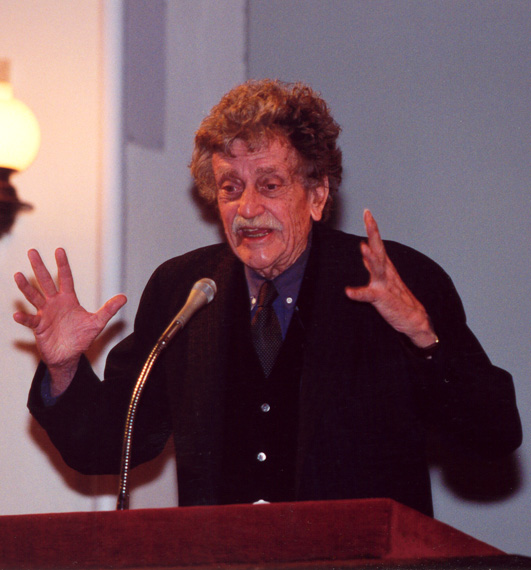
Vonnegut reading and talking about the end

Friday, April 20th, 2007

This seven-minute clip seems to be from a documentary I haven’t seen (yet).

Vonnegut’s mordant humor is well-served by his wry reading voice.

I really miss this guy.

Write like Vonnegut

Friday, April 20th, 2007

vonnegut3.jpgActually, I’m not sure that’s possible. You could imitate him, but not be him, nor would you want to. (Especially because he’s dead.)

But if you want some useful writing tips from Vonnegut himself, click here. I can’t guarantee your writing will come unstuck, though.

You will notice in reading his advice, by the way, that much of it is oriented toward helping the reader. I love him for that. (Just as playwrights who bore the audience infuriate me.)

Murderous playwriting

Tuesday, April 17th, 2007

brownstonebanner.jpgmcbeefbanner.jpg

Several people today have emailed me with links to the plays of Cho Seung Hui, the student behind the Virginia Tech massacre. Click here if you’d like to read them yourself.

They don’t tell us much beyond this: Mr. Cho was a very bad playwright. Really bad. The dialogue is forced and expositional, the staging doesn’t work, and characters such as the stepfather are set up as paper tigers for other characters to express their viewpoints. In fact, the only thing I like is the stepfather character’s name, Richard McBeef, but then only for a play in the style of Alfred Jarry.

Here’s the statement that these plays do not — repeat, do not — make: that because these are dark, troubled plays, Cho was clearly a dark, troubled person, someone who was going to be a murderer. No. These are dark, troubled plays that happen to be by someone who turned out to be a dark, troubled person who happened to turn out to be a murderer.

It always troubles me when people confuse the unattractive character in a play with its creator. Just because you’ve written racists, pederasts, murderers, and even Republicans into your play doesn’t mean you are one. It means that you are writing about them. Ian Fleming was in no way James Bond, Edgar Rice Burroughs was not raised by apes, and Harriet Beecher Stowe did not have an uncle named Tom.

These things may seem obvious to most of us reading this. Yet all across the net tonight people are reading the plays of Cho Seung Hui and deciding that someone “should have known.” If Cho gave other signs of mental distress, that’s one thing. But the writing in these plays tells us only that he had no future as a playwright.

Except — and here’s an irony — I guarantee that some enterprising director or producer somewhere is right now printing out those plays and getting ready to produce them. Remember, you read it here first.

The community of playwriting

Sunday, April 8th, 2007

I wrote my first play almost 30 years ago when I was 14. I was attending a high school I strongly disliked that provided early lessons in how to rebel; that’s how the play came to be called “Too Long.” The “teacher” — I use the word loosely; he was assigned to in some way oversee my play production at a student event while I did my best to subvert his authority without losing the production — said that the script was “too long.” So that’s what I named it.

How did I come to write this play? I was asked by some of the other kids if I would appear in their play — a jury-trial play of some sort — and I agreed; I was thrilled to be asked. But then I noticed that most of my close friends — the odd, the inept, the ungainly and ill-kempt, the losers and stragglers, the self-conscious and left-out, in other words, people like me — weren’t invited. I kept making pitches for them to be involved in the jury-trial play, but the kids putting that on just couldn’t find any way for them to be involved, even though, unsurprisingly, there was a role for everyone on the soccer team. I understood. Kids aren’t dumb about societies of people. So I decided I’d write my own play, a comedy, with only one parameter: If you wanted to be in my play, I would write you a role. It was an equal-opportunity production. I had a lot of fun with playing off the perceived notion of my friends’ identities — I made my best friend, a seemingly weak and withdrawn boy with glasses, into a serial killer who had strangled 29 people with one hand; I turned into a femme fatale the odd girl who never turned her head lest her perfectly straight hair wrinkle; I gave great gobs of dialogue to my stammering friend with full confidence that not only could he deliver those lines, he would. And of course, in keeping with the nature of such theatrical origin stories, it all came off as a huge success. The play got big laughs and for one night everyone involved was a star. And without knowing how to do anything, with no formal training except trial and error, I became a playwright and director without realizing it.

Not much has changed. Hundreds of productions and readings and workshops later, I still have no formal training in the theatre. Instead, like an apprentice or a magpie, I’ve just adopted what works for others when I find it also works for me. Moreover, I’m still working within mini societies much like the one in school: the society of actors and directors and playwrights at my theatre company Moving Arts, the extended society of such folk locally and across the nation, the society of students and colleagues at USC. I do have some formal training in playwriting, courtesy of David Scott Milton (who shaped my career and still teaches in the MPW program at USC) and the late and much-missed Jerome Lawrence. Dave and Jerry were part of theatrical communities as well and talked about them at length and did what they could to introduce their students to those societies; that’s an inspiration and an example that I work to pass on.

On Friday night I saw the world premiere of EM Lewis’ “Infinite Black Suitcase.” (Here’s a link to the theatre company, The SpyAnts, who are producing it.) Ellen Lewis was my student at USC, then my assistant director at Moving Arts, and a member of my playwriting workshop, and now she’s out and about and inspiring other people. Ellen is both strong and compassionate, qualities that don’t always intermingle and that one doesn’t always find in writers. On Saturday morning, after her opening night and its ongoing opening-night party and toasts from many well-wishers both blood-related and not, Ellen came to workshop (of course; she’s nothing if not dedicated). In talking about the pages of her new play, “Song of Extinction,” I said that the common thread in Ellen’s plays is “being strong, and going on.” She corrected me: while they may be about being strong and going on, she felt that “going on” is possible because other people help, both in the plays and in her life. And then she turned to the workshop and generously — probably too generously — thanked all of us for what is truly her success.

Every once in a while, I’m reminded of why I’m a playwright and not a novelist. This was another instance. I never wanted to be alone in a room writing for weeks and months at a time. I wanted to be working with a group, and that was one of my earliest writing experiences. No matter how much we might complain about it at times — about the directors who misinterpret the play, the actors who bungle the lines, the producer who didn’t market the play, and on and on — every working playwright I know is here because we need these other people and secretly hope they will be as committed and as talented, as inspirational, as other committed, talented, inspirational theatre people we’ve worked for. We love the actors and the audience members and the directors and producers and everyone else, sometimes in theory, but sometimes in practice.

Almost 10 years ago now I was fortunate to be in the audience one night for one of my comedies when a woman literally fell out of her seat laughing. The moment has passed, but it’s burned into my brain and I still love her wherever she is now. I’m still writing for that woman and other people like her, and still counting on theatre people to help me do it.
Their five most important books

Tuesday, April 3rd, 2007

Newsweek has a great little sampler of the books some noted writers say are most important to them. Here’s Walter Mosley’s list, which seems closest to my own reading — you’ll note that in addition to Camus, Garcia Marquez, and Freud (all represented by books I read, and some of which wound up on Doug’s Reading List), it includes Fantastic Four issues 1-100 (also a prominent suggestion to Doug — and to you). Mr. Mosley is a man of taste.

I have a great deal of respect for Dana Gioia’s work at the National Endowment for the Arts in bringing art to people who’ve never gotten much of it before, and his speech at a national conference several years ago similarly impressed me. One of the things he talked about was the death of his child, and how when something like that happens to you it burns through your life like a prairie fire, bringing instant clarity. It was thereafter that he set about quitting his (very successful, very lucrative) corporate marketing executiveship and dedicated himself to being a full-time writer. Here is his list of the five most important books to him; given his personal story, I think I’ll be reading the Merton book.

Marshall Rogers, 1950-2007

Monday, March 26th, 2007

rogersbatman.jpg

Comic-book artist Marshall Rogers, best known for his definitive work in the 1970’s and 80’s restablishing the gothic nature of Batman in “Detective Comics,” died Saturday, Newsarama is reporting.

I always loved his work, and reading of his death just now reminded me that I met him once about 25 years ago at a comic-book convention. But then I seemed to recall something else, and picking through the cluttered attic of my brain finally helped me stumble across the lost memory I was seeking: I interviewed Rogers over the phone in 1985 for The Comics Journal. I pulled down the relevant issue — #100 — and there it is. And here it is transcribed online if you’d care to see it.

Rereading it just now resulted in these immediate observations:

  1. I was a really bad interviewer. At least this time, and at least at first. The beginning of the interview is, well, flat-out rude: “First off, what have you been doing for the past few years?” That’s information I should have already known — and I suspect I did — but there is a better way to get it. My followup, “So more or less, over the past few years, one strip has been your job,” has a similar attitude that I regret. In retrospect, Rogers was nicer than I would’ve been.
  2. I suspect I was also picking up Journal editor Gary Groth’s pugnacity. I recall his recurring snipes to me about Denny O’Neil (whom I also interviewed in this issue) for being a heavy drinker; later, after the interview, I made nice with O’Neil and we wound up having a very pleasant Chinese lunch in Manhattan on the Marvel expense account. I also remember that I discussed with Groth the angle he wanted for each of the five pieces I have in this issue. Why he assigned me to interview Harvey Kurtzman, the creator of both “Mad” when it was a comic book and “Little Annie Fannie” in Playboy, I’ll never know, because I was completely unqualified — something Kurtzman glommed onto instantaneously, threatening to hang up.
  3. The interview, like all things from 1985, is incredibly dated. In the wake of “Shatter,” the first comic book done on a computer, I ask him if he’s afraid computers will supplant artists. Twenty years later, all mainstream comics are done on computer. You can also see how much the field was in transition in the mid-80’s, with the shift to creator-owned vehicles and profit-sharing.
  4. Hey — I too am one of the people whose intellectual property is being stolen on the internet. I say that because I sold one-time rights to the Journal for this interview, and here it is on the web for free. I guess we’d all better get used to that, if we’re not already. Either that, or I can emulate David Thomas of Pere Ubu and countless others who spend long hours hounding people around the globe to take things down. (And I’m linking to the interview — which I hadn’t even remembered conducting — so how put out am I truly?)

Please pardon my bringing these things up in what is, to some extent, a death notice; I just feel like a part of my life from more than 20 years ago came knocking.

Rogers’ work on Batman was clean and moody at the same time (and at its best when inked by Terry Austin); his Mr. Miracle had a sharp plastic snap to it that made it ping off the page. I’m not well-versed enough in the technique behind these tricks to explain how, but Marshall Rogers’ covers always stood out on very crowded newsstands. They belonged to what was a highly plastic era, but had a rigor and a punch that a lot of comics were missing. I’m sorry I won’t be seeing any more of that work, or any more of him at conventions.

Punchdrunk and silly

Thursday, March 15th, 2007

After more than 30 hours straight of writing, punctuated only by a few hours of passing out here in my office, I think I need to walk around the block or something.

The good news is, I’ve made strong progress on my book (about playwriting).

The other good news is that I finished a new one-act play in time for submission to a festival I was contacted about.

The not-so-good news is that I just caught myself sending emails like this one, to a friend of long standing (and sometimes sitting, and other times lying down):

Appropos of nothing, I thought I’d send you my new play, “Next Time,” written in time for submission to a one-act festival this September. (No idea if I’ll get in, but it’s run by a former grad student of mine — not sure if that helps or hurts.)

One brief moment in this play may seem familiar. About 15 years ago you wrote — and I mean HANDWROTE — a brief play in which versions upon versions of people stepped away from each other to show the layers and depths of a person. I swiped that, but because I’m lazy and it’s a short play, I’m showing only one layer, and they’re playing Monopoly. And the entire play is about layers of meaning and identity and reality, it’s completely removed from your own notion, as you see, but I wanted to acknowledge even the hint of a swipe where there might be one. So thanks for that, kind of, if, sorta.

Yes, I think it’s time for a break.

The three Fs of playwriting

Wednesday, March 14th, 2007

I’m not a believer in “rules” for writers. Where rules exist, good playwrights know them – and break them.

We break the rules of grammar to create dialogue that sounds like normal speech.

We break the rules of spelling to hint at character and dialect. Having a character say “tuff” instead of “tough” provides an indicator for the actor.

We break the rules of punctuation by placing commas not necessarily where they go but where we need them: to serve as brief musical rests for actors speaking our lines aloud.

And most importantly, we break the unwritten and unspoken but all too obvious rules of conformity and convention when we have our characters say, do, and be things that aren’t popular or nice. Society is that construct that ostensibly helps people get along by burying what’s uncomfortable; playwriting is a mechanism by which writers unearth the unpleasant for art and entertainment.

As opposed to rules, I believe in what I call “craft techniques” – theatrical givens passed down to us about how to help dramatic writing play better. Actors, directors, writers, all have these techniques, and they’ve kept them because they work. A few examples:

  • Put the punchline at the end of a joke because otherwise other words step on the joke and kill the laugh.
  • Don’t have an actor cross upstage on someone else’s important line because it steals focus.
  • If you have an actor play against the expressed intention of the line, you can often get a stronger reading by revealing subtext.

These aren’t “rules,” which inhibit us; these are techniques that help us succeed, and they’re generally related to the production.

When it comes to the writing, rather than keeping in mind rules, there are three notions that I hang onto, all of them starting with “F.”

istock_000002460202xsmall.jpgPlaywriting should be – needs to be – freeing. The act of writing a play frees playwrights, through their characters, to explore issues and ideas however they see fit: to see where they take us, to look at things in a new light, to find out what we think and to learn what we don’t know. This is a gift we pass on to the audience. Being free in your writing is a prerequisite to writing.

At the same it, playwriting should be frightening. If you never ever stop and wonder if you’re going too far, then you assuredly aren’t. You need to go further. If you want an audience to worry about your characters, you’d better put them in situations that make you uncomfortable while you’re writing it. This doesn’t mean putting them in oncoming traffic; it usually means they’ve said too much, too unkindly, behaved too rashly and too wrongly, been too good and are now paying for it, or are just flat-out unlucky in a truly catastrophic fashion. If everyone is safe, the play is safe – and no one wants to see a play that plays it safe. Playing within the rules of good behavior is safe.

fun.jpgAnd playwriting should be fun. This is the other reason that rules are to be understood but rejected: They usually stand in the way of the creative impulse, of the fun. If you’re having no fun writing your play, imagine how little fun actors are going to have acting in it and audiences are going to have seeing it. By “fun,” I don’t mean comic (although if you’re writing a comedy, it’s generally a good thing if at least you think it’s funny). I mean: exciting. You get up in the morning eager to work on it and go to bed feeling the same way. You think about it in odd moments. It colors your perceptions, as when you see someone in a supermarket berating a child and you realize that’s the way your protagonist would act. You feel truly alive when you’re writing the play and somewhat asleep when you aren’t. Fun is motivational. If everyone had more fun – if everyone were able to have more fun – the world would be a funner place.

Rules constrict people. In larger society, that’s often a good thing. In playwriting, not. To write plays, you don’t need rules. You need freedom, fright, and fun.