What happens when computers publish books
Monday, June 4th, 2012They rewrite great novels. Here’s what happened to “War and Peace.”
They rewrite great novels. Here’s what happened to “War and Peace.”
In no particular order, drawn from research performed over lunch with theatre people, and including solo shows:
*submitted by a female friend (thank you)
Yes, I did go see Waiting for Godot at the Taper on Friday night, and it was marvelous. It was surprising how fresh and entertaining the play was, and how moving in its conclusion, especially given how many times I’ve seen productions of it. Big congrats to the cast, director Michael Arabian, all the designers, and everyone else involved, on a flawless production.
But there’s another production that I’d like to talk about at greater length.
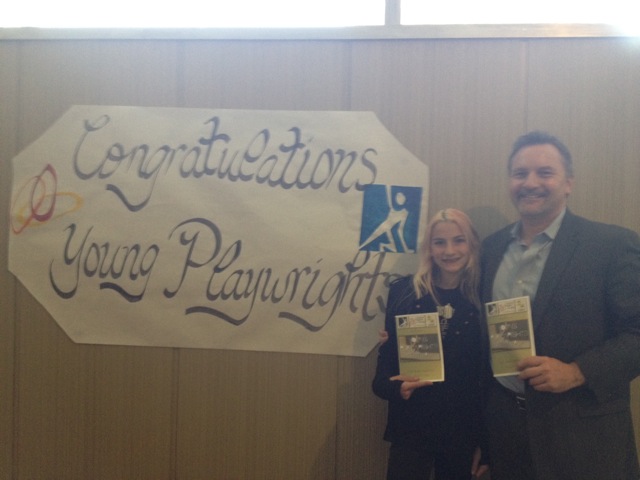
On Tuesday night I was able to see another play, this one the world premiere reading of a new play that marked the literary debut of a promising new playwright: my daughter Emma. Emma is an 8th grader who participated in a program at her school by Center Theatre Group — the folks who put on that Waiting for Godot production you should see — wherein students work for many weeks with a playwright who is a teaching artist to learn how plays work, and how to write one. Over the course of the school year, they do improv games, write scenes and lines of dialogue, and get to work with professional actors, culminating in an evening of readings by those professional actors. (One of whom, it turns out, was Rob Nagle, whom I’ve worked with at Moving Arts.) Eight of these brief plays, each of them co-authored by small groups of the students, were performed on Tuesday night by the actors.
Here’s the plot of the play by my 13-year-old daughter and her co-authors:
A father asks his (13-year-old?) daughter if she’s done her homework. She says she wants to watch TV first. (As I was watching this unfold, I was immediately hooked by the theatricality of this setup. I closely related to it, and its inherently theatrical complications.) He gets angry and loses his cool — so the daughter and her mother leave. They just get on a bus and leave town. For good. And then the father is angry with himself (for enforcing homework, I guess).
Clearly, there’s a lesson here for all of us, and that lesson was not lost on me: Be careful about how you insist on homework getting done, lest your wife and daughter get on a bus and leave town for good.
Over the years, I have made appearances in the writing of other people I’ve known, sometimes in poems, sometimes in plays or stories or essays, sometimes thinly disguised and sometimes not. One time I went to the reading of a play at the Pasadena Playhouse by someone I know and the characters were discussing another character, unseen in the play, who seemed rather much like me, and whose character name was “Mr. Wochner.” That seemed eerily similar to my own name, which is “Mr. Wochner.” So I have had previous experience of seeing a character that might or might not be based upon me shown in another light. But to be the abject villain of a piece — a piece written in part by my daughter, in which our heroine simply wants to watch TV unfettered by the necessities of homework — was new. And to witness the wretched state that the encounter with a demanding father left the mother and daughter in as they rode the bus to a faraway town was to leave me questioning my approach to homework. (Mother: “Do you think we’ll be okay?” Daughter: “I don’t know.”)
I was impressed with all eight of the students’ plays. They were funny, they were dark, they were brave, and they were untrammeled by the proclivities of professional playwriting that insists upon such things as subtext. In these plays, what is said is what is meant, and that made me hunger for such a world, where if we don’t want to go somewhere we say it, where if we want something from each other we just demand it immediately with the expectation that it will be given. The evening was a window into the mind of 13-year-olds, and that made for an experience I’ll long remember. And I offer this as proof: Tonight I took my family out to dinner, and then when we got home, we watched some TV. And when it was over, and only when it was over, did I tell my daughter to go do her homework. I don’t want to find her with a one-way bus ticket to elsewhere.
I’m seeing Waiting for Godot tonight at the Mark Taper Forum.
Just recently, I was telling the playwrights in my workshop that I would not being seeing this, given how many productions I’ve seen of this play. Just off the top of my head, here are some of them:
I’m sure I’m leaving out four other productions. Minimum.
And yet, I’m going again. Why? Top-notch cast, including Alan Mandell (who is now 84 and unlikely to be doing this sort of thing much longer; sorry, Alan), and featuring two actors who knew and worked with Beckett himself (Alan, and Barry McGovern); a video clip (above) from the production that, just in this excerpt, shows that the approach is right; it’s one of the most important plays of the 20th century and one I find deeply effecting; and, well, my friend Dorinne had an extra ticket and invited me.
Wish me luck.
Here’s a link to the “Retraction” podcast of This American Life.
It’s painful to listen to all around.
The podcast includes two interviews with Mike Daisey, and in one his facts are taken apart stitch by stitch by a reporter from public radio’s Marketplace show, a reporter who lives and works in China and who has toured the very factory Mike Daisey talked about, and who knows that the facts shared are not true. Yes, Mike Daisey lied about what he found. Evidently, he did not find children making Apple products. He did not interview as many people, or tour as many factories as he said. He wholecloth appropriated the story of a factory accident that happened 1000 miles away. He said that the factory had guards with guns, which it didn’t. He did not interview a man whose hand had been turned into “a claw” who had never before seen an iPad, even though he’d made his living assembling them. All these things, plus more, are fabrications, and Daisey cops to it. I don’t like what Mike Daisey did here, and I share Ira Glass’s outrage and barely sheathed anger at being lied to.
It’s also painful to listen to the last segment of the show — in which an actual reporter is interviewed by Ira Glass about the actual working conditions of the factories in China where Apple products are manufactured. Many of the sort of abuses that Mike Daisey made up exist in actuality. According to this report, Apple has made some course corrections — in eliminating child workers, for one — but there’s still work to be done, and I hope they mandate it quickly. They need to establish stricter standards and insist upon them.
I hope that two things come out of this sad story. One is that, ultimately, factory workers in China and elsewhere get better working conditions. The second is that we all take this as yet another reminder that lying — whether you’re Mike Daisey, or James Frey, or Richard Nixon, or Bill Clinton, or Jayson Blair, or Janet Cooke — is wrong.
Over on The Daily Beast, Jacob Bernstein quotes an associate of Mike Daisey about where the playwright-performer went wrong:
“One of his weaknesses is his sanctimoniousness,” says this person, who wished to remain anonymous. “That’s true with most artists. Most playwrights don’t like to see other people’s plays, most writers are not kind of about other people’s writing. Mike has made himself an easy target because he can’t keep his mouth shut. He got really excited about the press.”
While I’m not prepared to issue a blanket indictment of “most artists” as being sanctimonious, I’ve caught myself at it in the past, and I’ve seen it in plenty of other artists and non-profit arts organizations. We do like to think we’re changing the world for the better. So perhaps Mike Daisey’s story is not one of perfidious self-service (I hope not); perhaps it’s one of hubris, of honest error, and of getting caught up in his own press. I just wish he’d clarified the lines between fact and fiction.
I think we should also mention that it’s not just artists who try to change the world. Business does that too. I remember the argument by the Clinton administration during the NAFTA debates that the best way to improve the lives of people in other countries was to welcome them into the big economy. In spirit, I agree with that, and that is the argument underlying many of the pro-Apple comments found on various sites covering this story (including the New York Times, the Los Angeles Times, and the Wall Street Journal): that conditions in Chinese factories will improve precisely because Apple is there, subcontracting these people. The argument is also occasionally expanded to claim that doing work on Apple products is already better than the alternative. As the front page of today’s Wall Street Journal Business & Finance section reports:
The company [Apple] also went on a media offensive of its own, inviting ABC News into a Foxconn factory. An ABC reporter found evidence of teenagers doing work of “soul-crushing boredom” that was better than the conditions where they were from in the countryside.
Why is Apple making these products in China in the first place? According to Walter Isaacson’s biography of Steve Jobs, it’s because Chinese factories were able to implement changes almost overnight — in keeping with Mr. Jobs’ mercurial personality. When Jobs decided he didn’t want plastic for the first iPhone screen, Tim Cook, now the CEO of Apple, realized that U.S. factories couldn’t shift to manufacturing the necessary specialized glass screens in time to make their proposed launch date, and he moved the company to manufacturing in China, where employees could be made to live on-site, and be awakened at any moment to be put back to work.
Why are factories able to enforce such work conditions in China? Because of government complicity and the lack of labor unions. And what led to the creation of government oversight and labor unions in the U.S.? Grueling work conditions and workplace calamities such as the Triangle Shirtwaist Factory fire. Those 146 garment workers who died in that fire in 1911, most of them young immigrant women, were the Chinese factory workers of their day. As China (and India) spring into modern industrialism, they will find that brutal government repression is required to keep their work standards low. That, and the sort of cold heartlessness almost all people everywhere thankfully lack.
One story I’ve been following all day is this one: that public radio’s “This American Life” has “retracted” the episode they ran several weeks ago culled from Mike Daisey’s monologue show “The Agony and the Ecstasy of Steve Jobs” because it contains fabrications. Here’s This American Life executive producer Ira Glass’s statement on their blog. Here are some excerpts from that statement:
We’ve learned that Mike Daisey’s story about Apple in China – which we broadcast in January – contained significant fabrications. We’re retracting the story because we can’t vouch for its truth. This is not a story we commissioned. It was an excerpt of Mike Daisey’s acclaimed one-man show “The Agony and the Ecstasy of Steve Jobs,” in which he talks about visiting a factory in China that makes iPhones and other Apple products. …
Daisey lied to me and to This American Life producer Brian Reed during the fact checking we did on the story, before it was broadcast. That doesn’t excuse the fact that we never should’ve put this on the air. In the end, this was our mistake….
During fact checking before the broadcast of Daisey’s story, This American Life staffers asked Daisey for this interpreter’s contact information. Daisey told them her real name was Anna, not Cathy as he says in his monologue, and he said that the cell phone number he had for her didn’t work any more. He said he had no way to reach her.
“At that point, we should’ve killed the story,” says Ira Glass, Executive Producer and Host of This American Life. “But other things Daisey told us about Apple’s operations in China checked out, and we saw no reason to doubt him. We didn’t think that he was lying to us and to audiences about the details of his story. That was a mistake.”….
Mike Daisey’s response, essentially, has been that his show is theatre, not journalism. That response hasn’t satisfied BusinessWeek, among others. I have playwright friends who’ve been emailing me with pretty much the same rationale. Here’s a response (edited together from several emails) from a very talented, literate, thoughtful playwright friend:
But isn’t Mike Daisey giving a fictional portrayal of real events? He is a character in his own play. Even if he had never been to China, he’s not making up what goes on over there. He’s just telling it effectively (in my view).
I guess this incident makes me feel particularly vulnerable, because I feel like I would have done the same thing – I would have crafted a compelling story from the facts I was exposed to, so that I could best get my message across. I don’t consider it lying, I consider it good storytelling.
I agree that branding Daisey a liar gives Apple cover to hide behind. But they already claimed to be changing their practices, rather than proclaiming their innocence, so I hope this comes too late for that.
But here’s the interesting question to me – because I agree with you, misrepresenting facts or disregarding them is detrimental to whatever cause you are trying to advance – but if you are just doing what I do as a playwright, which is taking something that I know is true and structuring it and manipulating it so that it has the highest impact, in order to get the result I want, and that makes a big corporation like Apple change, then why is that bad? How does that make Daisey’s emotional manipulation of his audience worse than James Cameron’s or Arthur Miller’s? I guess it gets to the question of, what is truth, really? Isn’t it more than a series of facts?
I would argue that his show is entirely true. It may not be factual, but it’s true.
In Titanic, James Cameron is giving a fictional portrayal of real events.
In The Crucible, Arthur Miller is doing the same.
I once wrote a play about Hieronymus Bosch. Given the dialogue alone, I think it’s clear that I just made it up, and even if it isn’t clear, I didn’t pass it off as being “true” or built upon the facts of my recent trip to 15th century Brabant.
But Mike Daisey’s show has Mike Daisey saying, I went to China and here’s what I saw.
And it isn’t true.
Mike Daisey didn’t say he was giving a fictional portrayal. He said, essentially, that his first-person show was a show about the facts of his trip to China.
And that’s where all the problems come from.
Moreover, as Max Fisher writes on The Atlantic’s website, the problem with this story is now that the story is “Mike Daisey’s lies,” when the story should be — and had been — inhuman work conditions in China. Now the story is directed in the wrong direction, and now all the facts of what all of us had taken as an expose, have been challenged. Which gives cover to Apple.
I’m glad Mike Daisey took on this issue and spread it. I wish he had stuck to the facts of his encounters.
“The Car Plays” closed yesterday at La Jolla Playhouse in San Diego, and with it my play Dead Battery. This was my first production in San Diego and, it occurred to me just now, this was the greatest number of performances of any of my plays. Oh, sure, I’ve had plays run for months, and this one ran only three weekends — but this play was performed 15 times a night, for a total of 180 performances. After that many performances, 15 a night for three weeks, and given the subject matter — a distraught woman cleaning out the car of her dead son — and the intensity of her performance, complete with crying and shaking and raging with anger, I can only assume that my actress is now checked into the Betty Ford Center.
Of all the news coverage that The Car Plays has received in its various productions around southern California since 2006, I think this local PBS reporting from San Diego gives the clearest picture of the experience.
That said, the focus in this piece is on actors. I understand that: The actors are right there in the play. If they think it’s a challenge acting in a car (and it is; they’re right), that’s matched by the challenge of writing a 10-minute play that takes place in a car — and is still captivating, requires being staged in a car, has a beginning middle and end, has a motivation for the actors to get into the car, and includes a way to get them out of the car (what dramatists call a “button”). These are fun, tricky little plays to run, and the success of the series is a testament to the process Paul Stein established for figuring out what works in cars, to the producers and the reading team, and to all the playwrights involved.
Just a reminder: It’s been extended through next weekend.

Which makes it all the better news that the show has been extended for one more weekend, which means it runs this weekend, and next, closing March 11. Here’s where you can get tickets (if you can).
In the publicity shot at top provided by the La Jolla Playhouse, you see Sara Wagner as Esme Coughlin in my play Dead Battery, plaintively making calls from within her teenage son’s car to learn more about his life, his death, and her own culpability. You also see a couple of audience members. (Look: Another sold-out performance.) I have to say, it’s an amazing voyeuristic experience living out these little playlets from inside the cars they take place in, and it’s a testament to the phenomenal work of some very very talented actors. My wife (admittedly perhaps biased) cried just reading the script; imagine how it feels being in that car while this grief-demolished woman struggles to maintain her self-control; now imagine what it takes for an actor to do that performance 15 times a night. I am enormously grateful to Sara and to my director, Paul Stein, who is also the progenitor of the entire Car Plays concept. I’m grateful to them both, as I hope you can see in this shot below, taken over celebratory beers at the local bar on opening night last Thursday.