Lee Wochner: Writer. Director. Writing instructor. Thinker about things.


Blog

Archive for the ‘Thoughts’ Category

Comical weekend

Sunday, March 27th, 2016
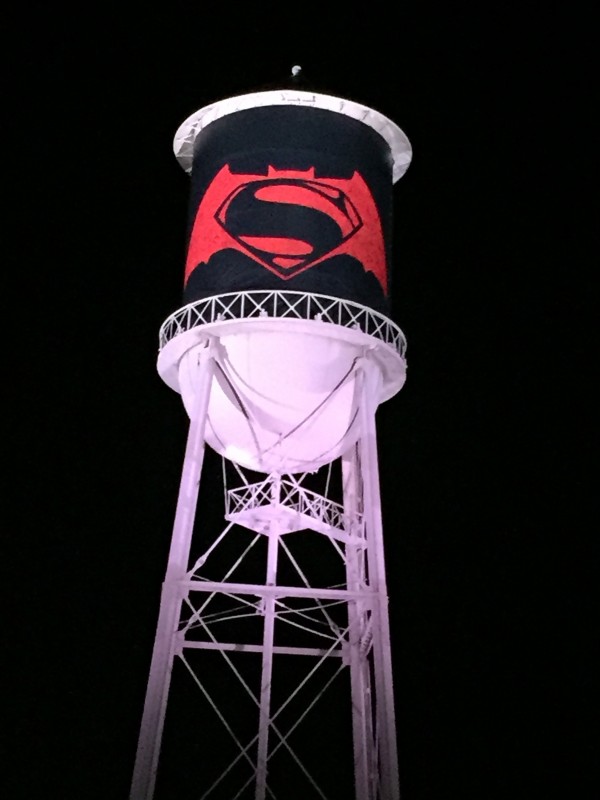
IMG_0800

This is a little bit of graffiti in my neighborhood.

Okay, it’s the Warner Brothers water tower (still in my neighborhood). On Thursday night, the folks at Warners were kind enough to invite a couple hundred of us to a screening of “Batman v. Superman” on the lot. I won’t say that you’re looking at the best part of the movie (that would be Wonder Woman), but I will say that even with a masters in writing and almost 25 years of teaching dramatic writing, and with five decades of reading comic books starring Batman and Superman, I couldn’t make any sense of whole chunks of the film.

The next day, I went to Wonder Con, the baby brother to Comic-Con, with a couple of friends. Wonder Con, which began years ago in San Francisco and has more lately been in Anaheim, was in downtown Los Angeles this year due to scheduling difficulties with the Anaheim Convention Center. I’m now going to show you the absolutely most wondrous thing I’ve ever seen in Los Angeles. Look closely.

IMG_0803

YES, that is my car parked at a white-striped FREE parking spot right on Figueroa Street, immediately across from the Los Angeles Convention Center. You’re going to want to save this photo. Some day, you will tell your grandchildren that you’d once seen a FREE parking spot in downtown LA and they will sneer at you. They will say, “But Gramps, all parking near the Convention Center is $20, or $30, or frequently even 45 bucks! FREE parking? You’re nuts!” But there it is — absolute proof, and unlike Bigfoot photos, obviously not staged or Photoshopped. It exists! At least, it turns out, until 3 p.m., whereupon it becomes a tow-away zone unmarked by signs.  Good thing my good friend the redoubtable Dr. Trek checked for me. Whereupon I moved my car… into $20 parking. But until then, I had this, I had the FREE PARKING! Another grail quest completed!

Wonder Con, as stated, is much like Comic-Con, if Comic-Con were Galactus and Wonder Con were Ant-Man. (You’ll note that unlike Comic-Con, Wonder Con doesn’t even merit a hyphen. That says a lot.) Still, it’s possible to catch up with old friends and have a grand time. Here I am digging in comics boxes looking for a surprisingly hard-to-find copy of From Beyond the Unknown #8, with a couple of old pals.

IMG_0807

Even Spidey-Sense couldn’t help me find that issue. The search continues.

Unlike the San Diego Convention Center (and, indeed, the City of San Diego itself), where the structure is laid out sensibly, the Los Angeles Convention Center is the product of a twisted mind whose architectural style pairs M.C. Escher with the Marquis de Sade. The Center has no center — there are actually two large buildings separated by a street and an enclosed overhead byway that gives no hint that one is crossing between buildings — and is shaped overall like clumps of organic matter with roots growing through them. You know how sometimes you’ll find a section of an airport closed for renovation and you’re shunted down narrow passageways serving as temporary workarounds? At the Los Angeles Convention Center, these claustrophobic corridors are permanent. Someone actually designed them this way. (And I’m not the only one to remark upon the terrible Los Angeles Convention Center. Mark Evanier has been going on about it as well.) Take this example:


IMG_0811

See the people up top? Perhaps you’d like to join them. Now, barring the power of flight, how could you do it. Well, if you back up 20 feet, you find this:

IMG_0812

Yes, that’s a lady in some sort of blue costume. It’s also a stairwell. How do I know it’s a stairwell? I went all the way inside to see what it was. There’s no sign, there’s no window, it’s completely shielded, so there’s no indication that it’s a stairwell — in this case, with a  female Deadpool lying on the steps taking a photo of this lady’s rear end for some reason — but trust me, it’s a stairwell. But then, one shouldn’t be surprised that it’s unmarked:  Most of the interior of the convention center is unmarked. Including access points to the parking garage. It took my friend Larry and me 45 minutes to find my car inside the convention center parking structure on Saturday night, and that was after consulting with a convention center supervisor and a helpful guard who walked us out and still couldn’t find access. (After walking about an hour on our own, Larry and I found it. By luck.)

Even with  the frustrations of parking and navigation, as well as scheduling that left me traversing one end of the convention center back to the other repeatedly over two days during which I burned 550 calories each day just by walking (thanks, iPhone tracker), Wonder Con was great fun. Two added great finds from the Con.

1. I finally got my dream job, and a sense of the benefits.

IMG_0816


2. I finally, actually, really got to see someone dragging toilet paper on his shoe. I guess it isn’t just a classic movie joke.

IMG_0823

Shandling and Shatner

Thursday, March 24th, 2016

William Shatner’s 85th birthday was on Tuesday — and just now we learned that Garry Shandling won’t be having any more birthdays.

In honor of both, here’s a scene that’s every bit as fun now as it was when it aired.

The three reasons

Thursday, March 10th, 2016

There are only three good reasons to write plays. They are:

  1. Because you have to.
  2. Because of the audience.
  3. Because of the actors.

For much of my life, reason #1 was it. I had to. And I still have that feeling. But it’s sometimes mitigated by other sorts of writing — essays, or reviews, or fiction, or (help me God) poetry. After four decades of writing, playwriting is still the default, but those others call to me too.

As I started to get produced, the lure of #2 was inescapable. Especially in the 1990s, I was getting produced frequently while getting published a lot, especially in literary journals, magazines and newspapers. (Y’know, those paper things of a bygone time.) What I found:  when you’re published, there’s no audience response. You’re not there when someone laughs or gasps. But with the theatre, when you’re the writer, frequently you are there. There when someone audibly *gasps* at the final revelation (as someone once did — and I still remember it); there when someone stands up and howls in protest, “Where do you find people like this? I don’t know where you find people like this!!” (as someone once did in 1989 — and I still remember it, his distraught infuriated Irish brogue and all); there when the lady literally falls out of her seat laughing at your comedy (as someone did, rest her soul). There when Fred Willard, whom you grew up watching on TV, comes to see your play.

But the thing you never expect — at least I didn’t — was that you’d love to write plays because of the actors. There is no feeling that compares with having a great actor fully embrace your role and bring it to life, adding that special stuff that permeates his or her core, that something that he has that no other has, that perfectly matches with your writing and the role you wrote, that adds surprising insight and depth, that explores every laugh you hoped for and pulls up others you had suspected but hadn’t dared count on, and finds wholly new ones that belong like an essential organ. That sort of actor it is a thrill to write for. That person becomes an odd extension of you — an extra set of talent that you’re connected to through an invisible web.

I just now found out that one of those actors, one of those actors for me, is going to be in town in May. I haven’t seen him in a few years, and he hasn’t been in a play of mine for too long (!), but just knowing he’s going to be here and that we can plot future productions together and maybe read my new pages — that seems like enough for right now.

Until I write a new role with him in mind.

And figure out how to fit all the pieces of our schedules and our lives into place so we can actually do the damn thing together next year or after.

Because life is short, but art is long.

Music masters

Wednesday, March 9th, 2016

George Martin certainly had good taste. In honor of the late George Martin, here he is exchanging insights with Brian Wilson (and, Wilson says, improving the mix for “God Only Knows”).

A surprise performance

Tuesday, March 8th, 2016

MovingArtsCrash

No, that’s not an environmental staging for our latest production (or a remount of our production of “Cockroach Nation”) — that’s an actual car crash into the Moving Arts building. While our theatre was damaged, as you can see, the clothing boutique next to us in the same building was demolished.

Here’s one story about it,  and here’s some local news coverage:


Just the previous night, about 20 of us were sitting in there discussing the rest of this season, including a plan for a potential bonus show some of we playwrights might put together. Right there where the building got hit? That would’ve been the back of my friend and director Ross’s head.

Glad we weren’t there for this. But we’ll be back.

Untried

Wednesday, March 2nd, 2016

Re Donald Trump’s ascendancy into serious contention for the presidency of the United States of America:

One could argue — and I may argue this, after some thought — that this is the triumph of the American concept that anyone — ANYONE — can become President. It’s something we tell ourselves from school age on. The election of Barack Obama, a first-term senator with almost no relevant experience, was another step in this direction, paving the way for Trump, someone with a background completely irrelevant to the presidency.

Re Obama — he turned out to be an excellent president, and one I wish we could keep, someone of fine judgment and character — but note that he defeated a woman with four decades of experience in Washington, DC (starting with the Watergate impeachment hearings). This election cycle, Republican voters have ruled out everyone with real experience (whatever one thinks of that experience): Bush, Pataki, Perry, Christie, Graham, Jindal and on and on — in favor of a bilious naif and two first-term senators.

Although Trump’s skills as a reality television star are serving him well, these election results are not just about Trump. They reflect an attempt to throw over experience for something newer, something “outside,” something entertaining.

Sound & Vision

Wednesday, February 24th, 2016

The Grammy tribute to David Bowie was bad. I don’t blame Lady Gaga, who is talented and who seemed 100% committed to what she had been asked to do (learning a lot of choreography and complicated song switches very quickly); I blame whoever strung together all those little bits of music and brought a Las Vegas approach to it.

But here’s a far better tribute, because it marries a strong singer (Lorde) handling a song she’s suited for, with Bowie’s actual backing band, and starts off with well-chosen video clips from Mr. Bowie himself — for whom the visuals, as someone who was always more a complete artist than just a singer, were always an essential element.

With great fame comes great exposure

Tuesday, February 23rd, 2016

When Marilyn Monroe died young, one wag said, “Good career move.”

Bad career move? That might be Stan Lee outliving his legacy.

Put another way: Stan gets plenty of movie cameos… but I haven’t noticed any art shows of his work, or any biographies not authored by himself, or any museum in the making. All of those things are going to Jack Kirby.

Familiar sounds

Saturday, February 20th, 2016

I know what you’re thinking:  These baby rhinos sound just like the latest album from Radiohead. (Unfortunately.)

Baby Rhinos Sound Like Whales Crossed with Elephants

For an animal built like a tank you'd expect them not to sound like this…

Posted by Break on Tuesday, February 16, 2016

Two late authors

Friday, February 19th, 2016

Two authors died today, Harper Lee and Umberto Eco.

Ms. Lee wrote one novel, “To Kill a Mockingbird,” that was largely derided in its debut as being unbelievable, because the 6-year-old narrator was too wise for her age. I didn’t care; the book, in its simple goodness and in its arch morality tale, stuck with me, as it did with so many.

More recently, Ms. Lee was reputed to have written — or to have had discovered — another novel, “Go Set a Watchman.” I read several excerpts of that book, which featured several of the characters from “Mockingbird,” but 20 years on, and decided quickly that a full visit to that book would have ruined the previous book for me, so I stayed away. I also suspected that the novel was not so much “discovered” as cobbled together, or raised by witchcraft in some fashion, because of the millions of dollars in sales that would surely follow. (And did.)

So, in full, I read one book by Harper Lee. That was half of her oeuvre, and it was the half that counted.

The great contemporary Italian novelist Umberto Eco wrote dozens of non-fiction works and collections of essays, of which I read a few, and seven novels, of which I read four in translation, which I consider to be the essential four:  “The Name of the Rose,” “Foucault’s Pendulum,” “The Island of the Day Before,” and Baudolino.”

“The Name of the Rose” was a masterpiece — a 1983 novel that greatly affected me in its ruminations over the nature of justness and proper religious observance, and also as a reminder of what was the 1300’s had in common with our own time, and what was strictly alien. In the novel, the lead character, a monk serving as a Sherlock Holmes of his time, is the owner of the latest innovation:  an early set of spectacles that enable his fading eyes to read. The entire novel centers around the question of what is proper for an abbey in its obeisance, to wit:  Is it proper to laugh, given that no mention is made in the Bible of Jesus ever having laughed? When your worldview is based entirely upon a literal reading of an ancient text, this is a pressing question, and is made immediately relevant to every literate reader asking himself every day what is right, and what is wrong. That vast passages of “Rose” are in untranslated Latin served only as a further inducement to think a little harder, to research, to parse out the meaning. This was a book that one leaned into intellectually, and, at the same, it was a thriller, with a murderer on the loose. It stands as a great achievement.

“Foucault’s Pendulum” (1989) is even moreso a game, in which Eco debunks the conspiracy theory from “The Holy Blood the Holy Grail” (which I had read previously) that Jesus had sired an heir and that a conspiracy everafter secretly controlled human events. “Holy Blood,” which in its center photo spread hilariously included an image of the authors’ believed current descendant of Jesus, is the book that ultimately  led us to the accursed Dan Brown novels that started with “The Da Vinci Code.” As a novel, the fault in “Foucault’s Pendulum” is a series of extended dream sequences / journal entires that can be completely skipped; my brother Ray had warned me of the time, and I sneered inwardly at the thought of skipping any part of a book, but later I found to my dismay that he’d been entirely right, that the journal entries were irrelevant, and that the novel would have been stronger without them. Nevertheless, all the other areas of the book are extraordinarily compelling, as one is pulled along on the trail of a conspiracy, and led to a very strong conclusion, with Eco again playing his strong cards:  marrying an intellectual pursuit with a classic suspense thriller.

With “The Island of the Day Before,”  my interest in Eco diminished, and my capacity for skipping pages grew. I even found it unable to finish the book. What I remember of it is that it took place on a ship where time seemed fractured — and that I didn’t care a lot, in fact at all, about any of it. It was now 1995, 12 years after “Rose,” and I’d discovered many other authors, most notably Rilke and Tolstoy, far more worthy of my time.

In 2001, having almost sworn off Eco, I put “Baudolino” on my Christmas list — and found myself surprised and delighted by it. Here, again, was the Eco I enjoyed: a wry commentator and occasional satirist drawn to the story of an earlier Christianity, but skeptically. In addition, it afforded the opportunity to learn a lot about the 13th century AD, the Holy Roman Empire of its time, and a great early Germanic leader — things I’m always curious about and don’t know enough about. And the book was a romp — it wasn’t a great achievement along the lines of “The Name of the Rose,” but it was fun to read, pulling you along like iron filings to a magnet.

And then… Eco produced three more novels, and I left him behind. “The Mysterious Flame of Queen Loana” sounded too close in theme to “The Island of Day Before,” centering around a character confused about his whereabouts and his past, and by the time “The Prague Cemetery” (2011) and then “Numero Zero” (2015) came along, I had moved on. Given that I have 79 novels on my bookcase waiting to be read, it’s doubtful I’ll return to Eco.

I’ve had a history with both of these authors, as each of us has with anyone whose art we’ve followed, whether it’s David Bowie or Eugene Ionesco or Darrin Bell. I never expected anything great again from Harper Lee, but I’m glad for what I got (both the novel and the movie version). With Umberto Eco, it only gradually occurred to me that “The Name of the Rose” was a singular achievement, and that I shouldn’t expect it again. How delightful it was, then, to find in 2011, after reading all 11 novels of Julian Barnes, that his most recent, “The Sense of an Ending,” was his very best. All of them, mind you, had been good, with all of them having flashes of greatness, but “The Sense of an Ending” showed a greater sense of wisdom and insight than all its predecessors put together — its lucidity about adulthood remains astonishing, and so the novel remains one of my most recommended. (That, and this one, which I promise you is elegantly written and unexpectedly incredibly moving.) I felt rewarded for having stayed in the game.