Lee Wochner: Writer. Director. Writing instructor. Thinker about things.


Blog

Archive for the ‘Thoughts’ Category

Snappy answers to stupid questions

Friday, April 29th, 2016

This morning I had my first physical therapy appointment in the latest round of attempts to cure the bursitis dogging me in my right leg.

Because this was my first appointment, I had to fill out the customary new-patient intake form. This one I actually puzzled over.

One of the questions asked, “What is your expected outcome for treatment?” I wrote down, “For it to get better.” Then added, “What else would people write here?” I was seriously at a loss.

For “What makes it feel worse”? I wrote, “Driving.” Again, an honest answer. And here was another one, in response to the question, “What makes it feel better?” I wrote, “Drinking.”

Reading that the therapist looked at me sharply and said, “What kind of whiskey?” “Oh,” I replied, “a glass or two of wine takes care of it.”

Within moments she had me twisting around into odd pretzel shapes and howling in pain.

This is the response one gets for honest answers.

Question / joke of the day

Wednesday, April 27th, 2016

Bernie Sanders is laying off hundreds of staffers.

What kind of socialist lays off people?

The urban jungle

Sunday, April 10th, 2016

Balto1

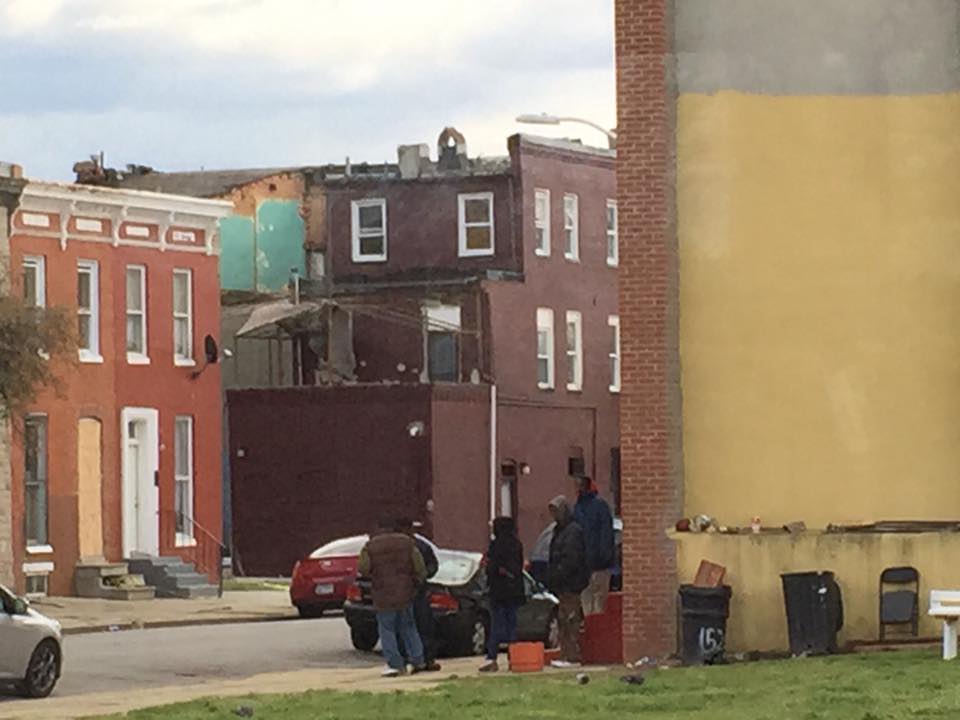
Boarded-up tenement. Residence. Boarded-up tenement. Boarded-up tenement. Residence.

Welcome to West Baltimore.

I’ve seen urban decay before, but nothing like this. Yesterday my 13-year-old son and I had the privilege of a guided tour through the worst examples of poverty and despair and hopelessness I’ve ever seen in this country. Worse than Newark, worse than areas of the Bronx or Coney Island, worse than the Atlantic City Inlet, certainly far worse than South Central Los Angeles, worse than, well, any redlined written-off ghetto anywhere near you.

Balto2

In most of those places, whole neighborhoods are gone — people have moved out. Not in Balmer. In Balmer, the vacant and nailed-shut houses are threaded through the remaining living spaces, like a cancer woven around and penetrating essential organs. There’s still healthy tissue in there — the occasional house with a clean front porch, or bunting, or a mailbox with mail in it. But the dark spots are everywhere.

Balto4


There’s also nothing to do. By that I mean there are no jobs. Because there are no businesses. There are still people living there, which ought to equal business opportunity (bearing in mind the entrepreneur Magic Johnson’s quote that “there’s always money to be made in the ghetto.”). But no, nothing. And later I learned that the area isn’t just a jobs desert — it’s also a transportation desert. There’s no subway or train or even bus line that comes here; in many cases, if someone could find a job, he’d have to walk two miles to get there. So there’s no way to get to a job, and there aren’t any jobs from neighborhood businesses because there aren’t any neighborhood businesses. Except one kind. The corner liquor store. Found on every corner. Just as you’ve seen on “The Wire.”


Balto3

The city has counted 15,000 abandoned buildings. But there may be as many as 40,000. They can’t be sure. And judging purely from the evidence of their inner city, I wouldn’t rely on city officials to generate an accurate count because they don’t seem reliable in other ways. There’s also — of course! — a large homeless population that fluctuates between 3,000 and 30,000 people a night. So  you’ve got 15,000-40,000 empty buildings — and 3,000-30,000 people sleeping outside. I don’t need to say anything further; this makes its own statement.

I did get to meet a number of hard-working courageous people in the private and non-profit sectors who are trying to improve the situation. I’m impressed with the work of some of them, and I’m sure that this situation can be improved, because it’s hard to imagine it worse.  Finding a way to replace some of the 100,000 jobs Baltimore has lost in the last 50 years would be an excellent start. Finding a way to help neighborhood businesses sprout up with be great too.

I asked my son what was his impression of West Baltimore and first he said that there’s nothing for people to do there. (Especially children:  we didn’t see any parks, but we did see signs mandating “no ball playing here.”) Then he shared the image that will most stay with him. In some of these buildings, he said, with their windows shattered or a roof collapsed or a wall knocked out, he saw trees growing inside. Whole, large, growing, thriving trees.

West Baltimore is becoming a literal urban jungle.


Balto5

How to know you’re not in L.A. any more

Sunday, April 10th, 2016

NotInLA

The bottle factory

Friday, April 8th, 2016

More than 30 years ago, I interviewed Denny O’Neil, the foremost writer of Batman comics of the 1970s, the writer who has most influenced the Batman you’ve been seeing in the movies the past 10 years. The interview was for The Comics Journal, and Denny and I got into a heated exchange about low art and high art. He’d once written searing issues-oriented comic-books, taking mainstream comics far far out in new explorations – and now he was writing GI Joe comics.

He defended the GI Joe comics (“Have you read it?” he said. “Basically it’s a superhero comic.”) but I couldn’t imagine how the person who’d tried to address poverty, racism, and drug abuse through the prism of superhero comics could defend writing militaristic toy tie-ins.

Of the entire exchange, and our lunch a week or two later in Manhattan, the thing that made the greatest impression was this: the bottle factory.

I was bemoaning popular low art. (Ironic, for someone writing about comic books, I know.) My lowest-common-denominator example was “Laverne & Shirley.” I don’t know why I hated “Laverne & Shirley” so desperately (nor do I know why my wife’s example later became “Charles in Charge,”), but “Laverne & Shirley” just seemed like the nadir, with its canned laughter and obvious jokes.

Denny’s response to this tirade was this: “Think about the guy at the bottle factory.”

“Huh? What guy at the bottle factory?”

“The poor guy at the bottle factory. He works all day at the bottle factory, he comes off, he wants to take off his shoes, have a beer and watch something simple and entertaining. He doesn’t want to read Tolstoy. It was hard and hot and demanding all day at the bottle factory. He loves ‘Laverne & Shirley.’ It’s what he needs.”

In other words, “Laverne & Shirley” wasn’t for me – but it was certainly for others. A lot of others.

Unfortunately, the choices of those of us who didn’t want “Laverne & Shirley” and its like were severely limited.

At the time, everyone in America was limited to three channels – CBS, NBC, and ABC – and maybe a couple of Ultra High Frequency channels if you could get them (we got 17, and 29, and 48, out of Philadelphia) – and maybe PBS. That was it. And so your choices were: whatever inane original series was on CBS, NBC or ABC; scratchy syndicated shows from an earlier era or old movies; or cheap “it’s good for you” television courtesy of the prim and proper.

For me, watching TV in that era was like working at the bottle factory. With rare exceptions, it was something to be endured.

Now television’s bottle factory has been blown up. It was blown up by cable, which gave creators new freedoms and more opportunities, and the Internet, which did the same and also removed the financial restrictions of needing a studio, and broadcast towers, and expensive cameras and editors and so forth. Now if you’ve got an idea for a show, you can make it yourself and distribute it yourself.

This bonanza of choice has segregated the audience into many little tributes. Today at the airport, a woman near me was excited because a semi-famous contestant from “American Idol” was waiting with us for the same plane. She pointed him out, and showed me his image on her phone as well, but I didn’t know who he was, having never watched “American Idol.” In the 1970s, with so few shows, everyone knew who everyone was.

All of this new choice has also made us pickier. A couple of years ago late at night in some hotel room I fired up Netflix to watch another episode of “Sons of Anarchy” and found myself mostly scrolling through my phone while it was on. Then I realized that not only was I not watching the episode, I’d never watch another one – not just because I didn’t care, but because I had so many choices I didn’t need to settle for this. When the menu is 90 pages long, why order something you don’t want to eat?

A few nights ago, I was watching “Mr. Selfridge” on my DVR and that bottle-factory feeling came over me. The characters I cared about (mostly the women striving to advance in a sexist and classist early 20th century England) were all gone, leaving me entirely at the mercy of Jeremy Piven’s completely ersatz performance. So I deleted it.

In the post-bottle factory age, we have the opposite dilemma. Now that there are an estimated 450 original scripted shows a year, and so many of them are excellent, it would be easy to lose your life to television. I can recommend “Breaking Bad” and “The Wire” and “The Sopranos” and “The Good Wife,” but no, I’m not adding “Orphan Black” or “The Americans” or “Homeland” or, probably, any other show that you’re recommending. I don’t have time. I don’t have the time. Well, specifically, I have just as much time as anyone else alive at the moment – but I’m working harder than ever to guard it for other things.

I read somewhere that when there are too many items on a menu, people are more likely to order less – or to order nothing. The wealth of choices is too daunting, so they lose their hunger. I used to yearn for great TV.

But now that it’s here, I wish a lot of it would go away.

Because I’d like to watch it. Really.

Not eye

Tuesday, April 5th, 2016

Last night I had the pleasure of seeing a good documentary about great artists who did a bad film.

Or, more precisely, “Film.”

Yes, “Film,” by Samuel Beckett. I first saw it in college, 30 years ago. What I liked then I still like: many of the visuals (once one gets past Buster Keaton’s eyeball). Here’s the opening:

The other thing I like, of course, is that it brings together Samuel Beckett, Buster Keaton, at the stage director Alan Schneider, who did many Beckett and Pinter and Albee premieres, under the producing aegis of Grove Press publisher Barney Rosset, to whom we’re indebted for publishing D.H. Lawrence, Hubert Selby Jr., and Henry Miller, censors be damned. For some of us, “Film,” released in 1965, would have been like an All-Star Game.

Unfortunately, it’s not very good. Even at 22 minutes, it makes its point too soon. Worst of all, it completely misuses the talents of the primary creators:  Schneider was a stage director with no idea how to shoot a film (he blew most of the budget on the first day, shooting one scene that was later cut); Beckett’s ideas for the film are almost entirely intellectualized and impossible to translate effectively; and Keaton — a master of comedy and a justly legendary film director  — is kept away from any input and in particular ignored when trying to introduce funny bits. Each is stripped of his actual gifts, his real talents. The end result is like what you’d have if you’d asked Michelangelo to sculpt with his nose.

What really brought this into focus for me was seeing the documentary “Notfilm” last night at a screening in North Hollywood, accompanied by a talk with the director. You can learn more about “Notfilm” here. “Notfilm” is concerned with the making of “Film” — the preproduction, the artistic antecedents, the production itself, its reception and its legacy. It’s a smart and fascinating film, and also a personal one, as director Ross Lipman gives us his thoughts about the film, its underlying meaning, and the confusions that arose among its creators. In one example of a smart decision, Lipman narrates it, which places the film squarely within the realm of his personal perception (which is the theme of “Film”).

“Notfilm” gives us two further satisfactions: For the first time ever, anywhere that I know of, we get to hear the notoriously reclusive and reticent Samuel Beckett’s recorded voice. And we get to see just how one can make a two-hour documentary about a 22-minute short. There’s something ironically anti-Beckettian about that.

What took so long?

Friday, April 1st, 2016

According to the LA Times, Donald Trump is  now the least popular American politician in three decades.

That’s less popular than the guy who lied under oath, the other guy who called the President “liar” during a state of the union speech, the people who led us into war against people who didn’t attack us, and the guy who went “hiking” while secretly visiting a mistress south of the border. That’s less popular than the KKK member who ran for governor of Louisiana and his opponent who was sentenced to 10 years in prison for racketeering. Trump is even less popular than Ralph Nader was among Democrats post-2000.


It’s just another success in a long line of similar achievements.

Cosplay banned

Friday, April 1st, 2016

group-cosplay-girl-superman

How dumb are some legislators? This dumb:  State legislators in five states just banned Cosplay  because they thought it meant dosing the drinks of beautiful women and then raping them.


Bawk!

Tuesday, March 29th, 2016

roscoes-logo-SOURCE


One of my favorite eateries, the artery-hardening Roscoe’s House of Chicken and Waffles, has filed for bankruptcy!

This is bad news for those of us who need a lot of fat, sugar and salt after going to the theatre.

Comical weekend

Sunday, March 27th, 2016

IMG_0800

This is a little bit of graffiti in my neighborhood.

Okay, it’s the Warner Brothers water tower (still in my neighborhood). On Thursday night, the folks at Warners were kind enough to invite a couple hundred of us to a screening of “Batman v. Superman” on the lot. I won’t say that you’re looking at the best part of the movie (that would be Wonder Woman), but I will say that even with a masters in writing and almost 25 years of teaching dramatic writing, and with five decades of reading comic books starring Batman and Superman, I couldn’t make any sense of whole chunks of the film.

The next day, I went to Wonder Con, the baby brother to Comic-Con, with a couple of friends. Wonder Con, which began years ago in San Francisco and has more lately been in Anaheim, was in downtown Los Angeles this year due to scheduling difficulties with the Anaheim Convention Center. I’m now going to show you the absolutely most wondrous thing I’ve ever seen in Los Angeles. Look closely.

IMG_0803

YES, that is my car parked at a white-striped FREE parking spot right on Figueroa Street, immediately across from the Los Angeles Convention Center. You’re going to want to save this photo. Some day, you will tell your grandchildren that you’d once seen a FREE parking spot in downtown LA and they will sneer at you. They will say, “But Gramps, all parking near the Convention Center is $20, or $30, or frequently even 45 bucks! FREE parking? You’re nuts!” But there it is — absolute proof, and unlike Bigfoot photos, obviously not staged or Photoshopped. It exists! At least, it turns out, until 3 p.m., whereupon it becomes a tow-away zone unmarked by signs.  Good thing my good friend the redoubtable Dr. Trek checked for me. Whereupon I moved my car… into $20 parking. But until then, I had this, I had the FREE PARKING! Another grail quest completed!

Wonder Con, as stated, is much like Comic-Con, if Comic-Con were Galactus and Wonder Con were Ant-Man. (You’ll note that unlike Comic-Con, Wonder Con doesn’t even merit a hyphen. That says a lot.) Still, it’s possible to catch up with old friends and have a grand time. Here I am digging in comics boxes looking for a surprisingly hard-to-find copy of From Beyond the Unknown #8, with a couple of old pals.

IMG_0807

Even Spidey-Sense couldn’t help me find that issue. The search continues.

Unlike the San Diego Convention Center (and, indeed, the City of San Diego itself), where the structure is laid out sensibly, the Los Angeles Convention Center is the product of a twisted mind whose architectural style pairs M.C. Escher with the Marquis de Sade. The Center has no center — there are actually two large buildings separated by a street and an enclosed overhead byway that gives no hint that one is crossing between buildings — and is shaped overall like clumps of organic matter with roots growing through them. You know how sometimes you’ll find a section of an airport closed for renovation and you’re shunted down narrow passageways serving as temporary workarounds? At the Los Angeles Convention Center, these claustrophobic corridors are permanent. Someone actually designed them this way. (And I’m not the only one to remark upon the terrible Los Angeles Convention Center. Mark Evanier has been going on about it as well.) Take this example:


IMG_0811

See the people up top? Perhaps you’d like to join them. Now, barring the power of flight, how could you do it. Well, if you back up 20 feet, you find this:

IMG_0812

Yes, that’s a lady in some sort of blue costume. It’s also a stairwell. How do I know it’s a stairwell? I went all the way inside to see what it was. There’s no sign, there’s no window, it’s completely shielded, so there’s no indication that it’s a stairwell — in this case, with a  female Deadpool lying on the steps taking a photo of this lady’s rear end for some reason — but trust me, it’s a stairwell. But then, one shouldn’t be surprised that it’s unmarked:  Most of the interior of the convention center is unmarked. Including access points to the parking garage. It took my friend Larry and me 45 minutes to find my car inside the convention center parking structure on Saturday night, and that was after consulting with a convention center supervisor and a helpful guard who walked us out and still couldn’t find access. (After walking about an hour on our own, Larry and I found it. By luck.)

Even with  the frustrations of parking and navigation, as well as scheduling that left me traversing one end of the convention center back to the other repeatedly over two days during which I burned 550 calories each day just by walking (thanks, iPhone tracker), Wonder Con was great fun. Two added great finds from the Con.

1. I finally got my dream job, and a sense of the benefits.

IMG_0816


2. I finally, actually, really got to see someone dragging toilet paper on his shoe. I guess it isn’t just a classic movie joke.

IMG_0823