Lee Wochner: Writer. Director. Writing instructor. Thinker about things.


Blog

Archive for the ‘Thoughts’ Category

Filled with “Doubt”

Saturday, November 4th, 2006

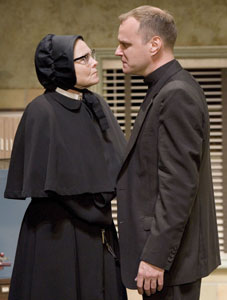
doubt.jpgA couple of weeks ago I went to see “Doubt” at the Ahmanson Theatre with two friends. The play was well-written, funny, surprising — and a bit of a cheat.

I say that because it purports to be a play about… well, doubt… but it never gives you enough information to truly feed doubts or build convictions. The play should be called “Intuition,” because it is largely built around a nun’s intuition that a priest is molesting a young boy. She confronts the priest, who denies it, and that is somewhat the extent of the plot. She confronts, he denies, she makes up a lie, he (and this is just to ruin the play for you if you haven’t seen it) finally sees there’s going to be no end to her accusations and gains a transfer to another church, and now that he’s gained what turns out to be a promotion to another parish and this time in a role that includes heading the school she turns to the audience and says, “I’m filled with such doubts.”

I guess because rather than punish him, God promoted him.

The entirety of the “evidence” against the priest is this: We learn in an early scene that Sister Aloysius saw Father Flynn place a consoling hand atop a boy’s wrist and the boy flinch. (If at age 12 I had felt the church pastor place a hand on my wrist in an open assembly, I would have flinched too. And he never molested me. For the most part, twelve-year-old boys don’t want to be touched by anyone.)

Maybe the play should have been called “Persecution,” because again, barring any scenes with additional fact, what we’ve got is a play in which a one person’s determination that she is right succeeds in driving another person out. In fact, one of my compatriots thought well into the play that that was precisely the theme of the play; he compared it to “The Crucible.”

The playwright, John Patrick Shanley, has a gift for dialogue. After a day of dealing with petty nonsense, it was an absolute treat to hear people discourse on a higher level. The sermons written for the priest are particularly strong, built around delightful metaphors that work as parables. But I don’t think the play is about what it’s advertised as. Of course, my father-in-law brought home a bag of Brach’s chocolate-covered blueberries that says “Harvest Fresh.” I said, “This is a lie. Blueberries in the orchard don’t have chocolate on them. So they can’t be ‘harvest fresh.'”

You always have to ask “Really?” To do otherwise is to believe that blueberries grow with chocolate, that “Doubt” is about doubt, and that Dick Cheney is keeping America safe.

Who wants something?

Saturday, November 4th, 2006

protagonist.jpgLast week in my Saturday playwriting workshop we were talking about how to identify the protagonist. Ellen immediately piped up: “I usually look at who wants something.”



That’s exactly right.

But I added, “In a good play, everyone wants something.”

Some Halloween inventiveness

Wednesday, November 1st, 2006

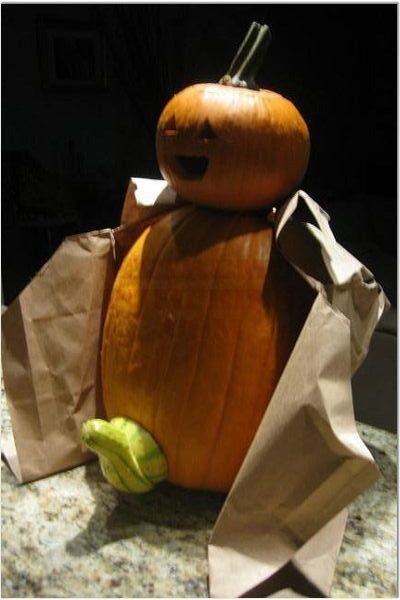
See? This is what I’m talking about!

swingerpumpkins.jpgvomitpumpkin.jpgplumberpumpkin.jpgdemon-pumpkin.jpgflasherpumpkins.jpg

Happy Halloween

Wednesday, November 1st, 2006

Too often we think everything is getting worse. Here’s one thing that is getting better: Halloween.

I can’t tell you how thrilled I am to see that Halloween has become more and more of a holiday and a celebration. (And if it could just knock Christmas off the shelves I’d be truly delighted.)

What do I like about Halloween? I like the inventiveness it opens up in people. I like that both kids and adults participate. I love how neighbors’ houses become spooky showplaces just for one night, with many people hosting theatrical events. And truly — why wouldn’t theatre people love it?

My wife and I got married on Halloween. (At first she was a theatre person and I wasn’t, then we trended into my being a theatre person and her not. Change happens.) It was a full-on costume party — all 200 guests had to come in costume. The wedding party wore 18th century royal ballroom clothes. My mother was a witch, my father was a clown. (That was their costumes — not their true identities.) My good friend the endlessly silly Joe came as a court jester — truly the most appropos attire of the evening. My brother came as a butler and was too convincing: All night long people who thought he was waitstaff sent him to fetch drinks. The person I know who could most easily pass for Groucho Marx in making endlessly bad asides came as Groucho Marx, while his wife was a very convincing Mae West. And someone we didn’t know, the guest of a guest, came mostly naked under a long trench coat: whenever he opened the coat, a flash would go off and the costume automatically took a photo.

This year it’s plain that I’ve worked too much. I’ve been too busy. How do I know? Because I don’t have a costume. I’m still going to take the kids around, and we’ve decorated the house a little bit, but I don’t have a costume. One year I went as the Gulf War. (The original — 1991.) I glued sand all over my fatigues, painted on a geotopical map with placenames, and glued down army men and little planes and rocket launchers, several of which would actually fire. Another year I went as Howard Hughes — glued on an ugly wandering grey-white beard, drew fake broken hypodermic needles onto my arm and shuffled around with a tissue box and a bottle of fake urine specimen. (And wound up drinking so much alcohol that I accidentally  swallowed half the beard, complete with sandwich matter stuck in it.) I’ve been Forbush Man. I’ve been a (female) streetwalker, and cut my legs shaving so badly that the tub filled with copious amounts of blood.

And this year I don’t have a costume.

This is a real wakeup call.

I still have a little time. I’ve got to figure something out.

The Prestige of being Priest

Monday, October 30th, 2006

The other night my son Lex and I went to see “The Prestige,” which we enjoyed greatly. On the way to the movie, I said to him, “It was written by Christopher Priest, a comic-book writer.” I recounted for him some of Priest’s comic books, most notably Black Panther.

When the credits rolled on the movie, I was surprised to see that Priest had not in fact written the script; rather, the film is based on the novel by Christopher Priest. Hm. I didn’t know that he was a novelist, but he most certainly was a scriptwriter, so why hadn’t he scripted it? And when had he become a novelist?

At home, still puzzling this over, I jumped on the internet and found Priest’s website. The site seems equally devoted to three areas: comic books, beautiful nude black women, and a religion he has joined. I share his interest in two of these things and, because my tastes are catholic I am completely nondenominational. It doesn’t matter if you’re focusing on Marvel or DC, or Asian or caucasian or Latino, etc. They all have their place.

(And I’m sure that right now every friend I have is clicking through to that website.)

In reading Priest’s lengthy bio, which stretches back into the 1970’s at Marvel, I started to feel that something was odd. After all, who was Christopher Priest? In my mind he was a guy who had started writing comics just over 10 years ago — that’s when I first noticed him anyway, and I’ve been reading Marvel comics since Stan Lee was personally writing them. How could he have been writing all these Marvel comics without my having noticed?

Then I come to this paragraph: “It was about this time Jim Owsley became Christopher Priest. He never discusses the true reasons behind his name change, but insists every story you may have heard about it is absolutely true.”

Then, after Googling “Owsley changes name to Priest,” I discovered that there was another Christopher Priest, also a writer, and also a writer in genre (science fiction). I read a bit about the controversy, then found this, from a guest-of-honor speech to WorldCon in August, 2005, written by the “original” Christopher Priest:

A few years ago I discovered that a young comics writer called James Owsley had changed his name to mine. It was a deliberate act, and he knew of my existence. The only reason he’s ever given in public for this irrational act is his belief that the name “Christopher Priest” is cool. In fact, he said “co-o-ol.” At first I thought it was a joke, then I thought it must be an error, and then at last I thought it was time for me to do something. When I contacted his publisher, an Owsley enthusiast called Brian Augustyn, I was told that the decision was made. It wouldn’t now be reversed, and it was “Chris”‘s inalienable right to call himself anything he liked. I should, in fact, praise the Lord for the good fortune of being born with such a co-o-ol name. When I pointed out, with good reason, that the worlds of science fiction and comics are perilously close to each other, and often confused with each other in the minds of certain people, I was told that the sheer excellence of Chris’s writing would permanently set him apart from everyone else. Including, presumably, me.

Since then, “Chris” and I have been regularly and routinely muddled up with each other. Enter my name in Amazon.com and you’ll see what I mean. A search in Google, or any other search engine, produces the same result. I often receive e-mails intended for him — I assume he often receives mine.

So without much effort this impostor has been not only irritating but seriously annoying. For several years I tried to take a tolerant, amused line on the problem, thinking that he’d get tired of the gag after a bit, but he shows no sign of it. Now, twice in the last twelve months, I have heard comments that publishers have had unpleasant experiences working with “Christopher Priest” and don’t want to work with “me” again. So as well as him being irritating and annoying, his professional incompetence is damaging me.

I’m not amused any more. My message is this. If you hear my name mentioned in any context, please remember what I’ve said and ask yourself if you’re sure which one of us it is. Beyond that, if anyone here has the least influence on him, please use it.

I don’t bear him any ill-will. All I want him to do is change his name back. He’s done it once, so there’s no great difficulty in doing it again. In fact, I suggested this during my conversation with his publisher. I even proposed a new by-line for him. I said, “Why doesn’t he call himself … ‘Harlan Ellison’?”

Mr Augustyn said, “That’s not a co-o-ol name.”

Then I went to bed.

In the morning, wanting to learn a bit more about “The Prestige,” I dropped “Christopher Priest” into Google again and found this site. And as soon as the photo of a blue-eyed white man came up, I finally discovered that “The Prestige” was written not by the comic-book writer but was based upon a novel by the British author — and that said British author is entirely correct: People are going to confuse the two of them. I had — for days.

The photo on the left of the comic-book writer Christopher Priest is the only one I can find on the web. The photo on the right of the rather haunted-looking Christopher Priest is liberally applied — perhaps in an effort to distinguish himself from the other Christopher Priest.

If you were a somewhat unknown writer who had struggled all his life to make a name for himself and had lately seen it coming to fruition, gaining guest of honor status at the world’s foremost science fiction convention, having your novel turned into a film as good as “The Prestige,” how would it feel to find yourself being confused with another genre writer who had taken the same name as you, and seemingly while knowing of your existence?

Years ago I discovered another Lee Wochner on the web. This Lee Wochner was Leland P. Wochner, he lived in Illinois, he was 70 years old — and he was a plumber. Not a writer. I remember the relief in discovering this.

MMMS (Mighty Marvel mailing Society)

Sunday, October 29th, 2006

MarvelPostageStamps

My whole life I have been someone who runs to get the mail. In it I might find checks or magazines or submission acceptances (or submission rejections) or misdelivered mail of someone else’s that I can look at with conjecture. (“Hm. The people one street over get Sanitation Monthly. What does this say about them?”)

Now, even though I’ve had a postal meter for years and generally use email or the internet rather than snailmail, I might actually use more stamps — just so that I can further share my love of these delightful images, which the Post Awful is releasing in 2007.

I do have some quibbles about the selections. In fact, they’re more than quibbles. I’m thrilled to see John Buscema represented with that beautiful and iconic Sub-Mariner #1 cover, and Gene Colan with Iron Man #1. And I’m actually just glad to have this set of stamps to begin with.

But… where’s Thor? When did Thor become a less important Marvel character than Sub-Mariner or, for Pete’s sake, SPIDER-WOMAN? If it’s about diversity — in this case showing a female superhero or two — then why not a black superhero? A case could certainly be made for Black Panther or Blade. Where is Dr. Strange? Certainly he’s a more important character than Spider-woman, and Steve Ditko did stunning visionary other-worldly work on that character — any number of covers or scenes would have made for a terrific scene. Ditko is represented solely by the cover of “Amazing Spider-Man” #1, and that’s in concert with Jack Kirby. Why not a purely Ditko cover to give Spider-Man’s co-creator his due? Or, again, a Doctor Strange cover?

The Daredevil cover selected is nothing special — and clearly was chosen because of the appearance of Elektra; when did Daredevil become secondary to Elektra? I guess when his movie did even worse than hers. And while the Hulk portrait depicted is in what I’ll call “The Trimpe Style,” it’s by Rich Buckler and (according to Mark Evanier) John Romita. I grew up on Trimpe’s work and I think the guy got a raw deal from the industry. (After 29 years with Marvel, and at age 56, he got summarily dumped.) It would have been a nice touch to finally give him a stamp of approval.

Needed desperately

Saturday, October 28th, 2006

Mark Chaet sent this in. Make me wonder just what he was looking for that led him to this….

It also makes me realize:  these zombies are seeking the essential one thing they don’t have (a fully functioning brain — which doubles as housing of the soul, life force, personality, and so forth). Now, they say they want to eat them — so once they get what they seek, they’re using it for impure purposes. They don’t realize that their expressed desire (to get brains to eat) does not reflect their true desire (to be alive again).

So what is this? Another good example of subtext.

More about online TV

Friday, October 27th, 2006

What was I just saying — about watching “TV” without actually watching TV?
Here are some stats, from a new survey.

Watching TV (without watching TV)

Wednesday, October 25th, 2006

Just came back from an after-event client/prospecting event in Santa Monica thrown by one of the sponsor-vendors of the Digital Hollywood event here in town this week. Over a succession of drinks (three vodka gimlets for me — and no driving) and way-too-large entrees, we discussed where media — and specifically “television” — might be going.

A little backstory:

In 1980, fresh out of high school, I somehow found my way to Alvin Toffler‘s book “The Third Wave.” Toffler was writing about the epochs of human civilization, and disruption, and niche marketing, and counterintuitive solutions, and, most importantly and on a grand scale, change. Twenty-six years later it’s more obvious than ever what an enormous impact the book had on me (especially having read it after “Nine Chains to the Moon” by R. Buckminster Fuller).

So tonight, as the gentleman charged with overseas ads for Sony programs on foreign-language stations in emerging markets wondered what the future would be, my response was: smaller and smaller niches, and more and more interactivity, with content seeking the correct viewer rather than viewers seeking the correct content, a la Netflix, Amazon, etc. While my train of thought was certainly hurtling down the tracks, fueled by good company and good vodka, I know Toffler was there first — and a long time ago.

Which brings me back to the title of this post. This past week I watched TV several times without watching it once. While I was out of town, I caught up on the show “Jericho” thanks to CBS’s absolutely terrific online viewing portal. (To my eyes, the best one yet; by comparison ABC’s is slow and jumpy and has too many commercials breaks of too long a length.) When I got back, having missed “Battlestar Galactica,” I popped two bucks for the iTunes download. And before leaving, my daughter Emma and I watched “Lost” on ABC.com.

You’ll note the absolute lack of “television” while watching television.

What will be the determinant of what formats and offerings succeed? As best bud Grant put it, “Convenience.” Yes, price will play a role, and content of course, but in an age where commodity prices fall precipitously every day, and where so much “broadcast” content is better than ever before, it’s ease of use — the flexibility that busy people demand — that will rule.

Good news for people who provide convenient good content at a fair price (or free).

Bad news for people who provide so-so content that is inconvenient and over-priced. This should be a wakeup call to all my friends and colleagues in the performing arts: Your work had better be as good as you think it is, and you’d better be thinking about how (or whether) peope can get there, let alone afford the offering.

And now I’m going to bed. To watch the third disk of “Elizabeth R,” from my Netflix queue. (Is there something on a “network schedule?” I guess.)

Further proof that there is a God

Tuesday, October 24th, 2006

Two drinks a day help men avoid heart attack

Moderate consumption can help raise ‘good’ cholesterol, study finds

Updated: 1:17 p.m. PT Oct 23, 2006

Even healthy men may benefit from a drink or two daily to help lower the risk of heart attack, medical researchers reported on Monday.
“Our results suggest that moderate drinking could be viewed as a complement, rather than an alternative,” to lifestyle interventions such as regular physical activity, weight loss and quitting smoking, said the study from Beth Israel Deaconess Medical Center in Boston.

The report said previous studies have linked moderate drinking to a lower heart attack risk, compared to the risk run by those who do not drink at all. The apparent protective effect may be that alcohol appears to raise the level of so-called “good” cholesterol in the bloodstream.

Between 1986 and 2002, 106 of the men had heart attacks, including eight out of 1,282 who downed about two drinks daily, compared to 28 of another 1,889 who did not drink at all.

Maybe the reason drinkers have fewer heart attacks is beause you actually have to slow down and ease up a few minutes to have those two drinks — and who wants to run around after having them, either? Wonder if they thought of that.