Lee Wochner: Writer. Director. Writing instructor. Thinker about things.


Blog

Archive for the ‘Thoughts’ Category

Found On Road Dead

Thursday, January 25th, 2007

That’s the old joke for what “F.O.R.D.” stands for, and given the continuing catastrophe of their sales slump and their mismanagement, it may soon come all too true for the company itself.

As MSNBC.com reports today, Ford lost $12.7 billion last year. That’s almost as much I spent last year filling up my Ford.

What could Ford do about this before it is, indeed, Found On Road Dead?

For starters, it could stop LYING to its customers. As regular readers of this blog know, I just leased a new Mustang convertible. I’ve had it about three weeks and I have to tell you, I absolutely love it. It’s a load of fun to drive, it represents a significant upgrade in every way from the former model (and I’ve had three of those former models), and every morning when I drop my daughter off at school, it wows all the 10-year-old boys out front. (If you can’t wow the all-important pre-teen market in any way, you have zero cool, and I’m trying to hang onto what little I’ve got.) But here’s the one — the one! — thing about the car:

So far, it’s getting 14.7 miles to the gallon.

That’s not only insulting and unconscionable — to me and to the planet — it represents a LIE that I bought. I say that because Ford advertises MPG on this car as 19 for City and 24 for Highway. If Los Angeles isn’t a City with Highways, I don’t know where we’d find one. If anything, my mileage should be in the middle at 21 or 22 MPG, not a full 25% lower than their lowest estimate.

The Ford Bold Moves campaign was all about being upfront with where the company has gone wrong and what it’s doing to fix that.

Misrepresenting its gas mileage makes roadkill of the entire message.

Are we sure rock stars do this?

Tuesday, January 23rd, 2007

Adrian Belew — legendary studio and touring guitarist for David Bowie, Talking Heads and Frank Zappa, fondly loved (at my house) frontman of King Crimson (especially since Robert Fripp insists on sitting upstage in the dark) — is selling his old effects boxes on eBay.

One minute I’m listening to a podcast from almost- and shoulda-been- rock star Cush about drinking and bad behavior in Hollywood with Belew in full rock-star regalia and entourage, the next I’m looking at boxes that may have been used to record, say, “Once in a Lifetime” up for bid in the thirty-dollar range.

Either Belew has someone else putting these auctions up, or he’s seriously wasting his time. (He could eclipse his scant eBay earnings in about 1/1000th of a second via his guitar.) Or he’s newly pathetic.

The power to believe

Tuesday, January 23rd, 2007

In an interview on Salon, notorious word-twister Frank Luntz, whose past counsel has been to push for “tax relief” rather than “tax cuts” and who proposed substituting “personalizing” Social Security over “privatizing” it (and whose biggest success was in repositioning estate taxes as “the death tax”) has bold advice for the quote unquote president with regard to the State of the Union: Be believable.

I realize that when it comes to believability I’m old-fashioned. For the most part I like my believability to be linked to facts, particularly ones I can believe. Only occasionally do I fall back on pure belief, belief unsupported by facts, as with my belief in the inherent redemptive nature of art — even though Picasso was a thoroughly unpleasant person, Hitler was a scenic artist who later got up to some very mean business, and Francis Bacon painted grotesqueries like this. Irrespective of this blind spot — and it looks like one I’m filling in — I like belief to be based on facts.

The quote unquote has never needed the facts. His belief has been pure. God talks to him. I wish He told him better — or truer — things, but there it is. I wonder if now Luntz wants the quote unquote to be “believable” in a factual way. If that’s what he’s prescribing, both men would be better saving their breath, except Luntz is no doubt thrilled for this media opportunity. I’m betting the quote unquote, though, will wish he were somewhere else tonight, like under the covers. At least, that’s what I believe.

How noble of him

Sunday, January 21st, 2007

If the republic needs him, Newt Gingrich says he’s willing to ride in and save it.

You just don’t see this sort of selflessness every day.

Separated by birth (aurally)

Saturday, January 20th, 2007

Driving home today from the rehearsal of my new play I was scanning Sirius satellite radio and came across a program I hadn’t heard before. The voice, though, was instantly recognizable. “How nice,” I thought, “that they gave Carol Channing a radio show!” There was no mistaking the voice, and she sounded just terrific — every bit as energetic, charming, and daffy as she ever was. I thought, “At 86 years old, maybe having a radio show has given her a new lease on life!”

Then what I thought was a show turned out to be a plug for the show and not the show itself, and it turned out the show and the voice didn’t belong to Carol Channing. It was Richard Simmons.

Find my confusion unconvincing?

Here’s an mp3 of Carol Channing (in an enconium to Modesto!).
Here’s an mp3 of Richard Simmons.

Imagine them without the horns and backup singers. (And please — imagine Simmons with a better song.)

Curt Dempster, R.I.P.

Saturday, January 20th, 2007

Another day, another death learned of via the internet, this time of Ensemble Studio Theatre founding artistic director Curt Dempster, who died yesterday at age 71. Here’s the story as published by Playbill.

Dempster’s life work was new work by emerging writers, and he and his theatre have certainly helped a number of them emerge. As Playbill notes, Richard Greenberg, John Patrick Shanley, Arthur Giron, Jose Rivera, Eduardo Machado, and Leslie Ayvazian all got there start there. It has also been an important home for David Mamet, the late John Belluso, Christopher Durang and others. Ensemble Studio Theatre has never had a lot of what we often call “resources” (a euphemism for money) — the building itself is a crumbling eyesore too close to the water and therefore overrun outside by rats — but it has a lot of heart.

I met him only twice, and then briefly. The first was in July 1990 when my friend Shawn Garrett and I were thespian Johnny Appleseeds, traversing the entirety of Manhattan in hundred-degree heat and hundred-percent humidity on a mission to drop my scripts at every theatre in town. At the Public, Joe Papp looked at me as though I was a cockroach (a reaction I understood better in the years to follow as I grew to recognize the incompetence of my approach). At EST, Curt Dempster looked up from the overflowing stacks on his desk in a sort of nod while I left the scripts with someone else. Years later when my play “Anapest” was getting a workshop production, I was reintroduced to him.

Neither of those brief encounters matters, but given the legacy he’s left I can’t help saying I met him however briefly, and that I’m grateful for what he created.

A memorial service is being planned; watch the EST website for details. The home page has a simple but tasteful tribute, which says that at EST he built “the premier developmental theatre of the United States of America.” It’s hard to argue with.

Former colleague burned to a crisp

Friday, January 19th, 2007

For the second year in a row, I have discovered through the wonders of the internet that someone I was once close to has died.

It’s a bizarre feeling.

In this case, it’s Bill-Dale Marcinko, whose name will mean absolutely nothing to just about anyone reading this. And when I say I was once “close” to him, I guess what I mean is this: Back in the 1970’s long before the birth of the world wide web and the ways in which it interconnected everyone, when I was trapped in the backwoods of southern New Jersey with no transportation and a fervent desire to be elsewhere, when most of the people I knew and was close to were people I corresponded with and never met, I knew Bill-Dale Marcinko. Like me, he was a guy who published fanzines. I read his, he read mine, we found something to argue about via the mail — if you weren’t in a fan feud, you really weren’t anyone — we sniped at a then-seemingly-important group called The Fans of Central Jersey, and we actually met up once or twice at conventions. That sort of thing ended for me when I got more involved with women (not girls), and graduated from fanzines to “real” zines (like The Comics Journal), and became a reporter, and adorned myself with the outward trappings of growing up without ever fully growing up inside.

Now I find out that Bill-Dale was burned to a crisp in his house in late 2005. He was 46. In reading the various notices — and here’s one and here’s another — it sounds as though college was the high point for him, and that afterward it was a long slow slide that left him living alone in the house of his deceased parents, taking daily deliveries of pop culture ephemera from UPS, and building a Collyer-esque clutter that ultimately barred firefighters from saving his life.

Is this tragedy? I don’t know. Historically, tragedies concern a fall from great heights (one of the reasons “Death of a Salesman,” which concerned an everyman yet called itself “a tragedy” was revolutionary — much as I don’t care for it). Think Oedipus, or Macbeth. Marcinko’s height was putting out three issues of a xeroxed fanzine densely packed with text, one with an actual raisin hand-taped into each copy. Did he have writing skill? No less so than whoever is behind TMZ.com or Entertainment Weekly. But it didn’t lead anywhere larger for him.

In one of the zines I was producing during this period, I ran cartoons from a friend of my good friend and mentor Richard C. Roesberg. (Who sometimes comments on this blog.) His friend was a phenomenal artist (and I don’t use the adjective lightly) and a clever wit; I got two 3-panel samples of a strip he was going to do about Albert Einstein and his wife and I published them both, but no more came, no matter my cajoling. His friend was also someone who daily became more and more unhinged, until for some reason he moved out of the interior rooms of his house in Philadelphia and moved into the spaces behind the walls where the closets connected up. And then he killed himself.

I don’t know anything more about Bill-Dale Marcinko’s life since 1980 or thereabouts, but I will say this: Last winter in my mother’s basement I came across my copies of the three issues he put out of his fanzine and during a purge of accumulated junk from my early life I couldn’t throw them into the refuse pile. I shipped them back to California, where I now live, and where I still have them, and where I will keep them.

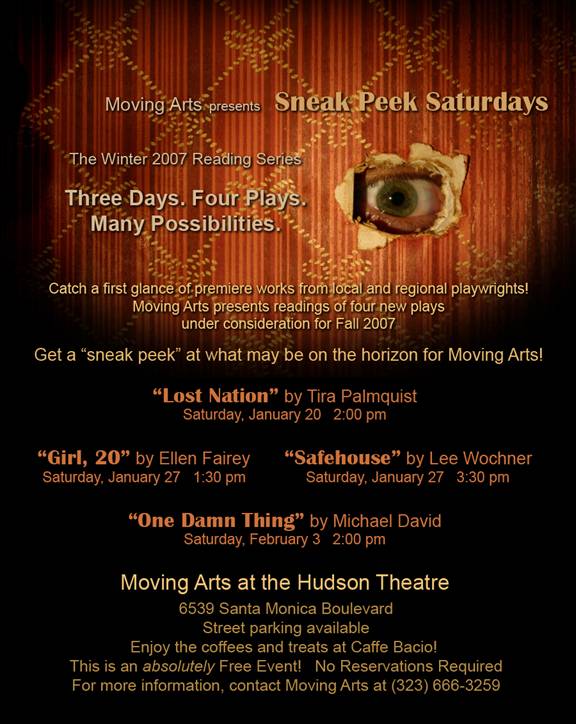
New play readings: You’re invited

Wednesday, January 17th, 2007

sneakpeek.jpg

Three of these plays I don’t really know, and so can’t talk about.

I don’t know “Girl, 20” by Ellen Fairey, or “Lost Nation” by Tira Palmquist, although I’m planning to attend and learn about them.

I also don’t know this play “Safehouse” by, well, me. I’ve read it — heck, I’ve even written it — but I don’t know it very well. I for sure don’t know it as well as literary pal Trey Nichols who put this series together with the powers that be at Moving Arts and was part of graciously picking the play. Trey called me today and talked about my play in such an energetic smart way that he almost talked me into believing the play was that good; at the very least, it sounded interesting. Given the actors he’s talking about enlisting for the production, I could get very excited about this. In the meantime, I feel more aware of what’s missing from the play than of what’s there.

The play that I do know is “One Damn Thing” by Michael David. It’s a play about Edna St. Vincent Millay, long past her peak, struggling to write one more poem but constantly pulled back into the incandescence of her past when she was indeed able to burn her candle at both ends and still be luminous. I find this play entertaining, inventive in its staging, funny and tragic. Millay has the bad grace to die long after her powers had faded, and I can tell you from previous readings of this play when it was a work in progress that it is deeply moving to see the contrast between her highs and her lows. Please come and be part of the audience and part of launching this play into the wider world.

Never Before Told: The true origin story of Doug’s Reading List!

Tuesday, January 16th, 2007

It’s always fascinating to see how you turn up in someone else’s writing. And by “fascinating,” I mean distressing. As a dramatist, I’m entitled to the truth as I create it, and other people’s views (particularly of stories involving me) just get in the way of that. Here’s a case in point.

Remember my good friend Doug, of “Doug’s Reading List“? Yesterday, a year and a half after the creation of The Reading List, and six weeks after my posting it here, he sent a broadcast email with his version of how the list came to be created:

Back when we were planning to go out via sailboat, I asked a well read friend of ours, Lee Wochner, to give me a list of his “take to the desert island” books. I expected him to spend a few minutes banging out his top-of-the-head top ten list and leave it at that. But to Lee, books are the essential currency of our humanness, the primary record of our civilization and any personal list of favorites to be the ultimate opening of the kimono – the baring of the ultimate soul – the absolute and total revelation of who you are as a person.

Most people today would feel that way about recommending their top 10 rental DVDs or best episodes of Friends or favorite American Idol competitor. Books, and reading, have slid from their place of honor in American culture, as a quick glance at literacy rates and market share & revenue numbers for publishers & newspapers will reveal.

I used to feel just as strongly about books as Lee does. Everywhere I ever lived I dragged every book around I’d ever owned, except for the complete collection of original 1st edition Ian Fleming James Bond paperbacks I’d received from my uncle Doug and loaned to Jay Buckles in 1974 and never got back and my large format anniversary edition Harold Head comic book that disappeared into Dan Norenberg’s Oldsmobile Vista Cruiser station wagon in 1976 and never returned. Not that I’m resentful and have a hard time letting go or anything.

My woodworking project in high school was a bookshelf. I dragged that around too, and showcased prized books in feature locations around my room, and later, houses. Although many things you wore, watched or discussed reflected who you were, I always believed that nothing told your story like your books. Whenever I visited someone who was a reader, who had books around their place, I always took a long, lingering trip to the bathroom and spent as much time as possible scanning their shelves to a) see if I recognized anything I’d read that validated my existence and provided a connection and b) see what I hadn’t read that defined my gaps and the differences between us.

My first big purge of books was when we moved to California. I sold the bottom layers of my library at our garage sale in Hudson, WI. I had them all laid out on our cargo trailer, which they filled mostly two deep, spines up. After the sale I pulled the trailer down to our used book store in town to sell a few of the remainder to the owner, then took the rest to the local retirement home and hospital for their libraries. It was a traumatic experience. I haven’t forgotten that either, and have spent the intervening six and half years fine tuning a long, complex and very tenuous logic chain that makes my wife entirely responsible. Not that I hold on to things like that or anything.

When I told Lee about the garage sale his expression clouded and he looked at me like a traitor to the cause of literacy and higher thought. The sale, the abandonment of books – the very thought of it – visibly turned his stomach. I would have had the same reaction not two weeks before I’d done it.

The next big purge was when we dispersed our worldly possessions in preparation for this upcoming travel. I sold some more at our garage sale, but donated most of them. I gave my dozens of sailing books to Jimmy Sones, a friend who also nurtures a dream of one day sailing over the horizon. The rest that I really treasured I put in a cargo trailer and drove out to my son, Adam, also a reader, in Minnesota. He put them on the bookshelves that I gave him, which were made by his grandfather as his high school woodworking project back in the early 50s. My dad’s shelves were much better made than mine, and of the two (mine went a long, long time ago), I’m glad I kept his around for such a suitable family heirloom moment.

So, at this point, I am essentially bookless. Aside from a few wilderness medicine books, survival manuals and some guidebooks, I have only a handful, most written by friends.

This is a very strange place to be for a kid who read, on average, at least four books a week for most of my childhood.

So, I need your help. I need your “take to the desert island” list of books so I can stock up for these travels.

When I asked Lee for his list he ended up spending over nine hours on it (see it here: Doug’s Book List ), which I guess is about what I would have invested if someone would have asked me this question prior to the Great Book Purge.

You, on the other hand, do not need to invest that much time or energy.

The expedition vehicle we ended up with is not a 53’, 35,000 lb. cruising sailboat. It isn’t all that big and is already at the limit on weight. Consequently, we don’t have a lot of capacity for me to drag along books. So, your list can, and needs to be, short.

If you could only take a backpack full, what books would you take to a desert island?

Be well,
Doug
—————————————-
Douglas Hackney
dhackney@egltd.com
www.hackneys.com/travel

(You’ll note that I have helpfully included Doug’s email address and website should you wish to draft your own Doug’s Reading List and send it. To him.)

As I’ve written here before, I’m glad to call Doug a friend. He’s a smart person who repeatedly puts his energies into helping the world, usually in a direct fashion, one person at a time, whether it’s clearing debris post-Katrina, donating books to a burned-out store in San Diego, or gifting tools to a would-be motorcycle mechanic in India. I admire Doug. Doug is good people. Which is why it saddens me all the more to see how memory loss is afflicting him at such an early age.

In Doug’s version, Doug tells a tear-stained Lee that the imminent sailboat departure of he and his wife affords the retention or acquisition of no more than 10 books. Lee cannot imagine the world reduced to a mere 10 books and with a darkened brow associates Doug with the “Friends” culture. From “Anna Karenina” to “Friends” to… WWF rebroadcasts on a 2″ iPod screen… it’s a downward voyage, led by Doug’s divestiture of his library. Doug isn’t on a heroic quest, but a fool’s odyssey — one Lee succumbs to joining.

Here’s Lee’s version:

Doug bemoans to me his lack of a degree in literature (completely understandable — the bemoaning part) and asks if there might possibly somehow be some way that I could provide him with a primer — a list of bare essentials that will allow him to escape cocktail-party chatter with only minor stabbings from cocktail toothpicks and in the meantime enlighten him in the non-Biblical literary underpinnings of Western civilization. What we’re looking for here is work that is both relevant and popular in such circles, or which will enable Doug to steer the conversation back to safer shores. (Which provided the reasoning behind my “Hold your own at a dinner party” sub-list, “i.e., the 11 most-discussed, most-influential works of modernist literature at this time; impress your friends, astound your enemies. Comprehensive? By no means. Will these 11 provide enough artillery to cover your weaknesses? Absolutely,” and why the list features Kafka, Beckett, Camus, Sylvia Plath, et al.)

These two origin stories differ greatly, as you see.

In the comics, it has always irritated me when origin stories are recooked. Supergirl goes from being Superman’s cousin as well as the only other Kryptonian to escape the planet’s destruction to being either a shapeshifting protoplasm or a human being with the same Earth name as Supergirl but now infected by the protoplasm, back to being Superman’s cousin but from another dimension, and so forth. I can’t follow it and I don’t like it. (I don’t think it’s a coincidence that I read none of these related comic books.) Iconic characters and iconic stories are iconic for good reason: The original version carries a deeper truth, one that tells us something about ourselves. Who was the alien Superman, after all, but a Jew, sired by Jews, newly Americanized, someone who had escaped the destruction of his own planet and was now eager to represent his new nation in the battle against Hitler and the forces of genocide and oppression? To suddenly, if briefly, recast him as a cyborg, as DC Comics did in the 1990’s, is lunacy. Forces of reasonable goodness still merit representation; cyborgs deserve nothing.

I feel similarly about the two origin stories now competing for primacy with regard to “Doug’s Reading List.”

In Doug’s version, he can transport only so many books, so he needs a desert-island reading list. We’ve all seen that story. In fact, we’ve heard that story as well, as with radio programs like “Desert Island Discs.” It doesn’t take us very far. It’s about economy of scale, and that is a story lost on a nation of strivers and dreamers.

In my version, Doug is seeking the wisdom of the ages and turns to me for guidance. (This version clarifies why the endeavor is worth nine hours of my time.) Doug is much like the Indian motorcycle repairman who only needs the tools. I draft the list, provide options oriented around Doug’s own goals (“desert island” is there, as well as “succeed at cocktail party,” and further reading choices), as well as a point-by-point explanation of why some titles were chosen while others left off. Ideally, Doug adopts the list and, armed with newfound insights gleaned from this reading, transcends the material to lend new perspectives on what he’s read and on what surrounds him in our world.

To me, that is an American story, and in the six years I’ve known Doug I’ve come to associate him with what we think of as American ideals: mid-Western, commonsensical, hardworking, successful, generous, populist, honest. He may believe that his story of the list is correct — it may even be correct — but it’s not right. It’s not right for Doug, and it’s not right for America.

Filmic infantilization

Monday, January 15th, 2007

The narration in “Little Children,” which I finally saw on Thursday after months of strong coercion from friends with respectable opinions, was immediate and jarring. We don’t get narrators in dramas much any more — and certainly not third-person narrators. Whereas in 1944’s “Double Indemnity” it was a fine device for Walter Neff to narrate his own downfall, now he’d have to shut up and leave us to our own judgments. So why this switch? Moreover, why was the narration voiced by Will Lyman, probably best known as the firm ironic voice behind the PBS documentary series “Frontline”?

During the first few scenes I couldn’t help rewriting the film — sans narration. The narrator tells us that Sarah Pierce marks time every day until she’s relieved of child care; why do I need the narrator to tell me that when I can see it? In another scene, Sarah shakes hands with the new friend she wishes she could touch — and the narrator tells us she wishes she could touch him. Imagine listening to someone read you a story and while you’re listening to the story you’re crossing out whole paragraphs at a time. That was the impact my hyperactive editorial mind was making on this moviegoing experience.

Until suddenly I understood: This is a documentary we’re watching. It’s a fake documentary (not a mockumentary, which parodies for comedy), but a documentary nonetheless, of the stunted lives of a certain subclass of suburbanites, as depicted here by this representative (fictional) sample. The “little children” are the childlike adults who act heedlessly and (almost) suffer consequences. And in the end, they are transformed into grownups: One stays with his mate, while the other grabs up her child and apologizes.

Except….

It would seem that each remains in what has been presented as an unbearable situation. Sarah is seen back at home clutching the child she hadn’t loved, in the home of the husband she disdains; her lover is being tended by the wife who insists upon a future in the legal profession that doesn’t interest him. So our choice would seem to be: act like children and be happy but careless and irresponsible; or sacrifice happiness and live as an indentured servant to adulthood. This is a barren decision tree.

It’s odd to sit through two-and-a-half hours of a film, love every moment of it, marvel at its wit and grace, and come away having really no idea what sort of statement it is trying to make. “Little Children” is a literary film, finally inferior to the director’s previous film, “In the Bedroom” (which also investigated moral ambiguities with regard to parental response), and as such is a treat in a calendar generally full of explosions and Tom Cruise. Literature as practiced in the past 100 years asks more questions than it answers, and this film is of a piece with that new tradition. But in a way it cheats: By offering only one (bad) answer, it refutes the breadth of experience the rest of the film endorses.