This morning before leaving for my acupuncture appointment I had time to read the lead story in the Los Angeles Times: “No stopping climate shift, U.N. study says.” (As is typical for the Lost Angeles Times, the story isn’t findable on their website, so here’s a link to the San Francisco Chronicle’s coverage.) A quick scan leaves one with this impression: No matter what we do, the glaciers will keep melting, oceans will rise, and everyone — everyone — will pay the price.
The information wasn’t news, but to me the tone was. Just again last week, Al Gore had assured me via DVD that things were fixable. Now all the scientists he is always quoting were making Al seem… naive.
 This topic was much on my mind as I left a meeting later that day in Santa Monica that was 22 miles from my office. I left the meeting at 3:20 and 70 minutes later had made only 3.7 miles of headway. (Mind you, I was driving — not walking. Walking would have been faster. Clearly.) Finally, having exhausted phone calls to friends, relatives, and strangers, and having triple-checked my email on my Treo, and having no further interest in being boxed in on all sides by other frustrated people, I pulled into the Westfield Century City mall to go see a movie. And of course the movie that was starting immediately was:
“Children of Men.”
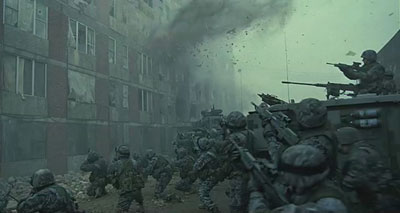
In “Children of Men,” everything I’ve been seeing in the breakdown of our planet and our manmade infrastructure is evidenced in a dystopian future only 20 years from now. The scenes of urban combat look awfully familiar to anyone with a television set, as do the shots of “detainees” and rampaging young adults with guns, and the overall ick of sky and water. In “Children of Men,” pollution has choked the planet, and human infertility has become total. Where watching, say, “The Omega Man” could be entertaining because we had little sense that its future was around the corner waiting for us, “Children Of Men” is a bracing confrontation with a future that seems all too plausible.
 I left the light entertainment of “Children of Men” glad for having seen it — glad in the way one is “glad” for having seen Picasso’s “Guernica” (which of course is visually referenced in the film, as is the cover of the Pink Floyd album “Animals,” for reasons that elude me). It was disturbing, surprising and gut-wrenching — precisely like sitting boxed in in L.A. traffic, but less so. I was happy to have made better use of my time. I rode the escalator down, got into my car, exited onto Santa Monica Boulevard —
— and found that traffic had not cleared one bit in the two hours I had been in the movie theatre. No matter which direction or what roadway, traffic was moving with all the speed of a snail on warm tar paper. At one point I called home and left a message saying that if I came across a motel with a lit vacancy sign, I was pulling over and checking in. Eighty minutes later, I finally got to my office. Total travel time: 2 hours 30 minutes to go 22 miles.
I’m not exaggerating.
I know the region had a major traffic and construction accident on the 405, but this is indicative of a pattern that is only going to get worse. Greater Los Angeles is on its way to becoming a city of isolated city-states (if it isn’t already) much like Italy through most of its history. Downtown will have nothing to do with Santa Monica.
But then, I’m not sure what Santa Monica, which is on the coast, will be like. Gore predicts that over the next 44 years the oceans will rise 10 feet, which will turn our Burbank home into very valuable beachfront property. The U.N. report says 7 to 23 inches within 93 years.
 Whatever happens, it’s clear that we’re entering a period where great fissures are forming in our civilization. Robert Kaplan wrote about this in 2000 in his book The Coming Anarchy, and I remember thinking when I read it that it seemed the most prescient book I’d read since Alvin Toffler’s The Third Wave. Toffler wrote about our shift out of the industrial revolution and how painful that was going to be; I wonder if he knew how quickly that shift would happen? Now every day I see signs of a fourth wave, a wave of collapse or retreat. If new technology is riding to the rescue, as the quote unquote president and some others believe, I hope it arrives quickly. Because in the meantime, there is often simply no way to get anywhere, and that seemingly little problem is indicative of many many larger problems.


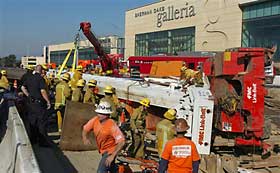 Here’s the AP story about the accident supposedly behind
 Is the actor doing this for purposes of exploitation? No, to play the troubled young man in