Lee Wochner: Writer. Director. Writing instructor. Thinker about things.


Blog

Archive for the ‘Thoughts’ Category

Tears for (and from) the villain

Tuesday, June 5th, 2007

Hang onto your lunch. Here’s the official statement from the quote unquote vice president about his crony Scooter Libby’s sentencing to 30 years in prison for his role in outing one of our own country’s covert agents:

Statement from Vice President Cheney on Scooter Libby

WASHINGTON, June 5 /PRNewswire-USNewswire/ — The following is a
statement by Vice President Cheney:
“Scooter has dedicated much of his life to public service at the State
Department, the Department of Defense and the White House. In each of these
assignments he has served the nation tirelessly and with great distinction.
I relied on him heavily in my capacity as Secretary of Defense and as Vice
President. I have always considered him to be a man of the highest
intellect, judgment and personal integrity — a man fully committed to
protecting the vital security interests of the United States and its
citizens. Scooter is also a friend, and on a personal level Lynne and I
remain deeply saddened by this tragedy and its effect on his wife, Harriet,
and their young children. The defense has indicated it plans to appeal the
conviction in the case. Speaking as friends, we hope that our system will
return a final result consistent with what we know of this fine man.”

Too incredible to believe? Here’s the link.

Here’s a little perspective, courtesy me:

  1. Thirty months is not long enough. The U.S. Constitution calls for a sentence of either death, or a prison term of “not less than five years.” Thirty months isn’t long enough, but I’ll take it.
  2.  If there is anyone the quote unquote vice president should be “saddened” for, it is Valerie Plame, and her husband, and the citizens of the United States, including other CIA agents who have to wonder when it might become convenient for this administration to out them as well and place their lives in jeopardy.
  3. Cheney does not understand the definition of “tragedy.” Historically it is a fall from a great height, and I can only hope for more tragedy of that sort, perhaps involving Mr. Cheney himself. Arthur Miller tried to adapt it to adhere to the common man as well, as in “Death of a Salesman,” and insofar as that seemed to carry over the notion of hubris (Willy Loman, like Scooter Libby, being guilty of said mistake), then this is indeed a tragedy. I do not however believe that either definition is what the nefarious Mr. Cheney means. Rather, I think he means it is an “injustice” — which is laughable. It is not enough justice. But I’ll take it.

“Life is pretty damn good…”

Tuesday, June 5th, 2007

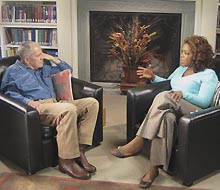
mccarthy-winfrey-cp-3059606.jpg“Life is pretty damn good and we should appreciate it more.”

It shouldn’t be surprising that that is the key takeaway from the author of “The Road,” the novel more than any other in the past year (perhaps in the past 10 years) that I’ve been thinking about, talking about, dwelling on, and recommending to friends, in his interview today by Oprah Winfrey. The bleakness of the post-apocalyptic “Road” is a reminder and an inspiration to recognize the value of what’s here now (and, with luck, to preserve that value). I remember in the immediate weeks after reading it thinking throughout every day that nothing I would face that day could be truly troubling by comparison. And isn’t that the strength of literature: to make you feel life anew?

I should also take a moment to profess my abject love of Oprah. This is probably only the third time I’ve watched her show, but every time I’ve been struck by her obvious genuine interest in the interviewee and the subject. (Want to see the exact opposite? Check out a man named David Letterman.) Some years ago I saw her interviewing a man who had written a book called “No Bad Boys,” about helping troubled youth; this author (and psychologist) was saying that he didn’t believe in “bad boys,” but in boys who needed help. As I watched that profile and his work with some of these boys and Oprah’s questioning, at one point I was reduced to tears. Sentimental? Sure. Heartfelt? Absolutely. I don’t believe in bad boys either, and I was glad to know that someone out there was doing something about that.

Maybe part of my love for Oprah, even given my limited exposure, is her determination to fix little corners of the universe. I too think things are fixable, or at least improvable. Oprah has no room for cynicism, and neither do I. She loves books and wants to talk about them with their authors. In a mainstream way, who has done this since Johnny Carson a long, long, long time ago? No one. It’s fashionably cynical to dismiss Oprah as a sentimentalist, but like her or not, she’s creating new readers for writers like Cormac McCarthy.

In this interview, McCarthy responds in style. He’s not a press hound — this is his first television interview ever, and one of very, very few interviews in his career — and that self-protectiveness may have contributed to his simple, matter-of-fact humility and wisdom, present throughout this interview. With regard to his seemingly odd punctuation style, which some have slammed as an affectation, he says, “I believe in periods and capitals and occasional commas. That’s it.” That style, he says, is “to make it easier to read, not harder.” Disagree if you will, but his books are beautifully written and quickly read.

If you missed the interview, it’s online at Oprah’s website. Here’s the link. If you’d like to see a talented contemporary novelist untrammeled by his recent success and wealth, one who acknowledges debts to forebears remembered (Faulkner, Joyce) and forgotten, watch this. To do so you’ll have to join Oprah’s free online book club (which you can later quit if you like), but is that so much to ask? You can always quit later, and all she’s trying to do is share her love for books she admires. Just like the rest of us.

Lots of character

Friday, June 1st, 2007

Over on the wonderful website of late lamented “Cracked” magazine, they detail the 20 best “unnnameable” character actors of all time. (They look pretty recent to me, because if you’re truly talking about character actors, how could you leave out the delightful Shemp Howard, who brightened every B movie he was ever in?)

I’ve met #19 and #1 several times (#1 is a major Democratic activist I’ve run into frequently in well-heeled back yards), the seemingly identical brother of #6 was my student (and is a very fine writer), and #17, who was in a play of mine, is a terrific actor who is great to work with.

And I direct your attention to #11, who has even followed me onto the “Cracked” website.

Another remembrance of Charles Nelson Reilly

Wednesday, May 30th, 2007

The LA Times’ Charles McNulty remembers his lunch with Charles Nelson Reilly and reflects on why theatre people loved him.

The life and death of Jose Chung

Wednesday, May 30th, 2007

I loved the episodes of “X-Files” and “Millennium” that featured Charles Nelson Reilly as writer Jose Chung. And who wouldn’t? Reilly played it straight (for once), but they were entirely tongue in cheek.

This brilliant seven-and-a-half-minute clip from “Millennium” gives the history of the recently conceived religion Selfosophy. It is riddled with clever in-jokes, not least of which is naming the guru, Onan Gupta, after the famous self-abuser in the Bible.

This next clip, about three minutes, is from the end of Jose’s first appearance, on “The X-Files.” To me, the ending provides a fitting epitaph for Charles Nelson Reilly, except I can’t quite decide what it is — and that makes it all the more fitting.

Driving Ass

Wednesday, May 30th, 2007

Forget “Driving Ace,” the title to be had in Los Angeles is “Driving Ass.”

For years, my nominee was the distracted driver who while staring at herself in the rear-view mirror and applying eyeliner with a hard cosmetic pencil rammed into the back of another vehicle, therefore lodging said pencil in her eye and later receiving a new cosmetic accoutrement:  a glass orb. Although I never met her, I did know the police officer who arrived on the scene, saw her off to the hospital, and ticketed her appropriately. (As though the loss of depth perception and eyes that move synchronously  weren’t enough punishment.)

A year or two ago, though, that person lost the title of Driving Ass to the man I saw eating a pizza while hurtling down the freeway. Not a slice of pizza — an entire open box of pizza perched between his chest and the steering wheel, box lid up.

But now, thanks to my son, I’ve got a new one. This person truly deserves the title.

Two days ago, Lex tells me, he was almost hit while riding his bicycle by a woman who sped through an intersection without looking. She rolled down her window and screamed at him, “Idiot!” (Which he is not. Occasionally late, or routinely sloppy in his room, but never idiotic.) When she rolled down her window, that’s when Lex saw what she was doing while driving her car:  nursing a baby. Although this makes me want to tabulate precisely how many good and reasonable laws she was breaking, I’m not surprised by the behavior. If you’re going to have the baby out of the car seat, well, why not nurse him or her at the same time? And since you’re already in the car and nursing the baby, why not drive somewhere at the same time? And if you’re doing all that and not paying any attention, why not blame someone else for your near-accident (for which, had it happened, I assure you I would have gone the furthest inch to see that baby taken away from her assuming he or she had survived, and every bank account drained had my son been hit). After all, in for a penny, in for a pound.

Transmuting metal into time

Monday, May 28th, 2007

surfercoin.jpg

Among other powers, the Silver Surfer can channel cosmic energy to restructure matter.

In this case, he’s changing U.S. quarters into a hefty fine and possible jail time.

The Life of Reilly (on film)

Monday, May 28th, 2007

Well, you won’t get to see it on stage now, but you can see the film. Here’s the trailer.

Charles Nelson Reilly, RIP

Monday, May 28th, 2007

charles_4.jpg

Sometime during my life travel as a person who works in the theatre, I came to realize that Charles Nelson Reilly, who died yesterday, was a genius. (And I use the word reservedly, but not in this case.)

As a kid I used to see him on “Match Game” and “Hollywood Squares,” in a regular featured role on “The Ghost and Mrs. Muir” and in odd guest appearances on “McMillan and Wife” and, seemingly, every other show on television whether intended for adults or children. Reilly always played someone fussy and wacky, and became the subject of ridicule among my circle of friends in high school and college. I think we all loved him but thought it wasn’t cool to love him, so although we all knew who he was and all could discuss with some knowledge his various acting gigs, none of us embraced him as a performer. I remember thinking that the guy had found one thing he could do and had somehow parlayed it into this career.

When did I, well, grow up about this? I’m not sure. But I do know that by the time about five years ago I saw him in his one-man show “Save It for the Stage: The Life of Reilly,” I knew for sure that the man was brilliant. His show was somewhat scripted but largely improvised around set pieces, and consisted solely of Charles Nelson Reilly on-stage talking, and occasionally picking up a prop or going to a stage location and doing some more talking. That’s about it. It ran a staggering four hours (I am not exaggerating) and judging from the audience response could have run another four. That night I would have told you that Charles Nelson Reilly was not only the funniest man in the universe, he was the best actor as well. The show was 100% riveting and 1000% entertaining. After this four-hour personal extravaganza, which touched on his heartbreaking youth, his near-brush with death in the infamous Hartford circus tent fire (an event that clearly marked him; he never again sat in an audience, and in his show said that he still had nightmares about being trapped in that crowd burning to death), and his rise to success and celebrity, Reilly was then mobbed in the lobby for what seemed another four hours. People could not get enough. It was an astonishing performance — both the show itself and the show in the lobby — and now I’m sorry that that show has closed for good.

Looking back I can see how my friends and I were confused while young. Charles Nelson Reilly seemed like one of those “famous, but for nothing” game-show stars. No, Reilly was a hugely talented and highly trained Tony-winning actor who found himself on game shows, where an entire generation (mine) discovered him, and where he damaged his career.

reilly.jpgIn addition to his solo show, I got to meet Reilly several times. He was a Tony winner for “How to Succeed in Business Without Really Trying,” and agreed to be part of a cast reunion fundraiser at USC about five years ago when the theatre school staged the show. (Somewhere around here I have three copies of signed cast-album CD’s.) We talked a bit afterward and he was kind and generous. I believe we had him as a presenter at the Ovation Awards but I can’t fully recall; what I do recall are endless discussions and great fear that he would talk all night in what was a tightly timed show. We also profiled him for LA Stage magazine, in a piece I didn’t write but did edit, and the photographer told me Reilly was generous with his time and very inventive in the photo shoot — which clearly showed in the pictures. And I saw him at numerous events and personal appearances and whatnot. He had a reputation for being difficult and cranky, but when I saw him he was always kind and generous and bitchy and very very funny.

He was also, as I said, a formally trained master. After 20 years of working with people who have studied television and film acting and who are now auditioning for the theatre and don’t seem to understand that there isn’t a microphone hanging 10 inches above their heads, I’ve grown to appreciate that more and more. In the theatre, craft is supremely important. It is not enough just to show up, and it is certainly not enough to just “be brave,” as David Mamet advises in one of his very bad essays on acting. One moment from Reilly’s solo show that I’ll never forget was his dissection of the contemporary “Hollywood Squares.” There may have been some sour grapes — again, game show appearances hurt his career, and now he was linked with a game show that, in a new version, was terrible — but to him the difference was in the background of the “stars.” Where once they were highly trained and recognizable character actors and comics, people with real accomplishments and real talents, now they were people who had been voted off various “reality” shows. “They say, ‘Hello, stars,'” Reilly complained, “but it should be, ‘Hello, shit.’ These people aren’t stars. They’re shit.'” In print it just looks nasty; on-stage it was funny and sounded true. To Reilly being a celebrity was not being a star, and calling these people stars was a deep insult.

Charles Nelson Reilly was a star, an actual star, someone who had earned every bit of his career. I’ve never seen anyone so completely hold an audience in the palm of his hand by simply talking to them, and for four hours. Dame Edna can do it (and John Leguizamo can’t), but not for four hours.

Unintentionally revealing communications, 1 in a series

Saturday, May 26th, 2007

This posting just came across the Yahoo message board for our program at USC. It’s from a student.

I am too lazy to call individual people up, so here’s the thing. I’m
moving into a new place in Westwood this coming Friday June 1st. I know
it’s a work day, but I could use at least one person to help me move
out and maybe later join me at a pub to numb away my aching joints. Any
help would be appreciated. Cheers

-Reza

Uh… yeah. I’m sure most of us will run over to help someone move who admits to being “too lazy” even to personally ask people to help. Somehow I don’t see this person being very helpful in his or her own move. I take the “I could use at least one person” phrase at face value.

I also enjoy that even the pub invitation is not communicated as a thank-you (just as the other wasn’t truly a request for help, but an invitation to be used). No, the pub invitation is a further opportunity to cater to the needs of the requester.

If you’re reading this and want to get used, let me know and I’ll forward the email address.