Lee Wochner: Writer. Director. Writing instructor. Thinker about things.


Blog

Archive for the ‘Thoughts’ Category

Not silent, and not dark

Friday, October 26th, 2007

Good news that The Silent Movie Theatre in the Fairfax district has reopened again, according to the Los Angeles Times. Better news, I think, that in its new incarnation as a revival art house the venue isn’t limited strictly to showing silent movies. I love silent movies, but in the DVD (and, soon, post-DVD) age, I doubt there’s enough of an audience to sustain the theatre. Best news:  96-year-old Gaylord Carter is still the organist. Yes, I said 96. Mr. Carter accompanied Buster Keaton films in their original release; 80 years later he’s still magnificent.

It’s nice to know that LA is going to have another revival house, one that sounds like The Little Art Theatre. I have many fond memories of the long-lost Little Art, deep in the woods of Bargaintown, NJ. In the early 1980’s before the advent of home video, this was the only place anywhere near my home to see art films, foreign releases like “Jean de Florette” and its sequel “Manon of the Spring” (both of which we just Netflixed last month), and assorted strange offerings like the Herve Villechaize / Oingo Boingo vehicle “Forbidden Zone.” The Little Art was also where I had my first date with the woman who would become my wife; we drove over there after a college event to see the midnight showing of “The Rocky Horror Picture Show” and wound up being the only two from our crowd who went.

Even with all those charms, though, it had never had a 96-year-old organist.

Watching a master at work

Thursday, October 25th, 2007

shelleyandlee.jpg

Last week while I was in Las Vegas, I caught the act of revered colleague Shelley Berman. In fact, in retrospect I wonder if I didn’t go to Las Vegas precisely so that I could see the act of the revered Berman.

I grew up seeing Shelley do his act on The Mike Douglas Show and The Merv Griffin Show and the like and even then thought there was something special about him. In an age that spanned far-out groovy comics, new absurdists (Steve Martin, Emo Phillips, Steven Wright), and human jumping beans frantically yanking props out of boxes (Gallagher, are you out there?), Shelley’s act was practically zenlike in its comparative stillness. His humor moved at the speed of erosion, and with similar particulate precision.

Although every year for almost 20 years I’ve seen him do some variation of his act in his capacity as a lecturer the Master of Professional Writing program at USC — even when his act that day revolved around mocking the miniscule salad at a faculty luncheon — I’d never seen him do stand-up in a club. So the opportunity to see him at Harrah’s, where he headlined the Improv, wasn’t one to miss.

And I’m glad I didn’t miss it. As a generous courtesy, Shelley had me seated next to his wife of 60 years, Sarah. Especially from that ringside perspective, my admiration for his comic facility grew. It’s pointless to try to recapture his lines here, especially without his delivery, but few people know how to work a room like that, improv off people in the front rows, weave in old bits seamlessly, or maintain a meticulously calculated pace, let alone do it so well at age 81. It felt wonderful to laugh that deeply.

His career revival is in full flourish. He’s recurring on “Curb Your Enthusiasm” and “Boston Legal,” he plays Adam Sandler’s father in that comic’s forthcoming new film, and he was recently given a lifetime achievement award at the Boston Comedy Festival. With all that, though, at the close of his act he said he always returns to live performance because of the bounce he gets from an audience. “This is what I live for,” he said.

Here’s Shelley’s website. You should check in once in a while and see if he’s performing live somewhere near you. Then you should go.

On (not) burning down

Wednesday, October 24th, 2007

Although seemingly all of Southern California is burning down, no, my family and I are not personally in any danger. We’re in the heart of the San Fernando Valley, and the fires in Los Angeles County are mostly along the coast, or north of us beyond the valley. I post this by way of response to the people who have called and emailed with concerns.

What we are experiencing, and will continue to experience, is the fallout — for everyone who has lost or will lose their homes. More than half a million people in this state have fled their homes. Where will they all go?

Monday night coming home from USC, which is downtown, I had the top down on my convertible, as I do most nights. The air had the smell of a clogged chimney, and the night sky glowed a faint orange. Tonight, driving toward downtown again but earlier in the evening, the sunset was apocalyptic, a thick stew of smoke and pollution and ash with a tinge of red and yellow. Traffic was light as it has been much of the week in the downtown to valley corridor; people busily fleeing fires are off these roads.

A couple of years ago the hills that surround this particular city did catch fire; they burned for days. It was remarkable to drive to appointments and to attend events and check in occasionally with the status of the fires above and ahead: Yep, still burning. I remember visiting the Taste of Downtown Burbank outdoor food festival and hundreds of us standing around eating while sprinkles of ash gently drifted from the sky and onto us. No matter where you were in the city, you could see and taste the fires.

This time, they are farther removed. But they will be with us for a long, long time.

The mainstreaming of comics

Sunday, October 21st, 2007

We are at an odd point in comic-book history:  At a point when the sales of mainstream comics in the format most of us grew up with have nearly reached the vanishing point, comics in new and more adult formats have seen sales spikes. Maybe you can’t find comics on a spinner rack at the market or to any great degree at 7-11,  but you can find them in collected editions at Barnes & Noble, where they are selling in increasing numbers.

You can also find them deeply rooted in our mainstream culture, where they have enormous influence and growing general acceptance. Without comics, we’d have no “Heroes,” and without comic books I’m wondering what movie studios would be releasing on most of their screens any more.

In addition to their new marketplace foothold, comic books in my lifetime have become a source of worthy academic and literary  investigation.  Case in point:  the new biography of Peanuts creator Charles Schulz. Having come of age during the strip’s decline into cuteness and Hallmark merchandising, I haven’t been a fan. But I have to admit that the earlier strips show a multi-leveled psychology that underpins its later enormous success. (The same can be said with Spider-Man, and Superman, and all iconic character creations, Spider-Man being a loser unable to strike back against a bullying society, and Superman being an alien Jew determined not to lose another homeland or see his new race perish.)

I’ve decided I’m going to read that Schulz biography  early next year. (Yes, it’s gotten to the point that I’m scheduling my book reading. It’s the only way to accomplish these goals.) As much as being a biography of Schulz, and one related to comics, it also sounds like a biography of our culture in a certain time and place. Similarly, I’m looking forward to Mark Evanier’s forthcoming book, “Kirby, King of the Comics,” a mini-bio of sorts of Jack Kirby in preparation for Evanier’s long-in-development biography.

For insights into these two books, as well as other thoughts about the place of comics in our culture today, I suggest this fine piece in today’s Los Angeles Times.  While I bemoan its title — “Comic strips aren’t just for laughs,” which is, after all, a variation on the tired “Hey, comics aren’t just for kids!” angle — the piece itself is dead-on about something that has been signally important in my life and the lives of many, many others.

Three practical tips for this presidential season

Saturday, October 20th, 2007
  1. How to identify the front runner? The front runner is the candidate who is so concerned about being perceived as a front runner — and therefore someone whom the actual electorate can take down a peg in a looming contest — that he denies it. (Or she, as this case may be.)
  2. Similarly, beware of candidates who run as “fiscal conservatives.” For examples, please see Nixon, Reagan, Bush, Bush, et al.
  3. Also, always be wary of “the people’s candidate.” What people? Which people? I’m part of the people, and so are all of the people I know, and yet we almost never support “the people’s candidate.” In one example from 2004, Dick Gephardt was a guy who clearly needed to meet more peoples. Even the peoples he knew didn’t support him, so I was never sure who he meant.

Sands of time

Friday, October 19th, 2007

sandsimplosion.jpg

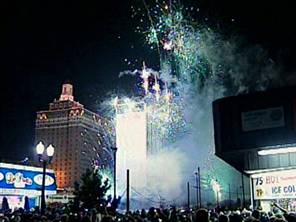
In Las Vegas, imploding old casinos to make way for new ones is almost a way of life. (And, judging by the casino hotel I stayed in there just yesterday, it needs to happen a little more frequently.) But in my old stomping grounds of Atlantic City, it hadn’t happened until last night, when they blew up the Sands real good.

I remember playing blackjack at the Sands when it opened in 1980 (and when it was called the Brighton, after the hotel that originally stood there), and yes, I was underage and got in anyway. (I don’t recall any of my friends ever being stopped at any casino hotel.) I would drop in occasionally for the next eight years until relocating to Los Angeles, but after that I never went again. If they blow up Harrah’s — or, perhaps, when they blow up Harrah’s — I will lose a large chunk of my history: just out of college, I worked at Harrah’s for almost a year, and often booked suites on the sly so I could host poker parties; at the end of one of them, my father sadly shook his head and said about one of my more, um, entertaining friends, “Joe shouldn’t play cards,” and then left with all of Joe’s money in his pocket.

Here’s the true lesson to learn from this implosion: that Kansas was right, and we are indeed all dust in the wind. Because if in Atlantic City nobody was able to save the site of the final concerts by New Jersey native Frank Sinatra, then there is no final hope for a legacy by any of us.

Recommended reading

Tuesday, October 16th, 2007

Thomas Friedman on who really won in the long strange story of Bush v. Gore. Truly an epic saga, except the critics would say it was too neat, with the loser triumphant and the winner losing everything.

Finally, a presidential candidate we can get (way, way) behind

Sunday, October 14th, 2007

Steven Colbert he suited up and ready to run.

Weird NJ

Wednesday, October 10th, 2007

Those of us who are from New Jersey have never questioned why there is a magazine called Weird NJ. It is a land of odd characters, strange ironies, and who-knows-what happening deep in the woods (whether’s it’s occult practices or body dumpings). In order to keep my own head filled with useful weirdness, I frequently check in online with my old newspaper, The Press of Atlantic City, where I found this story. Essentially, the mayor of Atlantic City went missing for two weeks — just got in his car and drove away — and now has returned to resign. The getting in the car and leaving part we can all understand — it’s the returning to resign part I can’t follow.

Mayor Bob Levy had claimed to be a Green Beret in Vietnam who had won several medals in the commission of his duties. None of that was true, as you can read here. The Press of Atlantic City did a stone-cold expose, Levy had a mental collapse, and now he’s gone. I seem to recall former mayors of Atlantic City serving prison time while remaining mayor. In this day and age, I have to wonder what has happened to the sheer ballsiness of Atlantic City mayors. It’s a sad day for would-be Huey Longs everywhere.

A side note that some of us may enjoy about The Press of Atlantic City.

When I was a kid, the paper was called The Atlantic City Press — a pretty good name, when you think about it. Everyone I knew had a beloved nickname for it — The Atlantic City Mess — because it was riddled with errors. (Although to my eye The Los Angeles Times has many, many more errors of commission and omission on a daily basis and, let’s be fair, many more resources.) About when I was in high school, the paper changed its name to The Press because their distribution covered much of southern New Jersey, which put them in competition with the Philadelphia Inquirer and the Courier Post, and because, honestly, nobody wanted to be associated with Atlantic City any more. Shortly after that, casino gambling was voted in, Atlantic City started a turnaround, and the error of the name change became apparent. So rather than switch back, they tagged “of Atlantic City” onto the end of the moniker. So now it’s a badly named newspaper.

I worked there from 1977 or so, when the offices actually were in Atlantic City, until 1980 (by which time we had moved to the unaptly named Pleasantville), starting at age 14 as a classified ad taker and moving my way up to full-time classified ad sales until having a falling out with management. We were trying to unionize, and management decided to make an example of the kid. I was asked to fight that but chose not to, and shortly afterward went into business and then to college. (I had graduated high school early.) A few years later, the Press was hiring copy editors, they did a recruitment from the literature program I was enrolled in in my college, and I took the test and passed. (The only one to do so.) That put me back at the Atlantic City Press, this time as a copy editor, then senior copy editor, then production editor. I was 24. Every day that I was there, as you can see by the above unconscious misuse of the the newspaper’s name, I wished it would just fix its damn name. But I loved the paper and the job with all my heart.

Another presidential option

Monday, October 8th, 2007

By the way, on the off chance you don’t believe the next presidential election is really over, and if you aren’t entirely crazy about the current field of candidates, you could always do your utmost to draft a guy who already won that race before.