Lee Wochner: Writer. Director. Writing instructor. Thinker about things.


Blog

Archive for the ‘Thoughts’ Category

On Saturday, the act begins

Thursday, June 5th, 2008

On Saturday, the act begins: The act in which Hillary Clinton tries to rise to the occasion and bury all the hurts and indignities of the past 18 months and, like Lyndon Johnson (whom she famously referenced), admit her defeat to someone younger and (seemingly) less experienced who captured the zeitgeist in a way she was unable to.

That will be the external Hillary. Here will be the internal Hillary:

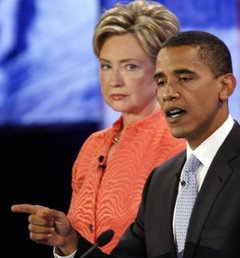
angryhillaryobama.jpgHere she is captured in this photo in a way we’ve seen innumerable times since January when her fate first became apparent. And no matter what you see on Saturday and beyond — a sunny buoyancy and an arm draped around her victorious foe — remember that, inside, this is the true look.

And you know what? I understand. We all should. She’s human. She’s ambitious. She believes she was right, and secretly hopes that he loses in November so that history will vindicate her. Even though I think she’s wrong, and has been wrong, and will be wrong, who among us can’t understand the terrible depths of her anger and humiliation?

All of yous

Thursday, June 5th, 2008

Y’all.
Youse.
You-uns.
You guys.
All of you.

These are just some of the regionalisms that Americans use to substitute for the lack of a different plural form of “you” in English. My favorite is the one employed in my mother’s hometown of Johnstown, Pennsylvania:  “Yins.” Yes, Virginia, there are many thousands of people in the Pittsburgh area who say “yins” when they’re addressing a group of people. My theory is that “yins” is a further contraction of “you-uns.”

Even though in my own speaking voice I use just “you guys” and “all of you,” I love every one of these locutions. For playwrights, they’re useful baubles to adorn characters with. But until yesterday I had forgotten one, and shame on me. Spending the day in Philadelphia, and seeing the Bill Irwin show “The Happiness Lecture” – developed with an ensemble of Philadelphia theatre artists – reacquainted me with one of the best plural-you forms in the country. Here it is, and no, I’m not making this up, and please keep your mind out of the gutter:

Yizz.

Further proof that Bill Clinton has lost it

Tuesday, June 3rd, 2008

Hillary Clinton looks like she knows her flight is coming in for a landing. Bill, meanwhile, is still flying too close to the sun. For further proof, click here. These are not the rantings of someone grounded in fact.

Best promotional item ever?

Sunday, June 1st, 2008

I have an Obama bobblehead on my desk. Now I’ve found a wonderful companion piece, if only I could get my hands on it:  this promo piece for the Saint Paul Saints, which depicts some of the prominent parts of Larry Craig in his most famous public works project.

Anyone know how I can get one of these? My birthday is in July.

The (ideal) human condition

Saturday, May 31st, 2008

Remember this post the other day, in which the lovely and incredibly helpful Shanda Clark, project coordinator for the Great Plains Theatre Conference, drives me to a television taping I’m unaware will star myself? In that post, I also mentioned that she picked me just after I’d gotten a promising report on my little boy, who had been briefly hospitalized with a truly upsetting autoimmune deficiency. I shared a little about that with her in the brief car ride.

The next morning when I opened the door, there was a package sitting there in the hallway on the floor. A white gift box tied with an attractive red ribbon bore a card from Shanda and the message, “Hi Lee, Just thinking of your family… and thought your boy would enjoy this when you arrive home. Shanda.” And inside were a rubber dinosaur, some playdoh, and a children’s art kit. I shared something about my son in passing, and she responded in this way for a little boy she’s never met, and for his father who, mere days before, had been a complete stranger. I was moved by this heartfelt gesture.

When I’ve been brought into retreats and conferences like this in the past and been well-treated, I’ve half-joked that “they treated me the way everyone should have to treat me.” This conference has gone one better: They’ve treated everyone the way we should all treat each other. The graciousness shown here has been nothing short of astounding. (Which, tomorrow when I’m not rushing off for final-evening cigars and drinks, will take me to the subject of playwright Doug Wright, perhaps the most gracious highly accomplished person anyone will ever meet.)

Today’s political prediction

Saturday, May 31st, 2008

Now that the fate of the Florida and Michigan delegations have been decided, with Hillary Clinton picking up 24 delegates but nowhere near enough to ever close the gap with Barack Obama, she will continue through the final primaries this Tuesday. Then, within a week, she will fold her tent and begin repairing her image with certain segments of the Democratic party.

I make this prediction for three reasons:

  1. She must go on, because she has proclaimed her desire for the party of “count every vote.” (Even though her long-ago plan was to effectively seal up the nomination within the first six weeks, therefore rendering meaningless all the ensuing votes. Have I menioned “hubris” here in connection with the Clintons? I think I have.)
  2. There is simply no scenario whereby she can gain enough delegates to take the nomination, even if a chunk of Mars were to crash through the atmosphere and cave in Obama’s skull. He’d still have more delegates.
  3. To go further than a week after the final primary would truly anger the party and all its activists and foreshorten her political future.

So:  By June 10th, she’ll be out. Unless, that is, she’s crazy. Given that she’s running for president, that shouldn’t be ruled out.

Sound communication

Friday, May 30th, 2008

Marshall W. Mason is one of the esteemed guests here at the Great Plains Theatre Conference. He’s a legendary director and, indeed, directed the first show I ever bought a ticket to, in 1980:  Lanford Wilson’s “Fifth of July,” starring Christopher Reeve, Jeff Daniels, and Swoozie Kurtz.

While he’s here, Marshall has been directing a snippet from a Doug Wright play as part of a tribute that was performed last night. Tonight, we’re all going to see “I Am My Own Wife,” a remounting of a production that ran here recently, brought back especially for the conference. The director of that production, a local whose name is Kevin and who seems like a very nice man, is noticeably caught up in the anxiety of remounting a small-town small-theatre production for the benefit of the visiting Pulitzer- and Tony-Award-winning author. Marshall, who shows every sign of being the kindest director I’ve ever met, has been nothing short of warm and supportive.

One of Kevin’s concerns has been about the theatre, a beautifully appointed mid-sized house with a colonnade supporting a balcony trimmed in warm wood. The theatre is undeniably attractive, but those stone columns add an echo to the acoustics. So Kevin had requested that thick black stage drapes be used to dampen the echo and support the actors. He had requested this in a friendly but firm fashion for several days, but nothing had come of it. Then, yesterday, Marshall had his tech runthrough for his segment of the tribute to Doug Wright, and now the black curtain was up. At dinner, he was eager to share this with Kevin and allay his fears about the acoustics.

So the execrable Robert Caisley and I are having dinner at our end of the table with Marshall when he politely excuses himself. “They’ve put up the black drapes and I must go tell Kevin,” he says. “He’ll be relieved.” He runs over to a table near us and leans in to someone he mistakes in the dimness for Kevin, someone who turns out to be Doug Wright’s partner David, in other words, someone who has no idea of the desire for dark sound-muffling curtains. Marshall leans over the table excitedly.

“Good news!” he proclaims. “They’ve hung the blacks!”

Much explaining of that gleeful statement ensued.

Word of the day

Friday, May 30th, 2008

Courtesy of VisualThesaurus.com, and no, I couldn’t believe it either when it arrived in my in box: “Playwright.”

Good Wrighting Word of the Day

Playwright

Of the half dozen English words ending in -wright in use today, playwright is the only one in which the creative act is writing, and the latest coinage (17th century) of them all. The -wright part is from very old English and denotes a maker of something, as in shipwright.

I’m betting the contemptible Robert Caisley already knew all this.

A sudden appearance

Thursday, May 29th, 2008

So this morning I’m sleeping in my room here at the Great Plains Theatre Conference and I’m awakened by a phone call from my wife. I’m glad she’s calling — I wanted to check up on our little boy, who’s been ill — but it’s awfully early, i.e., around 10 a.m. She thought I would be engaged already with adjudicating duties, but someone here at the conference knows me better than my wife of 20 years, because the schedule has never mandated an appearance by me before 3 p.m.

She updates me on the condition of our youngest (improving: good), and hurries off the phone because she can hear that she woke me. But now I’m up. So I read a little more of the Edward Albee biography I’m reading, and I do some further rumination on my new play, make some notes, and go downstairs and have coffee and shredded wheat with Silk. (Again: some wonderful person at this conference has channeled the inner me, because I don’t do milk if I can help it.) Then I throw some laundry into the washing machine in the basement. Now I’m back up in my room. I decide to check the schedule and find out what sort of thing happens before 3 p.m. On my personal itinerary that the helpful person or people have provided, it says, “12:15 — Metro & More taping.” I figure, Hey, they’re going to interview the conference guest of honor, Doug Wright, and I would indeed like to go see that: I’ve met Doug the night before and like him and his work (“I Am My Own Wife,” “Grey Gardens,” “Quills”). So I shower and shave and because I’m also now halfway into doing laundry, I put on last night’s clothes — the semi-casual clothes from last night — well, early into the morning — the clothes that a quick sniff tells me don’t smell too much of cigars and bourbon. Having miscounted the underwear I packed, I have no choice but to put yesterday’s back on, but it seems fine for now.

Just then, my cellphone rings again. It’s a weird phone exchange — 402 or something — nothing I recognize.

“Lee? This is Shanda.”

Shanda is one of the incredibly helpful conference people. Whatever you write on a list on the refrigerator, she provides. Someone else here wrote down “grapefruit,” and they arrived. Someone wrote “eggs,” and they arrived. I wrote down “Impeach Bush/Cheney.” I’m hopeful.

“Hi, Shanda,” I say.

“Are you coming to the Metro & Me taping?” she asks.

“Y’know, I am,” I say. “I’m just now heading out.” I can see by my Treo that it has started 10 minutes ago, but I figure I’ll slip in the back.

She says, “Would you like me to pick you up?”

Her ongoing thoughtfulness astounds me. “That would be really great,” I say. “Thank you.”

So I make some last-minute dabs and pats at my wet hair, glance again at the shaving cut on my neck, and walk downstairs, and she’s there already. I climb into her car and make some small talk.

“Who are they interviewing?” I ask. I know it’s stupid – they’re interviewing Doug Wright – but I have nothing else to say.

“You,” she says.

Ha ha. That’s a good one. “That’s funny,” I say.

She looks at me as she maneuvers the car onto the road. “No, they’re interviewing you.”

“What?” I say. Except it looks and sounds like this: “WHAAAATTTT?!?!?!?!”

“They’re interviewing you,” she repeats.

Suddenly I’m going to a very different sort of taping than I had imagined. Until one moment ago, in my mind I’ll be in the back of a studio audience enjoying the wit and wisdom of Doug Wright. Now with no notice I’m being asked to perform. It’s the actor’s nightmare: finding yourself on stage with no clothes and no lines.

“Am I dressed right for this?” I screech. “I just got out of the shower! I cut myself shaving! Are you serious? You’re kidding!”

She assures me that she’s not kidding, that I look fine, and that it’ll be fine, and I start to wonder if she’s polite or if because she hasn’t commented on it I can assume she can’t smell last night’s porch party on my clothes. About one nanosecond later I’m in the studio skirting cameras as I’m prodded toward the moderator’s desk and fitted with a lavalier mic. At no time is there a makeup person to check in with, which has me wondering just how greasy my forehead is at the moment, and how, by the way, is that cut on my neck doing?

Now I’m seated between the interviewer and my colleague, playwright Robert Caisley. Caisley has had more time to prepare than I: He found out about this five minutes before I did. He bears a similar surprised expression, although he’s had the savoir faire to grab the stage-left seat, so that he can hold forth, pontificating with ease and waving his arm about freely, as he’ll do throughout the interview in the periphery of my vision, resulting in a constant twitching blink from me every time his index finger draws close to my eye. I, in the middle seat, will be caught up in the ping-pong match between the host and the erudite Caisley. I decide on the spot that I hate Robert Caisley and for that chair would gladly run him through. I lean over to the interviewer, a cleanly composed gentleman with the bearing of a professional talk-show host.

“How long is this interview?” I ask. I’m trying to devise a strategy: perhaps a few pithy comments and I’ll be out. I’ve done interviews before; on radio they sometimes go 20 minutes, on television you’re looking at a couple of minutes and plenty of editing later.

“An hour,” he says.

I laugh. “That’s funny,” I say. “How long is this—“

“An hour,” he says again. He’s not laughing. He tells me it’s syndicated to about a bajillion different markets through some network or other, but I can’t hear anything except the surf pounding in my ears. He looks at his notes and tape begins to roll as I ponder my coffee mug.

For the next hour, I do my best to sound like I know something – anything – about writing and the theatre, all the while wondering about my forehead, my absurd clothes, my stale underwear, and the overarching all-informedness of Robert Caisley, who seems to know absolutely everything about everything, including the complete origin of Aristotle’s Poetics. Being better versed myself in the origin of Ant-Man, I realize I can’t compete on Caisley’s turf, so I blithely volunteer that I haven’t read Aristotle because I don’t want it to infect my own writing. (Caisley later congratulates me on this tactic.) I throw in a couple of bon mots about Arthur Miller and… someone else, I can’t remember… and the interviewer applauds me on my being able to capture in one short phrase what he himself has been wandering on about at length. This has me wondering if I’m stepping on his toes and now he’s punishing me for it. At some point, I launch into an anecdote about a play that my wife Valorie and our good friend Joe Stafford were in together in college. In this play, Joe’s character goes offstage to the bathroom, but because someone blew his cue and all the actors got lost in the action of playing Monopoly onstage, Joe’s character never made it back on stage – to this day, 20 years later, that character is still in the bathroom. The interviewer loves this story, and to illustrate his love of it, uses my coffee mug to represent a Monopoly piece in that play – and moves it over to his end of the desk, away from me, where it stays for the remainder of the taping. Now I’m sure that he’s in an unspoken power struggle with me. Meanwhile, Caisley is referencing great Russian directors that I’ve never heard of, and sharing stories of his father’s illustrious acting career in England and his own early introduction to the professional theatre back when I was building tree forts, and I start to fall back on my humble origins and my lack of formal training in the ardent hope that, as Americans, we will once again root for the underdog (in this case, me). Caisley impresses all and sundry with an impromptu discourse on the aesthetic unities, while I try to sound clever about what one’s chosen Monopoly piece says about one’s character. Who are these people who choose the thimble, and what does it say about them? (I am the horse and rider. Make of it what you will.)

The taping ends and while I now understand the feelings of the deer narrowly missed by a truck, everyone seems quite happy with it. The producer and the crew and the host are all upbeat. I’m still not sure what just happened. I congratulate the host on his sterling work — he was an enrapt and engaging conversationalist and I tell him this because it’s true and because perhaps it will prod someone in post-production to be kind to me on tape and use ProTools to erase the shine from my forehead. I’m led to another room to pick up a takeaway lunch and Caisley and I stumble out into the drizzle. I can’t help noticing that now that the taping is over, there is no ride back.

“What just happened?” I ask him. I tell him I had expected to be watching Doug Wright getting interviewed. Or, perhaps, someone else. I was not prepared for it to be me. He doesn’t understand it either, and relates that he had been lolling around outside in shorts and a hoodie when Shanda found him. He had run back to his lodging at breakneck speed to get dressed.

What now? Now, we wait. At some point or other, an hour of myself and Robert Caisley will be popping up on a channel near you. They’ve promised to send us each a DVD. If they host it online I’ll link to it — after I’ve reviewed it. In the meantime, I think I’ll study the rest of my conference itinerary very, very closely.

Writing vs. editing

Tuesday, May 27th, 2008

One of the things I tell students, and which I heard myself saying again the past two days in my workshops here at the Great Plains Theatre Conference, is that you shouldn’t try to edit while you write. It’s better to write, then edit. Otherwise, definitionally, you’re editing yourself — and writing should be a freeing process, not a judging process. It’s best to write, then edit.

My friend and colleague Shelly Lowenkopf is a writer and an editor, someone with major credits in both regards. If you’re interested in writing, I direct you to this posting on his blog, where he discusses the purpose of editing. Like most things I hear Shelly say, it’s filled with useful wisdom.