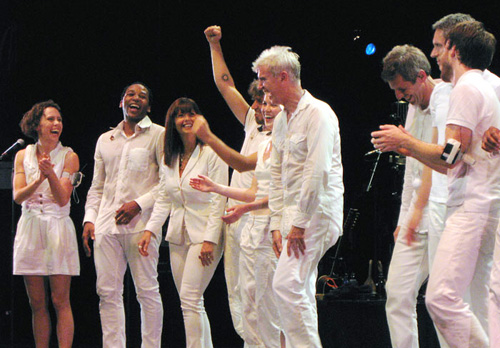
Last night, good friend Trey Nichols and I went to see David Byrne perform at the Greek Theatre here in Los Angeles. Neither of us had high expectations; it just seemed like a good opportunity for two friends to hear some music, then later share drinks and cigars. We got all that — and one of the best concerts we’ve ever attended. Only very occasionally in live performance are you present for an event where everyone on stage reaches a transcendent level, the audience takes note and feeds more energy and enthusiasm to the performers, and then the performers notch it even higher. Last night was one of those nights. Four songs in, when he had already received a much-deserved standing ovation, the normally taciturn Byrne looked into the crowd, grinned broadly, and scratched his head. That image of unreserved bewilderment and joy was transmitted to the outdoor amphitheatre’s big screens, eliciting a swell of applause and cheers from us all. David Byrne has always been cool. Last night, he was hot.
He’s touring to promote his new album with Brian Eno, “Everything That Happens Will Happen Today,” which I’ve been plugging here. I like the album enormously. On this tour, Byrne is performing songs from his 30-year history with Eno, which includes three Talking Heads albums (“More Songs About Buildings and Food,” “Fear of Music,” and “Remain in Light” ), the revelatory “My Life in the Bush of Ghosts,” song selections from “The Catherine Wheel,” and this new album. I’ve always been an enormous fan of their collaboration; until last night, I hadn’t realized it had been more than 30 years of music. Tempus fugit.
This Wikipedia page devoted to the tour details the exact set list. I had no doubt that the set list was tightly choreographed — literally — because the songs are accompanied by three young dancers. They crawl, they dance, they leap, they line up, they swivel around in office chairs. If this sounds distracting, it isn’t — it’s enhancing. It’s also so cleanly delivered, so practiced, so perfectly on the beat, that there’s no room for improv (hence the ironclad set list). What Byrne didn’t anticipate, though, was the sort of reaction he got last night, which necessitated a third encore, which included “Burning Down the House.” (A “non-Eno” song.)
For me, the night was memorable for another reason. I’ve spent a lot of years with David Byrne (and, indeed, saw Talking Heads on one of their final engagements on the “Stop Making Sense” tour some time in the 1980’s). I’ve also spent a lot of years — almost 15 of them — with Trey Nichols. After the show we did go out for those cigars and drinks, driving that long winding drive up the mountain in Burbank with my convertible top down to The Castaway, a restaurant that provides an encompassing visual purchase of this end of the valley. We sat there out on the ledge and drank and blew smoke and looked over all the lights far below and shared personal epiphanies about one artistic expression after another — in music, or art, or literature, or theatre — that grabbed us. We had so many in common it was impossible to keep count. (One example: Trey mentioned the Clubfoot Orchestra in passing; he had seen them accompany “Nosferatu,” “The Cabinet of Dr. Caligari,” and “Metropolis” in Berkeley in the late 1980’s, while I had seen them accompany “Sherlock, Jr.” and Felix the Cat shorts at Silent Movie in Los Angeles in the early 90’s.) Trey remarked upon how astonishing those Eno/Talking Heads albums were when they were new, and how little or nothing has surpassed them, and I reached back to my naivete and said, “Do you remember thinking that music was going to get better and better?” As we closed the bar and moved down the hillside to the parking lot where we finished our drinks and cigars, I remembered first meeting Trey at an event we were both reading in in 1995 and being struck by both his words and his presence in reading them and fully hearing all that potential and power that lay beneath. (My first thought: “Oh, no, a play about football.” My second thought: “No, wait. This is a play by someone smart enough to write a play that pretends to be about football, but isn’t.”)
I drove us back to my house, where he had parked his car, and we shook hands before he left. I carried inside the rocks glass I had stolen from the Castaway: a keepsake of the evening. Someone once said that when a friend dies, a library burns down — all those references are lost. My personal archive includes several experiences with David Byrne’s music — and many, many events with Trey Nichols.