Don’t trust anything she says
Wednesday, January 7th, 2009You’ll see why in just a moment. (Brace yourself.)
You’ll see why in just a moment. (Brace yourself.)
Sam Shepard was arrested yesterday in Illinois for drunk driving. According to news reports, his blood alcohol level was twice the legal limit. I don’t have any sympathy for drunk drivers, and I hope that if Shepard is convicted a judge won’t either.
But what I really want to talk about is this mug shot, which propels Shepard into the rarified ranks that include, say, Nick Nolte.
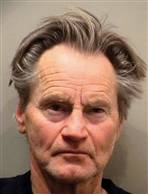
Well, he certainly looks drunk. And I know we all age (if we’re lucky). But my first thought after seeing this was about potential future roles for Sam. It now occurs to me that if Sam Shepard writes a sequel to “True West” (as Albee wrote a prequel to “The Zoo Story”), then Shepard seems perfectly disposed to play Dad. Because he looks like a toothless old man who lives in the desert. Yes, Sam Shepard, early action playwright and former hipster and lover to Patti Smith has become… a coot.
Congress insisted that U.S. automakers present a plan for solvency before it would approve a bailout — and then didn’t approve the bailout anyway. Which I was actually cheered by. Then Ford decided it didn’t need a bailout, and again I was glad — partly because I drive a Ford (a Mustang convertible) and would hate to feel dragged down by association into bailout-hood. If there is no longer a stigma in insolvency, we should create one anew.
My first problem with the proposed automotive bailout was that it treated all three of the U.S. manufacturers the same, even though their circumstances were very different.
Ford makes a good car — a number of good cars — that have been selling very well, especially that Mustang and the Focus and the F-150 truck. Yes, Ford may have too many brands right now (Mazda? Volvo?), but the company has cash reserves and was making money. Ford’s problem was the sudden credit freeze of the second half of last year. The near-collapse of the economy panicked most buyers, and those who were left standing couldn’t get access to credit. That left only the people who were going to pay cash for a car — and as we know, those people live in China.
Chrysler is owned by venture capitalists. Here’s what VCs do: They make many bets in the marketplace, and some pay off and some do not. VCs seek a return of 10-to-20 times their investment, and they like to get in, and then get out, of these bets. So when the Germans (Daimler) were losing a bundle on Chrysler, Cerberus did what VCs do — they picked it up cheap and tried to turn it around quickly so they could unload it with a huge return. Unfortunately, they made a very bad bet. Why you and I should be forced to finance their mistake is unfathomable to me. We’re certainly not going to share in any good investments Cerberus made in the past. To really nail home the point, let me note that as a non-public company, Cerberus is incapable of issuing any stock to the U.S. government as a way of paying back the investment (if that were ever even to happen). Chrysler should just be allowed to fail.
Which brings us to GM. Compared to the rest of the marketplace, they don’t make good cars; even if you believe they do, almost no one else does, so that perception becomes the reality. Their manufacturing and marketing is remarkably inefficient. Compared against Toyota, whose sales are almost equal in the U.S., GM has about one-third too many dealerships. And their chief executive is an utter failure who lacks the good grace to go away. Bankruptcy might actually be a good option for GM, so long as the company emerges from it. Because GM is so large, and directly or indirectly employs so many people, that the idea of GM simply vanishing from the economy ought to give us all shudders.
So: three very different situations.
But why write about this now? Wasn’t the failed auto bailout big post-election story of November?
That brings me to my second problem with the idea of running to the rescue of the automakers. While they did come up with plans that at least claimed to lead to financial success, all their new design ideas seemed retrograde: Please save us and we’ll build hybrids and we’ll expand research into electric cars. How 2004. Remember when great American companies championed innovation? You don’t hear much of that coming out of Detroit.
So today I stumbled upon this in the New York Times: some actual forward-thinking ideas of what U.S. automakers could build into their cars to make them more attractive. They include:
These technologies already exist. And they sound like the sort of thing that Barack Obama means to invest in when he talks about putting money into infrastructure. This is what Detroit should be asking for — the proverbial hand up instead of the hold up (“Give us money or we’re going to close, and you’ll be sorry.”).
Of course you want a panoramic view of Times Square on New Year’s Eve. So click here to see that. (You can also check out Glasgow, Sydney, and other locations — although for some reason evidently not Egg Harbor City, NJ.) The accompanying text says that the temperature at Times Square was one degree fahrenheit. Given the bare hands and bare legs on some of the women, I’m skeptical. (Although I know the credo: “Anything to look good.”)
While my wife and I were celebrating New Year’s Eve hosting a dinner party for seven friends, my good friend Doug Hackney was in a surgical suite watching his wife get a small chunk of her back removed. Here’s why.
My Uncle Rich is busy breaking his end of the internet again. But Uncle Jay was able to explain 2008 in a way we can all understand — in song.
The current issue of Reason interviews Craigslist founder Craig Newmark who says, among other things, that 13 years in customer service taught him that people are basically trustworthy. (You can read it here.) I think that’s probably true. I also think that most people have noble intentions and wish the best for their fellow human being.
Which brings me to a special year-end thank you.
This time last year when I looked ahead to 2008, I noted a couple of things I wanted to do. One was to spend more time with friends. Another was to do something big and new that was utterly un-work-or-writing-related, and have it benefit someone else. When a brochure arrived in the mail from the AIDS Marathon, it seemed to fit the bill for everything. So I signed up and I trained for 6 months and by way of doing that made some terrific new friends (to add to the pre-existing terrific friends) and then I went off and ran the marathon, and in the process of doing that my sponsors and I raised $4400 for AIDS Project LA, to pay for medical and dental care for uninsured people living with HIV and AIDS.
So I’d like to thank the following people who sponsored me to do this. (And by the way, some of these folks are people I’ve never met, who clicked to donate via the links on the blog.)
A big thank you to:
Kim Glann (who also gave me great running tips)
Mark Chaet
Michelle Mierz (who, as a marathoner herself, set a great example)
Isabel Storey
David Dobson
Anonymous
Darla Balling
Jeannine Fairchild
Ross T. Kendall
Dorinne Kondo
Ed Levitt
Gerald I. Locklin
Christopher Meeks
Durrell Nelson
Thomas W. Boyle
Janet Reynolds
Alan Ziter
Paula Brancato
Marcie Blumberg
Sidney Stebel
Maria Graf
Jeanne-Andree Nelson
Heather Leikin
Chris Lane
Larry Eisenberg
Jon Rivera
Wenzel Jones
Jalondra Davis
Ernest Burger
Congressman Adam Schiff
Madelyn Inglese
Jean Hobart
Michael Wochner (my dear brother, who also enlisted some friends to donate)
W James Gosline Jr
Dan Beck
Johnna Adams
Douglas Hackney
Pamela Johnson
Mark Niu
Kathryn Whitaker
Michael Folie
Stefan Doomanis
Trey Nichols
Peter Kuo
Barry Rowell
Jon Amirkhan
Lacie Harmon
Michaela Morgan
Richard Hamner
Jan Elliott
Jackie Baghdassarian
Kitty Felde
Janice Littlejohn
Lisa Wochner
Rich And Ruth Roesberg
Brian Kite
Mark Stephenson
Rodney Hobbs
Amy Kramer
Steve Ginsberg
Douglas Hackney
Susan Kamei Leung
Brett Fisher
Rebecca Davis
Joe McClain
Roy Vongtama
Michael Shutt
Paul Crist
Ray Wochner
Jan Williamson
Richard Ruyle
Your donations went to help some people who really need some help. And they proved, again, that while the news is filled with deceit and disasters, there are always untold millions of people around the world doing what they can for others, with nothing personal to gain.
Thank you.

The other day at a Chinese restaurant, my son opened his fortune cookie and this is what he found: A fortune that read “A SURPRISE WILL COME FROM AN UNEXPECTED SOURCE.” And then right behind that fortune, he found the surprise: The same fortune, again.
Below is a new TV commercial for a project called “One Laptop per Child,” which hopes to provide… well, you get it. This new commercial features John Lennon, who died in 1980 and, last I checked, was still dead. In the commercial, the lamentably late Mr. Lennon looks fit, and is garbed in a style most of his more knowledgeable fans associate with the period ” ‘lost in Los Angeles’ to ‘early New York,’ ” also known as 1973-1975. He also sounds rather well, especially after having been dead for 28 years. And I’m guessing that this reappearance from beyond the grave has given him extraordinary powers, because he says, “You can give a child a laptop and more than imagine, you can change the world.” Which is a visionary sentiment, given that Lennon perished before the commercial availability of laptops.
Just as I didn’t like it when an advertising agency dug up Fred Astaire to hawk vacuum cleaners, I don’t like this. This may be for a better cause — although that is debatable, given that the vacuum-cleaner company no doubt was helping to feed employees’ families — but I question whether the cause (donating laptops) merits putting words into the mouth of a dead man who always had a strong opinion about what he was for, and what he was against, and in this case could not be consulted.
“This sounds like Tiny Tim, Monty Python, and some horrible bubblegum pop band got into an accident and spewed this out.”