Lee Wochner: Writer. Director. Writing instructor. Thinker about things.


Blog

Archive for the ‘Thoughts’ Category

A lesson in economics

Tuesday, February 23rd, 2010

My friend Barry sent me this. (Not the Barry who broke his leg. The Barry who lost his leg. What is it with Barrys and legs?) Unfortunately, it explains everything.

USA Finance 101– How Our Finances got so Fouled Up!

An Easily Understandable Explanation of Derivative Markets

Heidi is the proprietor of a bar in Detroit. She realizes
that virtually all of her customers are unemployed
alcoholics and, as such, can no longer afford to patronize
her bar. To solve this problem, she comes up with a new
marketing plan that allows her customers to drink now, but
pay later.

She keeps track of the drinks consumed on a ledger (thereby
granting the customers loans).

Word gets around about Heidi’s “drink now, pay later”
marketing strategy and, as a result, increasing numbers of
customers flood into Heidi’s bar. Soon she has the largest
sales volume for any bar in Detroit.

By providing her customers’ freedom from immediate payment
demands, Heidi gets no resistance when, at regular
intervals, she substantially increases her prices for wine
and beer, the most consumed beverages. Consequently, Heidi’s
gross sales volume increases massively.

A young and dynamic vice-president at the local bank
recognizes that these customer debts constitute valuable
future assets and increases Heidi’s borrowing limit. He sees
no reason for any undue concern, since he has the debts of
the unemployed alcoholics as collateral.

At the bank’s corporate headquarters, expert traders
transform these customer loans into DRINKBONDS, ALKIBONDS
and PUKEBONDS. These securities are then bundled and traded
on international security markets. Naive investors don’t
really understand that the securities being sold to them as
AAA secured bonds are really the debts of unemployed
alcoholics.

Nevertheless, the bond prices continuously climb, and the
securities soon become the hottest-selling items for some of
the nation’s leading brokerage houses.

One day, even though the bond prices are still climbing, a
risk manager at the original local bank decides that the
time has come to demand payment on the debts incurred by the
drinkers at Heidi’s bar. He so informs Heidi.

Heidi then demands payment from her alcoholic patrons, but
being unemployed alcoholics they cannot pay back their
drinking debts. Since Heidi cannot fulfill her loan
obligations she is forced into bankruptcy. The bar closes
and the eleven employees lose their jobs.

Overnight, DRINKBONDS, ALKIBONDS and PUKEBONDS drop in price
by 90%. The collapsed bond asset value destroys the banks
liquidity and prevents it from issuing new loans, thus
freezing credit and economic activity in the community.

The suppliers of Heidi’s bar had granted her generous
payment extensions and had invested their firms’ pension
funds in the various BOND securities. They find they are now
faced with having to write off her bad debt and with losing
over 90% of the presumed value of the bonds. Her wine
supplier also claims bankruptcy, closing the doors on a
family business that had endured for three generations, her
beer supplier is taken over by a competitor, who immediately
closes the local plant and lays off 150 workers.

Fortunately though, the bank, the brokerage houses and their
respective executives are saved and bailed out by a multi-
billion dollar no-strings attached cash infusion from the
Government. The funds required for this bailout are obtained
by new taxes levied on employed, middle-class, non-alcoholics.

Now, do you understand ?
Phish story

Tuesday, February 23rd, 2010

Fifteen minutes ago, I got this email from a playwright friend:

I’m sorry for this odd request because it might get to you too urgent but it’s because of the situation of things right now,I’m stuck in United Kingdom with family right now,we came down here on vacation ,we were robbed, worse of it was that our bags, cash and credit cards were stolen of us at GUN POINT, it’s such a crazy experience for us, we need help flying back home, the authorities are not being 100% supportive but the good thing is that we still have our passports but don’t have enough money to get our flight ticket back home, please i need you to loan me some money, i will refund you as soon as I’m back home, i promise.

I emailed back:

John,

Is this for real? I’m going to message you through Facebook as well.

Lee

And so I did:

John, I got this email from you. Is this for real, or is this a phishing expedition?

Three minutes later, I got this reply:

No!!!lt isn’t a virus, I’m in this situation for real, I’ve been finding it difficult to make overseas calls from here. My phone’s out of service, probably because I’m outside the states. It has really been embarrassing for me,I’m very sorry for not informing you about our trip to U.K but I’m sure i can explain better when i return,I need some $$ as I have nothing on me now, was wondering if you could loan me $1,980, I’ll refund it to you as soon as I arrive home i will be glad to read from you soon.

John

And I got a Facebook chat message, “Hey Lee. You there?”

But I had already responded to the previous FB message with this:

What’s the name of the dvd you gave me? What happens to the lead character?

When I got no response to that, I messaged back: “Thought so. Contacting Facebook now.”

And I called my friend on his home phone back here in Los Angeles — and he answered. Right away. Why was he up? Because other friends who’d gotten that email called him to check. It’s 6:46 a.m. here and I doubt he would have been up otherwise.

Needless to say, he wasn’t robbed at gunpoint in the UK, and if he had been, a call to American Express or the U.S. Consulate or his bank or any number of other authorities would have loosened up some of his cash. I also let him know over the phone that if he had really been in a jackpot, I would have wired him the money. One of the things that made the phishing expedition so believable was the reasonable amount of cash requested.

What tipped me off that it wasn’t him? It’s not just the idea that John would have to inform me in advance that he was going to London (why would he have to do that?). It was the writing in the last sentence:  “It has really been embarrassing for me,I’m very sorry for not informing you about our trip to U.K but I’m sure i can explain better when i return,I need some $$ as I have nothing on me now, was wondering if you could loan me $1,980, I’ll refund it to you as soon as I arrive home i will be glad to read from you soon.” I think John would sooner shoot himself in the head than leave those personal pronouns uncapitalized, or write a run-on sentence fragment like that.

It comes in handy to know your friend’s writing voice.

The Tiger Woods decision tree

Sunday, February 21st, 2010

On Friday, I saw Tiger Woods’ apology-of-sorts on a screen at a bar in Ft. Lauderdale. He pleaded for people to leave his family alone. Immediately afterward, his plea was analyzed by four experts trying to get at the root meaning of what he’d been saying. After that, more people analyzed it for our benefit.

I didn’t feel that I needed the apology, such as it was, anyway. What had he done to me? Nothing. Same as he had ever done.

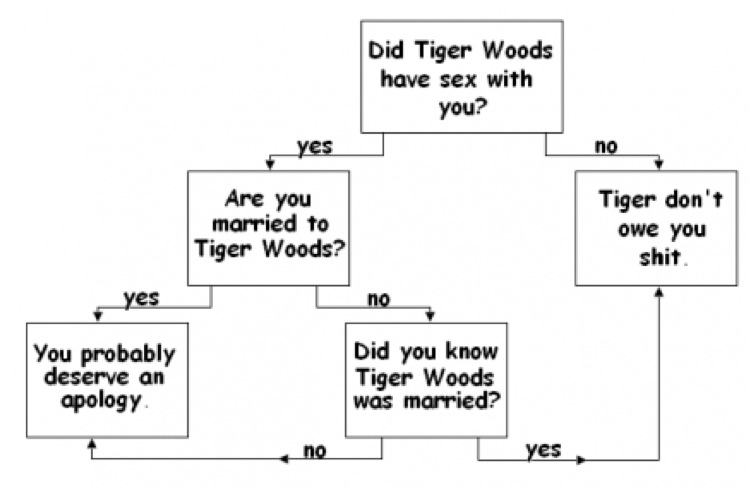
But what if, unlike me, you’ve actually had close personal contact with Tiger Woods. Perhaps you think you’re owed an apology, but you’re not sure. For you, there’s this helpful chart, courtesy of Brokey McPoverty:

tigerchart.jpg

Uh oh

Sunday, February 21st, 2010

No, I don’t know why all the paragraph returns have suddenly vanished from this blog.

But I’m going to get to the bottom of this.

(By asking people smarter than me to please get to the bottom of this.)

The problem with being oracular

Saturday, February 20th, 2010

Today in my playwriting workshop we again discussed unreliable narration, and twist-ending plotting — and then later I took my daughter to see a movie that turned out to exemplify the perils therein.

Unreliable narrators (or protagonists) have made for some of the best debates drawn from literature. Is the knight in the Canterbury Tales the most accomplished hero in medieval history, or is he a boaster with few actual accomplishments? It’s difficult to read Chaucer’s tone on this, and the evidence seems fifty-fifty. In “Turn of the Screw,” is the governess haunted by those ghost children, or is she insane? In Richard Nixon’s autobiography, does he actually believe his lies and justifications, or is he brain-damaged?

But a truly unreliable narration demands that the argument be split both ways so that we doubt. If we can decide early on one way or the other, the game’s over. The narration — or protagonist — can be unreliable, but our conclusion has become definitive. Once that happens, everything afterward starts to look like transparent writing tricks.

The same goes with twist endings. If you can sniff out the twist early on, everything else becomes drudgery. Today in my workshop one writer asked for advice — to pursue writing an unreliable character and a twist, or to expose the device early on and approach the material from a different angle.  Do these twists well and you wind up with “The Sixth Sense.” Do it badly and you wind up with “The Village.” (Or, someone else chimed in, any other M. Night Shyamalan movie.)

So there I was at 2:15 for the beginning of this week’s big new movie, and by the first scene I was sure I knew what was up. By the third scene, I had confirmation. The obvious problem with relying on gimmicks is that if they fail, you have nothing else to entertain people with. The leading man still looks like a rat-faced little boy to me, and his acting in this movie is stapled together from 50’s B-movies and James Cagney, circa the grapefruit-in-your-face era. Even the first scene looks utterly fake, and for reasons that mystify me:  It’s merely of people talking on a boat, and yet the background rolls past like a canvas in a stage melodrama. Is it so difficult to film people on a boat that you need to Photoshop every frame? If you know your lead character can’t be trusted, and that leads you to an immediate conclusion about the unsurprising twist awaiting you an endless two hours and ten minutes in the future, and your popcorn has already run out, what’s left to be enjoyed?

Whenever this happens to me in the movies (and it happens all too often), I wonder if others see things this way. The woman two seats to my left gasped and murmured throughout the movie like a lady with a hand up her skirt. At one point I actually looked over to see if she had been signed out for the day from a nearby facility. But no; she was just slack-jawed in absorption with a truly dumb  and patently phony bit of hooey made by supposedly the greatest living American director. Which left me remembering this exchange from “Annie Hall”:

Alvy Singer (the Woody Allen character):  Here, you look like a very happy couple, um, are you?
Female street stranger:  Yeah.
Alvy Singer:  Yeah? So, so, how do you account for it?
Female street stranger: Uh, I’m very shallow and empty and I have no ideas and nothing interesting to say.
Male street stranger: And I’m exactly the same way.

Global colding

Wednesday, February 17th, 2010

The folks who coined the term “global warming” have realized their mistake (too late), and now say they should have said “global climate change.” I can attest to that. My birthplace in New Jersey has been buried under an avalanche of snow for weeks now, I have a friend in Washington DC wondering what all this white stuff is that has shut down the government, and another friend sent me an email last night with the repeated refrain “Have I said how sick I am of cold and snow?”


And then there’s me.


I’m writing this from the restaurant of a 5-star hotel in Boca Raton, FL, where, I assure you, I am freezing my ass off. It’s plenty cold outside, but it’s frigid inside. This hotel, which optimistic realtors might call “Miami Beach adjacent,” was not built for sub-60 weather. The glass corridors admit a regular breeze that would freeze the flippers off a penguin. My room is beautiful (actually, too beautiful — when I walked in and saw a two-story suite I tried to offer it to someone else in the party whom I thought more deserving). It’s also positively polar. As we took a break to regroup, I told my business partner I was heading to my igloo to order some blubber.


This is Florida.  But it doesn’t seem like the Florida of our collective recollection.

Don’t fence me in

Monday, February 15th, 2010

Wonder why the federal deficit is so high? Perhaps it’s because the last administration in its twilight had to commit billions to bailing out the banks who underwrote the near-collapse of the global economic system, and because the present administration has had to commit billions to bailing out the general economy in the form of stimulus programs.

But perhaps it’s also because that first group did things like build a big three-and-a-half mile fence — at a cost of $57.7 million.

Which directs me to my true wonderment:  From 2001-2009, where were all the deficit hawks of the party of Glenn Beck? Why were they so willing to drink the tea back then?

The big writeoff

Saturday, February 13th, 2010

How much time do writers actually spend writing? This writer estimates his output at between 2 and 5% of his time. If that holds true for most writers, then most writers would be better off holding a job and writing on the side — which is precisely counter to the conventional wisdom.

Shooting for the stars

Saturday, February 13th, 2010

According to this piece in the LA Times, the affliction of Hollywood aspiration now has a clinical term:  “Hollywood NOS,” where “patients suffer from the mistaken assumption that…  showbiz glory will somehow insulate them from emptiness or the mundane hardships of day-to-day life.”

Favorite excerpt:

One psychiatrist, who would only speak anonymously because of his high-profile patients, described a session with a moderately well-known actress whose career was fading as she hit her 40s. The doctor told her that the “magic” part of her work life probably was over and that she would need to adjust. His patient looked out the window onto the flat white stucco building outside and said dully, “You see the way the sun is shining on the building? When I hear what you’re saying and see the flatness there, I want to kill myself. The mundane life, I don’t want any part of it. The work of it. The adversity of it, the lack of fame and specialness. I’d rather be dead.”

Sadly, this piece of reporting isn’t from The Onion. Everyone who lives around here has seen it in person all too many times.

Damned if you do, damned if you don’t

Thursday, February 11th, 2010

Albert Brooks on mainstream media response to Barack Obama, one year later. (And “mainstream” means Fox.)