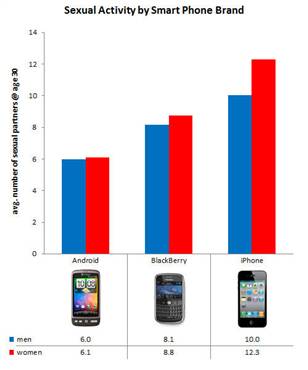
Another reason to get an iPhone
Wednesday, August 11th, 2010iPhone users get laid more often.

iPhone users get laid more often.

My good friend Doug Hackney emailed me this story. It seems that in Ottumwa, Iowa, where he was born, the town hopes to rebuild its economic prosperity off its new self-proclaimed identity as home to the “International Video Game Hall of Fame.” What is the linkage between Ottumwa, Iowa and video games? Nothing. There is none. Where will the funding come from to build what board vice-chair Dan Canny calls “the most complete archive of video-game history” in this city of 25,000 people? No one knows.
This is a cautionary tale, a parable for our immediacy if we don’t reclaim the aspirational future America has always pursued. Where middle America once produced things, now we produce a lust for the past: reliving the heyday of Donkey Kong and Pac-Man and Defender.
Something else Mr. Canny misses is this: When he quotes the “$58 billion global gaming industry,” that is apportioned toward two streams: platform games like “Marvel Ultimate Alliance” and “Gears of War” that are played at home on console units; and freemium games on social network sites, most especially Facebook, but also on mobile devices. His hall of fame — to games from the early Reagan era — has no relevance to that industry. And the people who actually work in that industry have no interest in these “Back to the Future” games — they weren’t born yet.
You can’t build the future by focusing on the past.

What we have here is an ad for Starbucks Coffee ice cream, “coffee free.”
Three questions:

Earlier today my friend Max Sparber put this lyric on Facebook, in response to the story of Steven Slater, the JetBlue flight attendant who quit his job after getting assaulted by a passenger, and who then grabbed a beer, opened the cabin door, and slid off the plane:
THE BALLAD OF STEVEN SLATER
Ain’t we all had a day
When we just had enough
Ain’t it true each one of us
Has been battered, worn, and rough
Ain’t you never felt irate
And won’tcha get irater
Well, my friends, we have a hero now
I speak of Steven Slater
It ain’t that easy to ride the skies
Laboring for JetBlue
A man’s got to keep widened eyes
For terrorists or shampoo
And worser still are the passengers
They turn a kind man to a hater
Won’t nobody stand up to this?
One man: Steven Slater
There was a particular day
And a particular customer
Who grew abusive to Steven
when he instructed her
She was endangering herself
And he didn’t care to debate her
And all at once she struck his head
She struck at Steven Slater
Some will say he made a scene
Or it was a crime
But Steven he had had enough
And if he has to, he’ll do time
Perhaps it’s great to keep your cool
But sometimes it is greater
To bid one final fuck you too
As did Steven Slater
He cursed her on the intercom
So that everyone could hear
And he then bid his adieu
And he grabbed himself a beer
And threw open the JetBlue door
With an escape slide and its inflater
And he slid down, drinking, shouting fuck you
Our hero, Steven Slater
The police they went after him
They caught him in his bed
He was supposed to finish work but he was
In flagrante delicto instead
A hero and a lover now, not a
Circumnavigater
Say what you will, but tip your hat
To a man who had enough
A man named Steven Slater.
To which I responded: Truly, Steven Slater will be the D.B. Cooper or Jesse James of our time. (Except: worse getaway.)
It didn’t take long for my prediction to come true. Here he is, mere hours later, getting lauded as a “working class hero.”
How long will his 15 minutes last? It depends upon the popularity of the reality TV show sure to follow, and the surrounding social media. And how quickly someone else with an equally interesting story zips into view.

As soon as you take a hiatus — as I did recently for two weeks, partly for reasons I’m hoping to blog about tonight — here’s what happens: Your readers leave. (Mine came back, by the way, and thank you.)
One more reason to hope that California voters reject Carly Failorina: The U.S. Chamber of Commerce has endorsed her.
This is a group that is so strident in its opposition to emissions control and even to acknowledging the reality of global warming that Apple, Nike, and other major corporations have famously quit it. In other words, all of Carly’s old pals in the tech sector don’t believe anything the U.S. Chamber says — and neither should we.
This line from a story on LATimes.com, about the reissue of Terry Zwigoff’s exemplary documentary, “Crumb,” caught my eye:
“A habitual crank with a pronounced antisocial streak and an aversion to mainstream culture, the director Terry Zwigoff has one of the most distinctive sensibilities in American movies.”
The rest of the piece goes on to refer to Zwigoff as someone bethrothed to non-mainstream culture; by extension, Crumb is discussed as someone outside the mainstream. I read this and wondered, does R. Crumb truly qualify as outside the mainstream?
Given this fantastic success, including the sort of success that most matters in the U.S. — financial — one has to ask, what does one have to do to be mainstream? At one time, the response might have been: appear on a sitcom. But as all mainstreams have splintered into niches, as the broadcast network triumvirate has subdivided into the limitless choices offered by satellite and cable, when shows like “Aqua Teen Hunger Force” and “Ideal” and “The Whitest Kids You Know” are able despite rather small audience numbers to to draw enough sustenance to survive, then the idea of “normal” has left the room.
So why is Crumb, for all his obvious success and enormous cultural impact, still regarded as outside the mainstream? Because 40 years ago, that’s how he seemed. When the counterculture got covered by the mainstream, when straitlaced organs like Time magazine dropped in on what was happening in Haight Ashbury, they said Crumb was out of it. And he was. But that was 40 years ago. The culture has changed. Many of the topics reserved for adult-oriented underground comix are now laugh lines on everyday TV. Given that, Crumb is the new normal.
For the past couple of hours, I’ve been having a discussion over on Scott Shaw!’s Facebook page about the relative merits of Stan Lee, not as an influential cultural force, but as a person. It started with this wall post from Scott: “I’m beginning to perceive many similarities between Stan Lee and William Shatner.” People started enumerating the similarities:
And then we came to this one, from Scott: “Apparently unaware of former co-workers’ resentments of ’em.” This was after Scott had mentioned working with Stan. So here was my reply:
“Scott, did Stan later take your work, sign his name to it, and sell it? Just checking.”
Which elicited the thread I’m going to quote from, below. Note everyone’s discomfort. We all feel beholden to someone who was an essential force in giving us the Marvel universe we love — and at the same time we’re hoping he makes amends of some sort while he’s still here.
Scott Shaw Lee, no, Stan did not “take my work, sign his name to it and sell it”. And I don’t think he did that to anyone else, either. Stan is no angel, and I’m not in agreement with some of the things he’s done — or has failed to do — but he’s made plenty of valuable contributions to comics, that is a fact.
Lee Wochner Scott, specifically what I’m referring to are the prints by Kirby or Joe Simon, without their signature, that Stan is signing for money. I had heard about it — and then I saw them at the Con. It just doesn’t feel (or look) right.
Scott Shaw I was completely unaware of that, Lee. I’d like to learn more, if you could please direct me…
Lee Wochner Scott, I just sent you an example. It doesn’t feel good to criticize Stan Lee — one of the formative writers of my life (with Jack Kirby) — but the relentless profiteering and the diminished recognition of the contribution of others doesn’t feel very good either.

Here’s the image I sent to Scott. Note the “Official Certification” of Stan Lee’s signature. See anyone else’s name on there — like Jack Kirby’s?
Lou Mougin Stan may not be perfect…who is?…but by all standards, he seems to have been a heck of a good guy to work with, and when you compare him to guys like Mort Wienieburger, Jim Warren, and some of the others of that time, who would probably have had your b*lls for breakfast if you disagreed with them…he comes off pretty well.
about an hour ago ·
Dean Griffith Stan Lee seems like a okay guy..I just don’t like the fact that he acts and gets treated like he is the only one that created EVERYTHING at Marvel
about an hour ago ·
Thomas Shim He really should give more credit to less self-promoting talent, tho. Then again, history is rife with this kind of dichotomy: Disney & Iwerks, Ruth & Gehrig, Jobs & Wozniak, Gates & Allen. The list goes on (in various degrees of analogous appropriateness.)
about an hour ago · · 1 personLoading…
I read an interview with John Romita Sr once, and he came off as a very honest & even-handed fellow. He said something like, in regards to Kirby/Lee creations, that it was impossible to overestimate the important contributions of both men, …that the one couldn’t have accomplished what he did without the other. Same goes for Ditko. And then when you think of the not-too-shabby work with Heck, Everett, Romita, Colan, Buscema, Severin, Kane, Trimpe, etc etc (names that were never hidden), I think it’s silly not to regard Lee as a great creative figure in comics or pop cultureSee More
54 minutes ago ·
I know this sounds weirdly ass-kissing, but I truly believe that Stan doesn’t realize the damage he’s contributed to in regards to his creative partners over the years. Maybe it’s living in the Depression, maybe it is unethical, but I find …it hard to believe that such a nice, talented guy would intentionally screw his partners. Yet I wince (or worse) every time I see he’s allowed someone to give him sole credit for a character or concept rather than correcting them. On the other hand, I’ve never seen Stan so pressed for a straight answer about the creation of Spider-Man in IN SEARCH OF STEVE DITKO, and he seems absolutely honest in his opinion…one I wouldn’t agree with, by the way. Stan is a real enigma, but I find it impossible to vilify him completely. I guess I just want Stan to become the TRULY good guy he thinks he is…because I know that deep inside he really IS a good guy who’s let his “survivor” instincts get out of control. I just can’t help but admire Stan Lee on creative and personal levels.
50 minutes ago ·
Lee Wochner I don’t think that anyone here is minimizing the contribution of Stan Lee. The operant question is: Are the contributions of his collaborators being fully recognized? Kirby seems to have created an entire cosmos (or three) on his own, without any assistance from Stan Lee. Could Stan Lee have (co-)created the Silver Surfer, Galactus, the Inhumans, Asgard, Wakanda, etc. etc., without Jack Kirby?
49 minutes ago · · 1 personLoading… ·
Lee Wochner And I agree with everything Scott just posted.
48 minutes ago · ·
And would add: Just because someone truly, really, believes something to be so — that doesn’t mean it is so. Stan is in denial. The recurrent picture of Stan Lee in Dan Raviv’s book “The Comic Wars” is of someone blissfully ignorant of how he’s accepted credit he shouldn’t have — and even of how people sometimes act badly. Sample line: “Even though he was a master of heroes and villains, Stan Lee was reluctant to think of anyone in the bankruptcy fight as the bad guy. ‘I liked (Ron) Perelman and I liked Bill Bevins,’ he said. ‘I really wanted it to work out for them. … Bevins asked me, ‘How much money are you getting now?’ I told him, and right then and there he made it three times as much!'” Read between the lines: Bevins is a good guy — because he offered Stan three times as much right off the bat. No other consideration came into effect — including which owner would serve Marvel (and Stan Lee’s legacy) better. Does this make Stan Lee a bad person? No. Does it make him someone with an unknowingly self-serving point of view? You be the judge.
40 minutes ago · ·
Lee Wochner And now I guess I’m done. Because I’m really not having any fun coming off as trashing Stan. I love comics, and Marvel comics, and I personally feel I owe Stan Lee a great deal. It’s just some of his behavior that deeply saddens me. I still like Picasso’s work, and evidently he was a real SOB….
39 minutes ago · ·
Scott Shaw It’s even harder when you know and immensely like Stan, who is never less than generous whenever we’ve dealt with each other. He really is a friend!
33 minutes ago ·
This isn’t the first time I’ve complained on this blog about Stan Lee’s blissful ignorance — here’s a representative post — and it probably won’t be the last. (And it’s well worth reading the comment on that post as well.) Why do I keep coming back to this? Because of my conflicted feelings. Since moving to the West Coast 22 years ago, I have run into Stan Lee probably a dozen times. Each time, even when, say, just passing by him at the Beverly Center, I feel a little twinge: equal parts excitement and regret. Two weeks ago when I was down at the San Diego Comic-Con, I was hurrying into the Marriott for a taping. (I was a scheduled interviewee for Morgan Spurlock’s forthcoming documentary about the Comic-Con. We’ll see if I make the final edit.) There was a clutch of excitement and security downstairs in the lowest level. An excited boy who looked to be about 16 turned to me and said, “Stan Lee was down there! Right there! It was Stan Lee!” I looked at him and remembered sharing that level of excitement when I was that age… and said nothing.
I have 1172 Friends on Facebook. They’re all Friends, but they aren’t all friends. How could they be? Who could possibly have time to devote to 1172 friends? But they are all people (or groups) I know. So when I agree to Friend someone, it’s because I know them. That’s my personal rule.
With “liking” — which recently replaced becoming a “Fan” — my rule is this: I click to Like if I do indeed like whatever it is. Danger Mouse, the Founding Fathers of the United States, the Duino Elegies, My Dinner with Andre — these are all things I am now publicly on record as Liking.
But now what I think I need is a Dislike button. And maybe also a Hate It button. I really want these. Why? Because United emailed me to ask me to Like them. And the thing is: I hate them. Passionately.

Why?
In June, the last time I flew United — and I hope indeed it was the last time — a long-time gate agent actually took me aside and apologized for the way company policy forced him to treat me. “I hate the way we have to treat customers now,” he said. “I think we’re ruining our business. I’m sorry.” I appreciated hearing that — but it did nothing to help me. Two months prior, I was almost stranded over night in Tucson (not a happy prospect) because they canceled my flight with no backup plan. (I booked onto another airline.)
Have I let United know about these things? You bet. Emails. Phone calls. I even sent something called a letter. I’ve gotten form replies or silence. Nobody cares.
So, when I got this lame inducement to Like United, I emailed them again. Here’s what I said: “But I HATE United. I wouldn’t Friend you if you flat-out GAVE me two tickets.”
That felt good, but it didn’t last long. I still want my Dislike button.