Lee Wochner: Writer. Director. Writing instructor. Thinker about things.


Blog

Archive for the ‘Theatre’ Category

Comic-Con 2011, day two

Friday, July 22nd, 2011

How much does Comic-Con matter to San Diego and its businesses? Here are two signs found near the restaurant in our hotel.

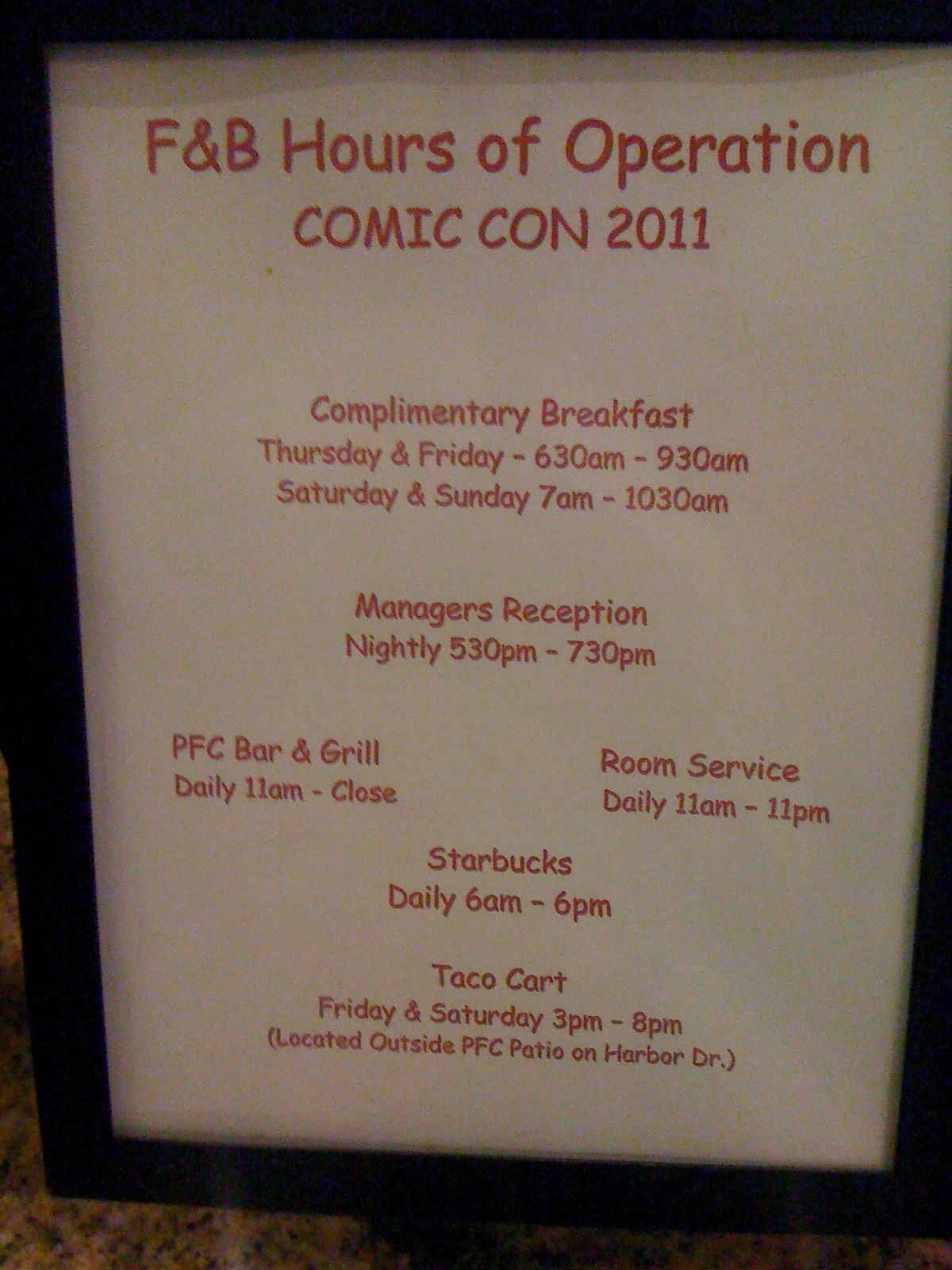
capshot1.jpg

conhours.jpg

No, I haven’t tried the Captain America shot. (Yet?)

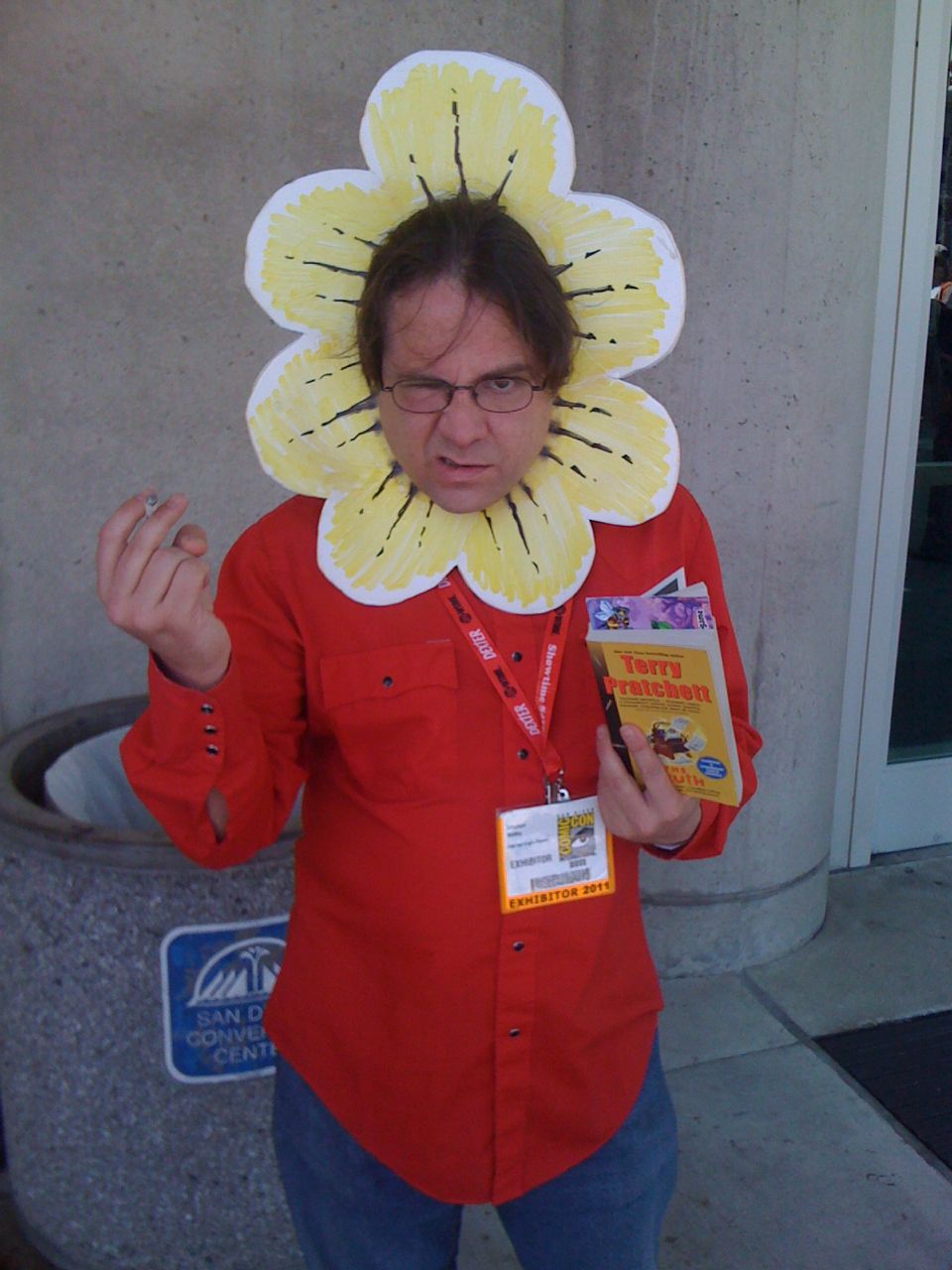
Here’s a fellow we saw standing in front of the convention center. I have no idea what his costume is supposed to be. I just liked the idea of an angry cigarette-smoking flower reading a book in front of the Con; that this guy is an exhibitor just sweetens the deal.
img_1865.jpg

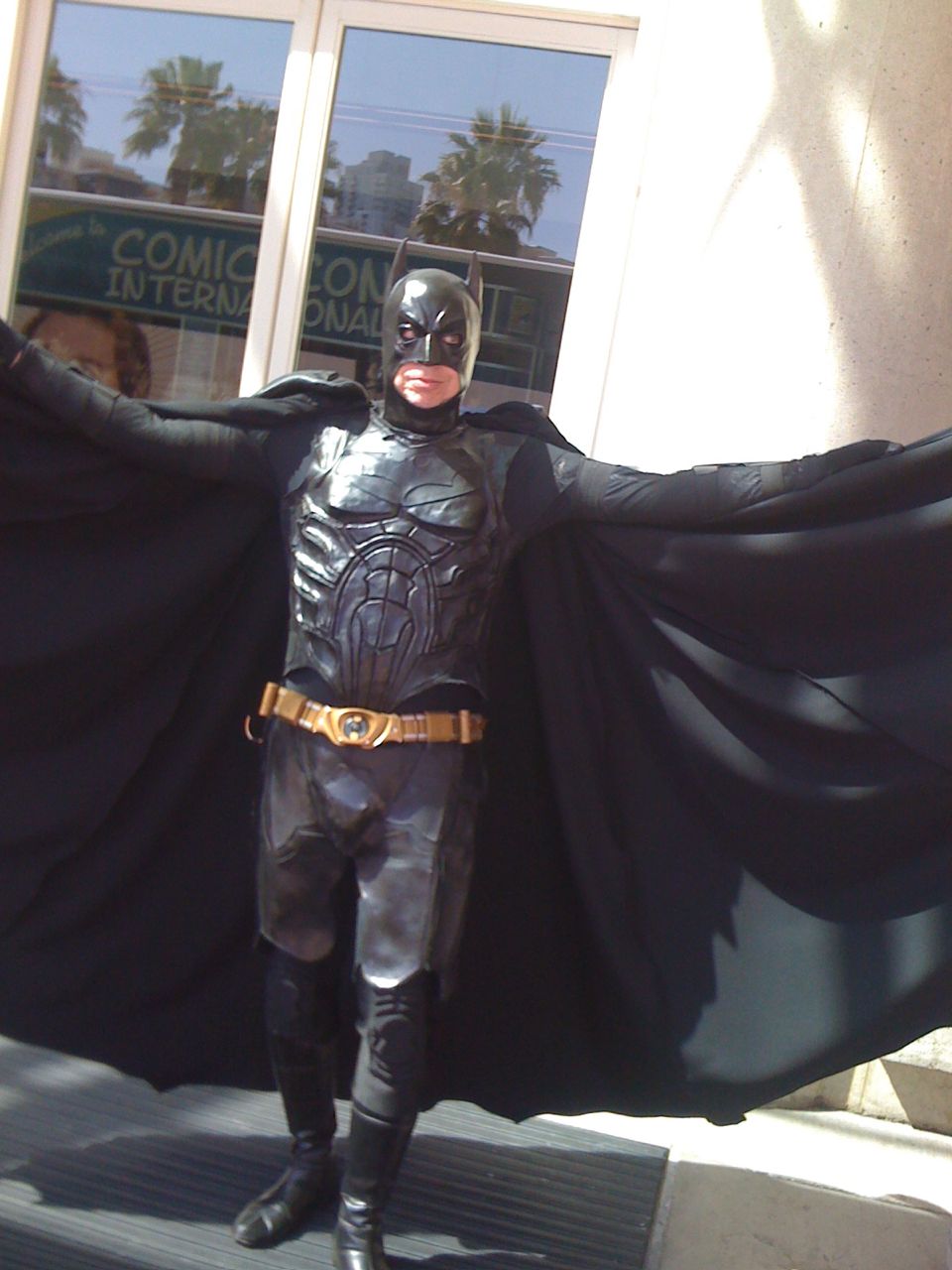
But then, you run into all types at the Con. Here’s someone you rarely see in daylight.
batman.jpg

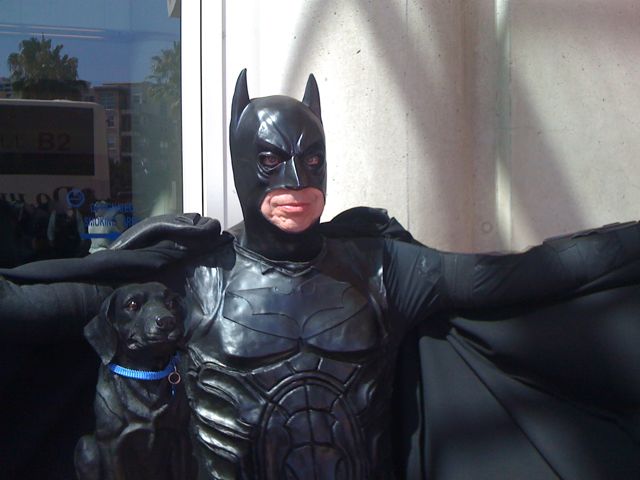
And here’s the same guy with my friend Roscoe Smith.
batman2.jpg

When I saw a panel entitled “State of the Industry” listed, I decided to go. Comic-books are an important part of my life, and for 40 years I’ve been hearing that they’re going to die any minute. (And, when you see the sales figures showing that major Marvel titles are lucky to sell 40,000 copies a month, you finally believe it’s true.) The graphic novel has led to a revival of the form, and certainly there’s money to be made in all those movie and TV properties, but I hope to keep getting those periodicals, too. So I went to the panel, and here’s what I discovered:  It was intended as a discourse between publishers’ reps sitting on the dais, and comic-shop owners, who made up the audience. It was a small room, overstuffed with perhaps 50 comics shop owners — and me, sitting quietly like a spy, the only reader in the house with no financial stake in this. Here’s what I got from it:  the publishers are going digital as quickly as they can, and the comics shop owners are very worried about this. One publisher (I forget which, but I don’t think it was DC or Marvel) couldn’t figure out why  a coupon they had made for comics shops to share with people to get them to try digital comics for free had failed; the retailers quickly let them know:  “Why would I want to get my customers to buy digital comics? What’s in it for me?” At times, the conversation was so heated I was waiting for angry villagers to arrive. The publishers were saying that readers of digital comics were a different audience, and therefore no threat, but if that’s so, someone wanted to know, why were they trying to get the shop owners to get their buyers to switch? And if they’re separate audiences, why does the last page of every Marvel digital comic have a plug for the Comic Shop Locator where you can find your local shop? Someone else complained that digital comics are 99 cents each, while the same comic is $2.99 (or more) in a shop. One of the publishers said that digital is “a very small part” of their business — and then the crowd wanted to know just how “small” a part; when the guy said 1-2%, then the retailer wanted to know if it was this insignificant, why were they devoting so much time to it? So my takeaway was this:  The publishers are heading into digital as quickly as they can, and the comics-shop owners, acutely aware of the recent demise of Borders and other bookstores, are feeling very threatened. And oh, by the way, two weeks ago I subscribed to Marvel’s digital comics; I spend about $40 a month on comics — the digital service cost me $40 for the year.

The next thing I went to was a tribute to artist Gene Colan, who died recently.  I thought Mark Evanier’s opening remarks were apt: that Gene Colan was lucky, because he lived long enough to be celebrated. Thousands of fans (including me) got the chance to tell him how much his work meant to them; he received a museum show devoted to his work while he was alive; and the next generation of editors who were devoted to his work kept him busy and respected. Marv Wolfman was also kind enough to say that he felt that it was from working with Gene Colan that he learned how to write comics. Marv was the fourth writer assigned to “Tomb of Dracula” (after Gerry Conway, Gardner Fox, and Archie Goodwin had each done two issues). There wasn’t much action in the book, which largely revolved around what would seem to be the supporting cast, making plans and deciding what to do. And while Colan could draw action (brilliantly), he also excelled at penciling highly expressive faces. This meant that Marv had to learn to write character-driven stories — and that’s what has driven his career ever since, as anyone who’s read his comics knows.

The next panel concerned the birth of comics fanzines, and included Paul Levitz (former president and publisher of DC Comics, and onetime fan editor of The Comic Reader), Roy Thomas (Alter Ego), Maggie Thompson (several fanzines, and then the Comics Buyers Guide) and others. I asked a question about RBCC, the zine that introduced me to comics fandom because the editor/publisher actually advertised it in comic-books, which was where I found out about it, and fandom. I can’t overstate the importance of this publication to me in my adolescence. Here’s what I learned about it:  The editor, G.B. Love, had cerebral palsy, and typed each issue one key at a time, and was only able to strike that key by hitting it with the eraser end of a pencil clutched in one hand. That he was able to publish that thing despite this challenge is a testament to his dedication.

Other highlights:

Terence and I went to AMC’s “Walking Dead” booth, where we found ourselves trying to get off the rooftop before the zombies broke in. As someone noted on my Facebook page, he seems awfully gleeful to be sawing my arm off. (Note Roscoe watching in the background with great alarm.)
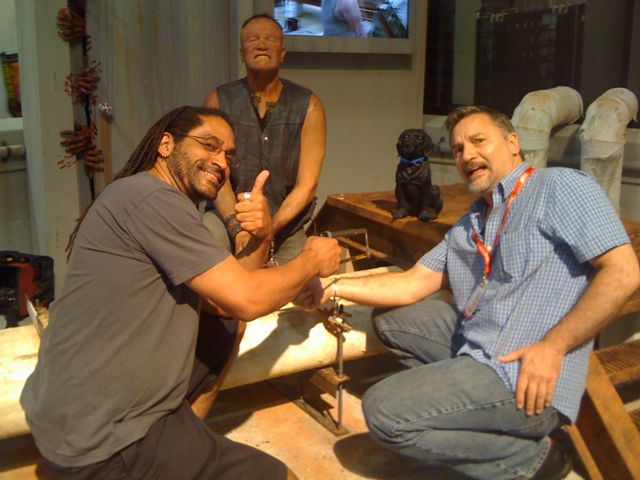
zombies.jpg

My friend Paul and I dropped in on the “Dark Shadows” panel. Like many other kids in the late 60’s, I rushed home from school so I could watch it, and was daily annoyed by the debate with my grandmother because she also had to watch another boy, a boy whose name I still remember was Glenn Jupin, and Glenn Jupin was too afraid to watch it, and I wanted to know why he couldn’t just go play in another room. (This is what life was like before DVR, DVD, and multiple TV sets.) I did watch it, and just about every day. Tim Burton is making a new version with Johnny Depp, and the crowd and I had our trepidation. (I still haven’t forgotten his take on “Planet of the Apes.”) Someone said, “I don’t want Barnabas to be Jack Sparrow with fangs.” Kathryn Leigh Scott is now 68 years old and is stunning. Maybe she really did get bitten and is immortal.

Our crowd, minus friend Larry, went out to dinner at Buster’s Beach House, where this photo revealed my son Lex’s friend Brendan to be possessed by a demon of a high order. (Sad, and a little terrifying.) Left to right:  Trey, Lex, Brendan Beelzebub, Roscoe, myself, Paul, and Terence. (Larry has been beamed off somewhere by “Star Trek” people.)
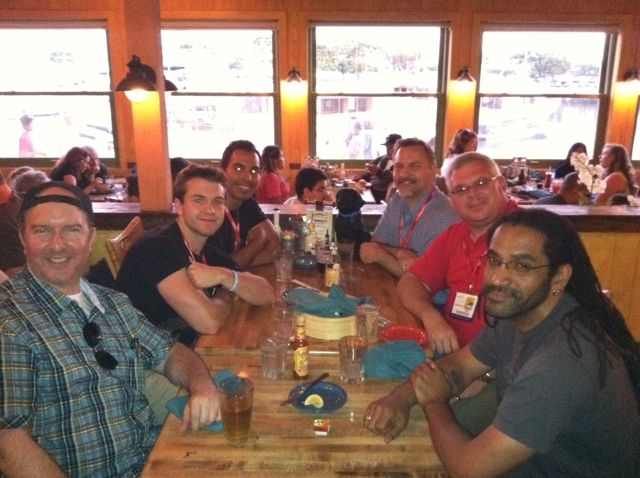
busters.jpg

After this, we went to see “The Worst Cartoons Ever” — and believe me, they qualified, hilariously so — and then the animated version of “Batman: Year One.” These two showings were on opposite ends of the convention center. Midway between them, we took this shot:
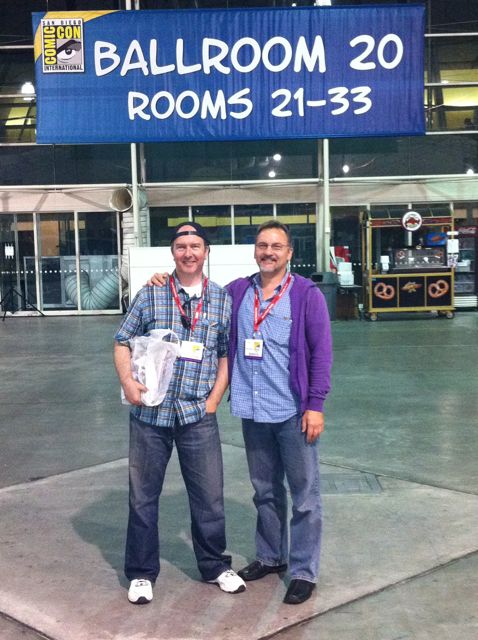
betweenshows.jpg

You will never again see the Sails Pavilion deserted in this way during the Con (picture 50,000 jammed just into this photo, and you, ahem, get the picture). It was a phenomenon, and I’m glad we captured it in a photo.

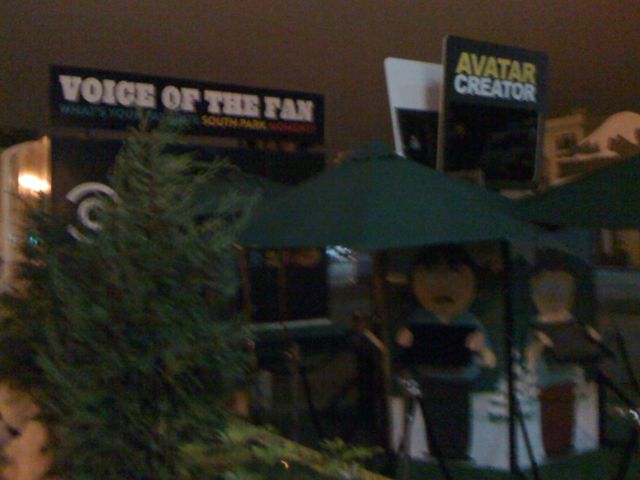
After “Batman: Year One,” which I thought was pretty good (especially enjoyed Bryan Cranston as Lieutenant Gordon), we walked past what I’m calling “South Park Village,” closed for the evening and every bit as spookily bereft as Storybookland.
img_1878.jpg

img_1879.jpg

img_1880.jpg

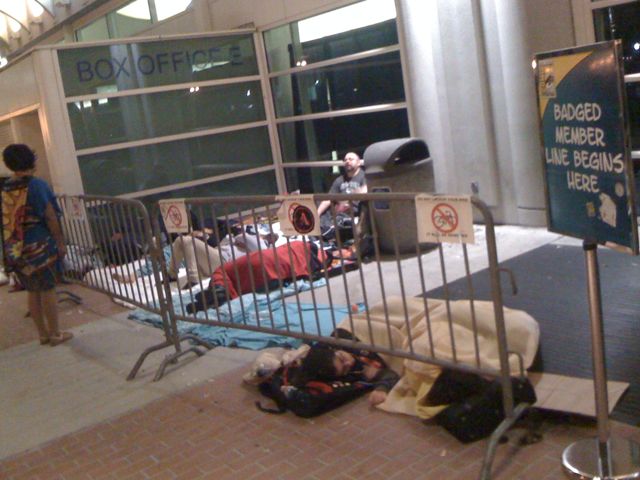
Finally, what is this a photo of? People camped out after midnight so that they can get their Con badge first thing in the morning.
campingout.jpg

More soon.

Booked out

Monday, June 20th, 2011

I just found out that while I was out of town, the bookstore where my daughter and our friend Steve and I have done Christmas wrapping for the past four years to raise money for Moving Arts… went out of business. I’ve grown to expect bookstores to close; I didn’t realize the trend was going to take our holiday traditions with it. Feels lousy.

A public service discussion

Monday, June 13th, 2011

Here’s the latest in a line of spoofs of the musical Spider-Man: Turn off the Dark. Setting aside for a moment my thoughts about the well-documented travails of that show (documented here and here and here and here and here and here and even here and now I’m thinking maybe this subject should have a tag all its own), let’s discuss something else I’m on about:  PBS.

Because I’m still trying to figure out why public tax monies are supporting, for example, Dr. Wayne Dyer.  And I remain unclear how Antiques Roadshow and its ilk serve any public need, especially given that shows very much like it are on commercial stations. But now I find that I’m turning against Sesame Street, too, because while I enjoy the clip below, I can’t find any educational justification for it. In what way is this different from things on the commercial networks Sprout or Hub? Why does it somehow make more sense to fund television programming than, for example, public education? Anyone?

Speaking of complainers….

Thursday, June 9th, 2011

Speaking of people who “in the cosmic scheme of things have no problems,” I submit the current “debate” generated by Tony Kushner, the everything-award-winning playwright of “Angels in America” and many other globally produced plays, including “Caroline, or Change,” “A Bright Room Called Day,” “Homebody/Kabul,” “Slavs” and “The Intelligent Homosexual’s Guide to Capitalism and Socialism with the Key to the Scriptures,” which is currently playing off-Broadway. Evidently in a recent interview, Kushner said in passing that “I don’t think I can support myself as a playwright at this point. I don’t think anyone can.” Which ignited this controversy.

While I know that they are rarer than a royal flush, I have met some wealthy playwrights, including Stephen Sondheim and Edward Albee, and got to know one of them somewhat well, Jerome Lawrence. Jerry and his writing partner Robert E. Lee were responsible for “The Night Thoreau Spent in Jail,” “Auntie Mame” (which led to their further hit adaptation, “Mame”), and “Inherit the Wind.” Each of these was wildly commercially successful. From its premiere in 1955 until at least the early 1990s, there wasn’t a day that “Inherit the Wind” wasn’t in production somewhere in the world. Judging from his house alone, which Jerry had built on a bluff with a three-quarter view of the Pacific Ocean, the UPS man was arriving every day with boxes of more cash.

Granted, times have changed. But on the face of it, the idea that Tony Kushner can’t support himself as a playwright is ludicrous. His plays are in constant production around the world, his lecture fees are noteworthy, and I imagine he’s received any number of awards, fellowships, scholarships, and distinctions, that come with monetary rewards. (Note that I’m leaving out his screenwriting career.)

Kushner’s complaint strikes me the way movie stars do when they say about a pet project, “I did it for nothing.” What they mean is: They did it for scale (which every actor I know would be delighted to get), and for back end (which almost no actor I know gets). Jerry Lawrence was a playwright, not truly a screenwriter (although he had credits there as well), and made millions upon millions from his plays. Given all the productions “Angels in America” alone had, including the current one, plus all the productions from his other plays, plus print royalties, plus lecture fees (which are part of being a playwright), I find it hard to believe he can’t make a living. Perhaps what he means is that he can’t make the living he’d like to; that’s a different matter, and to that I’d note that I’ve yet to meet anyone, from my low-wage theatre friends to the two billionaires I’ve met, who felt they should have less.

After I posted this sentiment online, someone else weighed in with something even more to the point: “He can’t make a living as a playwright and he’s surprised? This is a joke, right? I once helped Tony Kushner move a daybed that he bought in Austria for $10k. I wouldn’t lose any sleep over his checking account or how he manages to pay his bills.”

Exactly right.

Hearing the things you say

Thursday, June 9th, 2011

I haven’t posted on here in so long that for a moment I was afraid I’d forgotten the login.

Not sure why I’ve been absent. I last posted just before leaving for the Great Plains Theatre Conference, and I guess 10 days of constant talking and writing left me talked-out or something. At the same time, I’ve been stockpiling some things I did want to post here, so expect more frequency going forward.

While in Omaha, I led two playwriting workshops; served as a panelist on I think six plays; attended evening play performances; attended rehearsals and tech for my play, as well as the performance; and participated in the requisite bouts of drinking and cigar smoking.  I also petted a friend’s pet piglet (and here’s that photo):

leewithpig.jpg

I know — it’s difficult to see. That’s because my friend Max Sparber decided to get arty with the photo.  I guess that with photography, arty means you can’t see what’s in the photo.

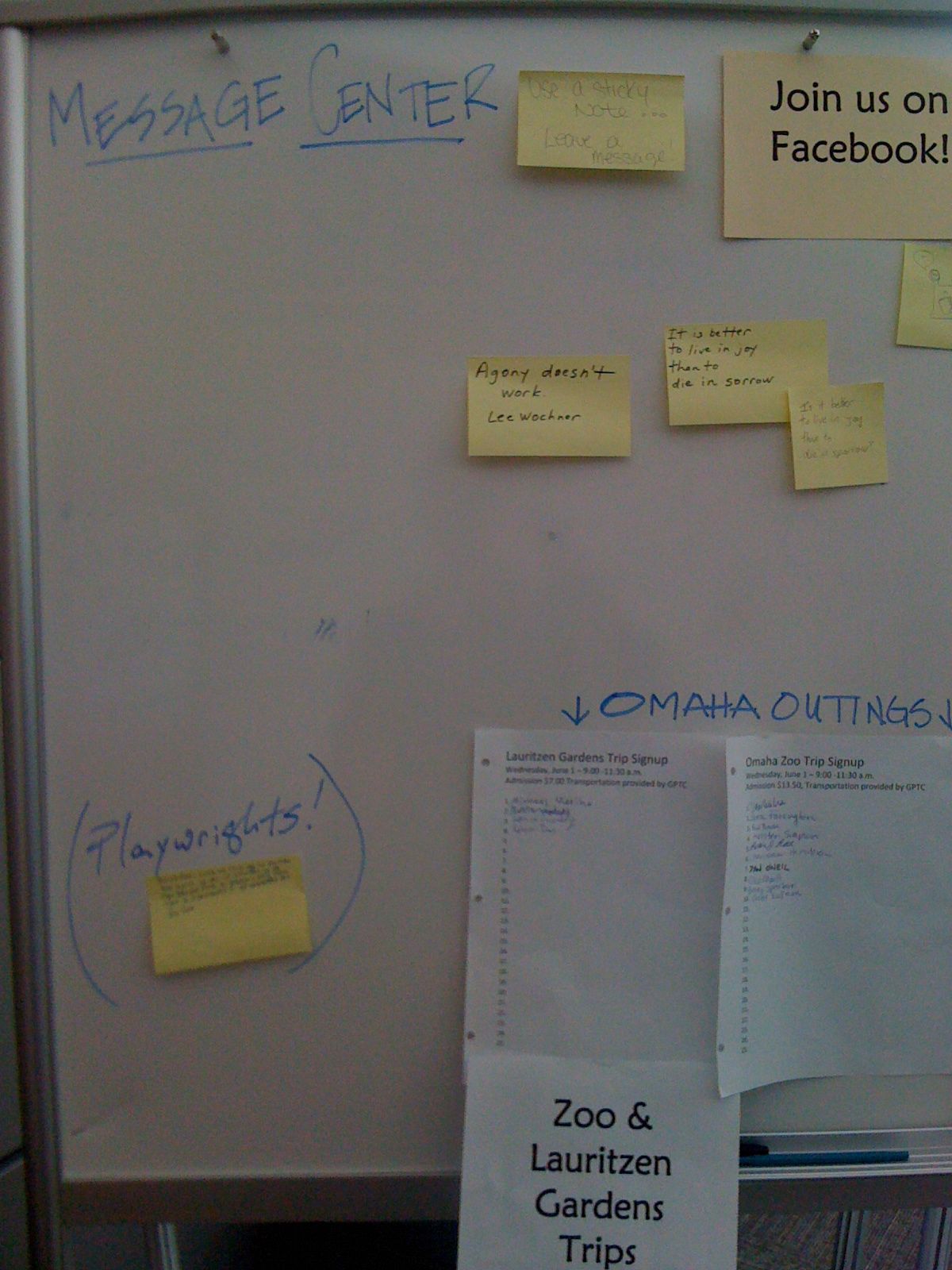
With all that walking around teaching and talking, you’re bound to say a few things over the course of 10 days. I’m pretty sure that in one of my workshops, “Starting at the Start,” I advised people to stop worrying about it and just write. I’m pretty sure I said that because I always say that, and for two reasons:  1) whining and complaining drive me crazy and I’m especially tired of hearing it from people who in the cosmic scheme of things have no problems; and 2) it’s unproductive. Whereas freeing yourself to just write, and edit later, often leads you somewhere good. Perhaps I stressed this philosophy of mine even more than usual, because here’s the quote I later saw posted on the conference whiteboard:

omahaagony.jpg

In case you can’t quite see that, it say, “Agony doesn’t work. Lee Wochner.” So I got quoted. At first I wasn’t sure what to make of this, but then I figured that since I evidently said it, I must agree with it. I thank the anonymous person who posted it, and wonder if it was intended as further inspiration to others, a reminder to himself, or a combination of both.  Or, since the message stayed posted for the remaining eight days of the conference, maybe no one bothered to notice.

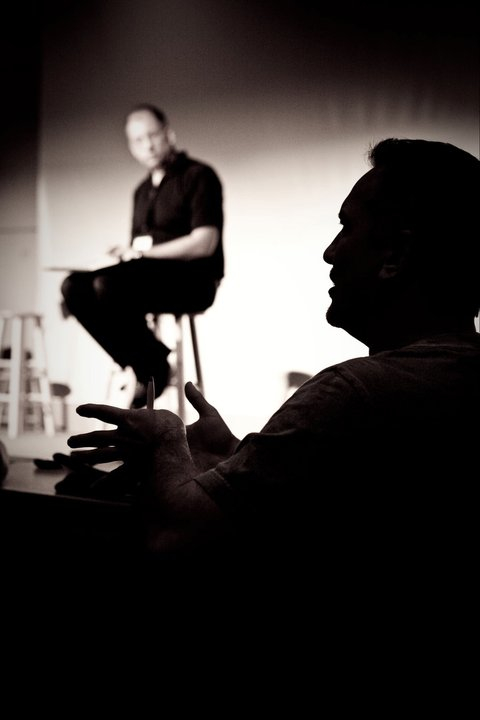
Courtesy of the conference photographer, here’s a photo of me in my official duties as a panelist, giving post-show feedback to a playwright. Note again the arty photography that inhibits seeing what’s in the photo.

leepanelist.jpg

A playwright in my workshop in LA saw this on Facebook and said I looked “very Citizen Kane-y.”

And evidently I said this, which I saw on Facebook because the playwright tagged me:  “Do what you want to do. You can have all your careers. Just make sure they’re all creative. – Lee Wochner.”

Yes, I remember saying this, and I think it was on the first bottle of wine. This was probably part of my discourse that we should “plan to live to age 120,” built around a speech I attended last year given by an osteopath, the gist of which was that because we can successfully replace more and more body parts, we should all make plans to be here a lot longer. (This did indeed go into my planning: I’m trying to get rid of things at an even greater pace, now that I understand just how long they’re going to be weighing me down.) Mostly, though, I was inveighing against pigeonholing; this young woman was concerned that people were trying to fit her into a specific box. Barring that mythic bus that may strike each of us out of the blue at any moment, we’ve all got plenty of time and options.

I left the conference on Sunday, and have been in southern New Jersey staying with my mother and family since then, at a low bubble in the local heat, humidity, and troublesome flying insects. More to come about the conference and other things soon. Right now I’m hearing myself say that it’s time to go back outside.

Scheduling rehearsal

Monday, May 23rd, 2011

I’m extremely scheduled. It is not my favorite aspect of my life. But when people ask me how I manage to get so much done, I have an answer:  I’m scheduled.

Last week I promised someone that while I was in the area on Saturday, I’d stop by her new coffee bar to sample the coffee. Which I did. Because I put it into my schedule, and my iPhone reminded me.

How do I remember to pick up my 8-year-old from school? It’s in my schedule. (And woe to me — and the kid — if I ever lose the phone. I hope he’ll have enough snacks for overnight.) Haircut? Concert? My wife’s work schedule? Even something as simple as “Get up”? They’re all in my schedule. As I said, I’m not proud of this.

Here’s what’s not in my schedule:  my memory. Because  tonight at five minutes before 7 p.m., there was a ring at my door and I greeted the nice theatre people outside this way:  “I thought we said 7:30.” And yes, I felt pretty crummy the moment I blurted that out. At the very least, I could have said hello first. To make it worse, it was correct in my schedule (and wrong in my brain), because there it was in my schedule that tonight’s rehearsal was set to start at 7 — and it’s Wednesday night’s rehearsal, for a different play of mine, that was scheduled to start at 7:30.

So now I have to put something new in my schedule:  “Remember to read schedule before making ass of yourself.”

UCLA half-dead

Friday, May 20th, 2011

This time last year I was bemoaning what had been done to the UCLA Live program, beginning with the termination of the theatre programming and culminating in a parting of the ways with its visionary director, David Sefton. Since then, I’ve seen scattered events and haven’t been impressed.

Today I got the new UCLA Live catalog in the mail.
It’s a disheartening document.

There’s not one must-see event.

David Sedaris. Again.

A silent film. Again.

The same mixture of “roots” music and world music, jazz, and classical. Again.

Some dance. Again.

No theatre.

The best series in LA has become the blandest series in LA. Yes, I’d like to see They Must Be Giants. Yes, I’d like to see Joan Didion. But that doesn’t make a series. Those are isolated events — and they’re interesting, not provocative. Not thrilling.

Here’s what we used to get:

The Berliner Ensemble’s “Arturo Ui.”

David Thomas, Pere Ubu and “Disastodrome.”

Socìetas Raffaello Sanzi’s “Genesi:  From the Museum of Sleep.”

Merce Cunningham and UCLA Dance doing some strange collaboration with the ghost of John Cage.

“Shockheaded Peter.”

“The Black Watch.” Which I didn’t even like — but I respected it.

Now we’ve got as little as they can afford, or conceive. Or both.

Really really sad.

UCLA Live’s new executive and artistic director, Kristy Edmunds, starts in the fall, and, as this recent dance review in the LA Times mentions, it’s not a moment too soon. Audiences have abandoned the series, and that includes me.

“Jersey Shore” gone (Oscar) Wilde

Wednesday, May 11th, 2011

Proving once again that theatre is indeed popular entertainment, just gussied up.

Summer theatre

Monday, May 9th, 2011

Courtesy of the New York Times, here’s an overview of significant offerings on stages across the U.S. this summer — including an offering from my theatre company, Moving Arts, as part of the Radar L.A. festival in June. More on that to come later.

Sitting in judgment theatrically

Friday, April 22nd, 2011

Two or three times a year, I get called upon to judge theatre competitions of varying sorts. This year, I’m one of the readers for the PEN USA literary awards, which is always an honor. And this Saturday evening, I’m a judge of this playwriting and performance event at the Secret Rose Theatre. It sounds like a lot of fun. If you’re around, stop by.

I have mixed feelings about contests, awards, and prizes. In grad school, one of my playwriting professors, Jerome Lawrence,  told me he was against writing contests because it pitted writers against writers. I understood his point of view (and that’s an indication of just what sort of a guy Jerry was:  generous beyond measure), especially as someone who at that time had already been on both sides of prize-winning — winning one when I wasn’t sure my play was the best, and losing the same contest the next year when I was sure mine was. Especially when there’s a performance element in judging  a playwriting contest, a lot rides on elements outside the playwright’s control:  How responsive was the audience on the judging night, how “on” were the performers, was it too cold or too hot in the theatre, how was traffic on the way there, was the box office friendly or surly, and so forth.

At the same time, believe me when I say I understand the marketing value of winning any contest or award (and, sometimes, the prize value). I don’t care which movies have won which awards, believe me (especially when  it’s a system that awards “Best Picture” to “Avatar”). But do awards build careers, and would I put the full thrust of marketing and PR behind any awards won? You bet.

There is a story — and I don’t know how reliable it is — that, 40 years ago, the Nobel committee was deadlocked between giving the award for literature to either Samuel Beckett or Eugene Ionesco. Finally, after much deliberation, one of the Ionesco champions who felt that Ionesco’s work had a broader scope than Beckett’s (and there may be something to that), switched sides to end the deadlock. And so:  Samuel Beckett won the Nobel, and Eugene Ionesco never did. Is the work of Beckett, the Nobel-prize-winning writer, better than that of Ionesco? Beckett has become far more deeply rooted in the cultural consciousness — referenced in “The Simpsons,” name-checked on “Quantum Leap,” parodied on Sesame Street — and a lot of that came from winning the Nobel.