Some Halloween inventiveness
Wednesday, November 1st, 2006See? This is what I’m talking about!





See? This is what I’m talking about!
The other night my son Lex and I went to see “The Prestige,” which we enjoyed greatly. On the way to the movie, I said to him, “It was written by Christopher Priest, a comic-book writer.” I recounted for him some of Priest’s comic books, most notably Black Panther.
When the credits rolled on the movie, I was surprised to see that Priest had not in fact written the script; rather, the film is based on the novel by Christopher Priest. Hm. I didn’t know that he was a novelist, but he most certainly was a scriptwriter, so why hadn’t he scripted it? And when had he become a novelist?
At home, still puzzling this over, I jumped on the internet and found Priest’s website. The site seems equally devoted to three areas: comic books, beautiful nude black women, and a religion he has joined. I share his interest in two of these things and, because my tastes are catholic I am completely nondenominational. It doesn’t matter if you’re focusing on Marvel or DC, or Asian or caucasian or Latino, etc. They all have their place.
(And I’m sure that right now every friend I have is clicking through to that website.)
In reading Priest’s lengthy bio, which stretches back into the 1970’s at Marvel, I started to feel that something was odd. After all, who was Christopher Priest? In my mind he was a guy who had started writing comics just over 10 years ago — that’s when I first noticed him anyway, and I’ve been reading Marvel comics since Stan Lee was personally writing them. How could he have been writing all these Marvel comics without my having noticed?
Then I come to this paragraph: “It was about this time Jim Owsley became Christopher Priest. He never discusses the true reasons behind his name change, but insists every story you may have heard about it is absolutely true.”
Then, after Googling “Owsley changes name to Priest,” I discovered that there was another Christopher Priest, also a writer, and also a writer in genre (science fiction). I read a bit about the controversy, then found this, from a guest-of-honor speech to WorldCon in August, 2005, written by the “original” Christopher Priest:
A few years ago I discovered that a young comics writer called James Owsley had changed his name to mine. It was a deliberate act, and he knew of my existence. The only reason he’s ever given in public for this irrational act is his belief that the name “Christopher Priest” is cool. In fact, he said “co-o-ol.” At first I thought it was a joke, then I thought it must be an error, and then at last I thought it was time for me to do something. When I contacted his publisher, an Owsley enthusiast called Brian Augustyn, I was told that the decision was made. It wouldn’t now be reversed, and it was “Chris”‘s inalienable right to call himself anything he liked. I should, in fact, praise the Lord for the good fortune of being born with such a co-o-ol name. When I pointed out, with good reason, that the worlds of science fiction and comics are perilously close to each other, and often confused with each other in the minds of certain people, I was told that the sheer excellence of Chris’s writing would permanently set him apart from everyone else. Including, presumably, me.
Since then, “Chris” and I have been regularly and routinely muddled up with each other. Enter my name in Amazon.com and you’ll see what I mean. A search in Google, or any other search engine, produces the same result. I often receive e-mails intended for him — I assume he often receives mine.
So without much effort this impostor has been not only irritating but seriously annoying. For several years I tried to take a tolerant, amused line on the problem, thinking that he’d get tired of the gag after a bit, but he shows no sign of it. Now, twice in the last twelve months, I have heard comments that publishers have had unpleasant experiences working with “Christopher Priest” and don’t want to work with “me” again. So as well as him being irritating and annoying, his professional incompetence is damaging me.
I’m not amused any more. My message is this. If you hear my name mentioned in any context, please remember what I’ve said and ask yourself if you’re sure which one of us it is. Beyond that, if anyone here has the least influence on him, please use it.
I don’t bear him any ill-will. All I want him to do is change his name back. He’s done it once, so there’s no great difficulty in doing it again. In fact, I suggested this during my conversation with his publisher. I even proposed a new by-line for him. I said, “Why doesn’t he call himself … ‘Harlan Ellison’?”
Mr Augustyn said, “That’s not a co-o-ol name.”
Then I went to bed.
In the morning, wanting to learn a bit more about “The Prestige,” I dropped “Christopher Priest” into Google again and found this site. And as soon as the photo of a blue-eyed white man came up, I finally discovered that “The Prestige” was written not by the comic-book writer but was based upon a novel by the British author — and that said British author is entirely correct: People are going to confuse the two of them. I had — for days.


The photo on the left of the comic-book writer Christopher Priest is the only one I can find on the web. The photo on the right of the rather haunted-looking Christopher Priest is liberally applied — perhaps in an effort to distinguish himself from the other Christopher Priest.
If you were a somewhat unknown writer who had struggled all his life to make a name for himself and had lately seen it coming to fruition, gaining guest of honor status at the world’s foremost science fiction convention, having your novel turned into a film as good as “The Prestige,” how would it feel to find yourself being confused with another genre writer who had taken the same name as you, and seemingly while knowing of your existence?
Years ago I discovered another Lee Wochner on the web. This Lee Wochner was Leland P. Wochner, he lived in Illinois, he was 70 years old — and he was a plumber. Not a writer. I remember the relief in discovering this.

Mark Chaet sent this in. Make me wonder just what he was looking for that led him to this….
It also makes me realize: these zombies are seeking the essential one thing they don’t have (a fully functioning brain — which doubles as housing of the soul, life force, personality, and so forth). Now, they say they want to eat them — so once they get what they seek, they’re using it for impure purposes. They don’t realize that their expressed desire (to get brains to eat) does not reflect their true desire (to be alive again).
So what is this? Another good example of subtext.
 A nifty little piece in today’s LA Times about Battlestar Galactica and its fictive relationship to the Iraq war (and others). There’s nothing revelatory in it — and you’d have to be flatlined not to get the obvious parallels in the storylines — but it’s worth reading if, like me, you’re drawn to the basic survivalist theme of the show: How much will you sacrifice to survive, and what must you never sacrifice in order to save your humanity?
Friday night’s episode was especially gratifying for two little bits of character work: Tigh’s poisoning of his own collaborationist wife, and Thrace’s reaction when she learns that her “half-Cylon daughter” isn’t actually hers at all.
The former was expected; the resistance had provided exactly what the colonel needed (an obstructionist mission that kept him off the sauce and on-goal). But Michael Hogan’s portrayal was beautiful and moving in depicting just how much the colonel was giving up by putting down his leggy blonde wife: given that his post-torture character is now a lame one-eyed old wretch, it’s doubtful there are many romantic relationships in his future.
Perhaps even better was Katee Sackhoff’s response when someone else on Galactica thanked her for having rescued her child, which Sackhoff’s character had thought was her own. Her expression in handing over the little girl was a rolling tableau of shock, hurt, and humiliation. I used to see that face on people in bars just before they threw up in the parking lot.
The past several months I’ve been watching apocalyptic disaster films with my four-year-old son and eight-year-old daughter. We started with “Last Man on Earth,” in which Vincent Price stars as the eponymous enemy of vampiric zombies (or zombie-like vampires) who slowly and ineptly stalk him at night. For the kids, the most memorable part is when Price finally finds some companionship in the form of a bedraggled poodle — until he discovers that said poodle is also infected and he has to put it down. (My daughter especially seems to think the movie is about the poodle.) On a scare level, even given that the film features nominally flesh-eating undead, the film rates a zero even for young children, who endlessly roam the house muttering, “Morgan… come out…” in a caricature of one of the scenes.
After we had exhausted the charms of this odd little film — in the end, Price winds up battling what seem to be mutant humans who are introduced far too late — I figured we’d move on to “The Birds.” Still somewhat scary, still in a sense apocalyptic. Not having seen “The Birds” in 30 years or more, I had forgotten two things:
Still, for that brief period of the movie (half an hour?) when the birds are truly on the attack, the kids (this time including my 15-year-old son) were held in its grip. Apparently, birds can kill schoolteachers, pluck out farmers’ eyes, peck through roofs, blow up gas stations and, I guess, if truly pissed, unleash a torrent of birdshit all over you. All of this made an impression.
What is more powerful than flocks of antagonistic birds? Try a swarm of killer bees, as seen in “The Swarm.” This time, there was action throughout, starting with the murder-by-bee of a picnicking mother and father while the son helplessly watched from within the car. Now the kids were riveted. Bees are evidently far more destructive than zombies, birds, or whatever election horseplay Karl Rove can cook up: Bees can derail trains, blow up nuclear power plants, and decimate Houston.
So, what’s next? We watched “The Omega Man,” but this didn’t go over so well, I think because of the testosterone-amped Charlton Heston’s character. After the relatability of Vincent Price’s zombie chores — find them, stake them, haul them to the dump, burn them, much like cleaning the kitchen and taking out the trash — Chuck Heston’s zombie war was clearly high fantasy. It just didn’t carry the threat of dad getting really mad.
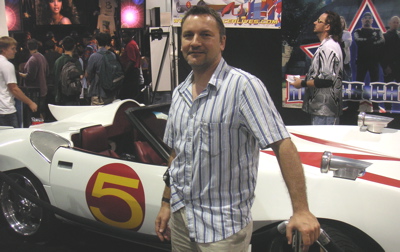 So lately we’re watching “Speed Racer.” For one thing, since the lease on my Mustang is up, I think it’s going to be my next car. For another, Spritle and Chim Chim are clearly the heroes of the show — something my kids relate to. (While they don’t hide in the trunk and jump out at key moments to save their older brother, they do like to get into my wife’s minivan through the hatch.)
Once “Speed Racer” is exhausted, I think we’ll move on to other forms of disaster movies, starting with “The Poseidon Adventure.” Or, if we want to see a disaster of truly magnificent proportion, we’ll just rent the recent remake.
Think it’s obvious what you’re saying (or writing)? Read these instructions for surviving a terrorist attack.
 After a rehearsal run-through for my play “All Undressed with Nowhere to Go,” the director gave the actors notes. Insightful, intelligent, penetrating notes that impressed me and made my head spin. Then he turned to me: “Anything to add?”
I looked up and said to the actors, “Do it better.”
And y’know what? Next time — THEY DID. Maybe that’s all they needed: “Do it better.”
I said it on a lark — and it got a big laugh (the desired response) — but it worked. Sometimes we need to know what “better” means; we need more guidance. But other times, we only need to hear that whatever we just did didn’t work and we need to do it better.
I know I have that feeling often when I look back on what I’ve written. “This could be better,” or, more often, “This needs to be better.”
And then I do it better.
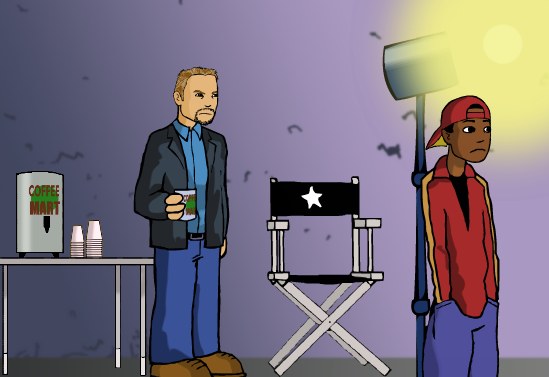 Whereas in times past I may have acted cartoonishly, now I’m acting in a cartoon.