Lee Wochner: Writer. Director. Writing instructor. Thinker about things.


Blog

Archive for the ‘On seeing’ Category

Puttin’ out the Ritz

Wednesday, June 27th, 2007

A reader of this site (and, I admit it, friend and mentor) emailed me to bemoan the changes at the beloved Ritz cinemas in Voorhees, NJ (somewhat over the water from Philadelphia).

Hello Lee,
Now I know how you felt when your beloved ‘silents only’ movie house closed.  I just checked the listings for the Ritz 16 and they were gone.  Further searching revealled that a huge chain bought the theater and is making it over into a hit distributor.  Someone else bought the Philly branches and it appears that they are still doing the right thing, but ‘our’ Ritz is gone, despite claims by the new owners that they will devote two out of sixteen screens to art films.
I found a blog that had many posts from equally shocked and disheartened folks.  Some of them had attended the ‘new’ Ritz and were sadly disappointed.  There were reps from the new masters in the lobby telling people that indy films are very slow in the summer, which is why they got replaced by Shrek.  One blog poster responded with a list of 25 art flicks he saw last summer at the Ritz.  So much for that argument.
I posted, answering one question people kept raising.  They wanted to know why the new lords didn’t keep the old policy.  I suggested that, if you already buy the same eight hit movies for all your other outlets, it’s easier to add one more multiplex to that list, rather than deal with some small distributor to rent films that don’t even get advertised on prime time TV.
Anyway, I’m in shock.  I mean, the old Ritz was going to get the new Guy Maddin film.  I was looking forward to seeing it on a big screen.  I ask for justice… DENIED!

Sorry for the rant, but I feel like I’ve been kicked in the stomach.  In protest I’m going to go and re-watch my copy of Donny and Marie Osmond in “Goin’ Coconuts.”  Vive le Cinema.  Or Viva la Cinema.  Whatever.

Inconsolably,         Sad Rich

Dear Sad Rich:  All too often it’s about selling the popcorn rather than the art. Here’s another case. Here’s what I learned from my years working for Twentieth Century Fox:  on first-run films in initial weeks, the distributor gets 70, or 80, or 90, or sometimes even 100% of the ticket (the percentage goes down as the weeks roll by). The theatre gets what’s left (if anything) and the concessions.  So, how much have you spent on popcorn and Coke at the Ritz, and how does that compare against the popcorn-and-Coke sales for the new “Die Hard” movie? I thought so. Same here.

That doesn’t tell the entirety of the tale, though, because I’m sure there’s a good business model for upscale art houses, like the Arclight here in LA.  The Arclight shows both art flicks and major releases, but here are the differences:  it costs more, but in return you get reserve seating and a true and enforced “be quiet” policy. Once upon a time I used to go to art houses — like the delightful Little Art Theatre, in the middle of the woods in Egg Harbor Township, NJ, where my wife and I had our first date (“Rocky Horror Picture Show”) and where later we saw great movies like “Jean de Florette.” But now that I’ve got a Netflix account — 70,000 films and counting, including the complete Werner Herzog (!) — and I’ve got a large cinema-quality screen at home, why hassle with text-messaging and other cellphone interruptions at the movie theatre? There’s only one good reason:  the audience experience. So if it’s a comedy, like “Borat,” you want to see it with an audience. But anything else? I’d rather see it with an audience of 1 to 5 — myself, and maybe assorted family members.

If you don’t have one, it’s time for a Netflix account. And I just checked and yes, they have Guy Maddin’s films in stock.

Previous fun from J. Keith van Straaten

Wednesday, June 20th, 2007

The host of “What’s My Line? Live on Stage” is the funny, personable — and stylish! — J. Keith van Straaten. Before resurrecting “WML?” he hosted this live talk show in L.A. Watch and enjoy.

Cool show for you

Wednesday, June 20th, 2007

My firm, Counterintuity, provides cool, fun, “counterintuitive” marketing and strategy solutions to companies. As part of that, we do an awful lot of what feels like playing “What’s My Line?” with clients — figuring out what they do and how to get that message out. (Which, as you can see, is much like writing and directing plays. Honest.)

So when we found out there’s a live stage version of “What’s My Line?”, complete with celebrity mystery guests, we jumped to become its sponsor.

This is about the show.

This is how to get tickets.

It runs Sundays at 8 pm at the Acme Comedy Theatre in Hollywood. I’ve seen it only once so far but it’s a huge load of fun.

Things could always be worse

Thursday, June 14th, 2007

Didn’t like The Sopranos finale? Here’s how it could’ve been far, far worse. Even if you didn’t watch The Sopranos, there’s a good lesson to be gleaned here about the value of staying relatively independent.

Tonys Triumph

Wednesday, June 13th, 2007

As related here, I didn’t watch the Tony Awards Sunday night. But, as friend and blog reader Chris W. said, I would if they were hosted by Triumph the Insult Comic Dog. Thanks to Chris for sending this in.

HBO? Yeah, I used to watch that.

Monday, June 11th, 2007

I wonder how many people are going to start saying that, and if I’m going to be one of them.

For years, the only original programming I watched regularly on TV was on HBO.

But here’s what the past two nights have been like:

  1. “The Sopranos” ended. And not well. The blackout ending wasn’t clever, it was cute. Cute being a not-good thing. As in, “too cute for its own good.”
  2. Then I watched the premiere of “John from Cincinnati.” My son said he thought it was the worst first episode he’d ever seen. He’s only 16, so one could take that with a grain of salt. But I’m, um, significantly older and as he was saying that I was wondering whether or not it was the flat-out worst episode of television I’d ever seen. Of any sort. Including “Mind of the Married Man.” Including “Who’s the Boss.” Including “Super Nanny.” Worst. At least these other shows weren’t self-important. If “The Sopranos” was cute, this was willfully obscure. And annoying. Deeply annoying.
  3. And tonight I watched the season premiere of “Big Love.” I didn’t care for it last season, but this time as I lay there watching this I actually started thinking about chores and errands I had to catch up on in the next few days. Then I thought about switching off the show and getting started on that early. Then I actually did that.

HBO. Remember when it seemed important?

Oprah, easy target

Friday, June 8th, 2007

Over on Slate, Troy Patterson dishes Oprah’s interview with Cormac McCarthy, missing the entire point:  Whether you like her or not, who else with this much mainstream power shines so much love on book reading? Be glad.

A don’t-miss performer

Thursday, June 7th, 2007

roncampbell.jpg

In my universe of true acting talent, Ron Campbell, above, is his own galaxy.

I’ve seen him in several wonderful plays, most especially the extraordinary one-man show “R. Buckminster Fuller: The History (and Mystery) of the Universe” (which received a nice feature here). I’ve been an appreciator of Fuller since late adolescence. Despite my familiarity with Bucky and his thinking, I remember after seeing this show some years ago in Chicago walking out of the theatre and feeling that I had a better perception of (and gratitude for) the world and its potential. Whether or not everything is fixable, it is certainly improvable. And we ought to get on that.

Yes, the underlying work was brilliant. But on top of that, Campbell was utterly captivating. Unless you’ve ever stood alone on a stage, you can’t fully understand how difficult it is to be that mesmerizing. (I’m not a performer — not since my rock ‘n’ roll days, anyway — but I am a speech-giver, and I’m well aware of what mesmerizing is. Because it isn’t me.) Charles Nelson Reilly was mesmerizing in an inexplicable way. The first production I saw of “Waiting for Godot” was mesmerizing (because, as with being spellbound, I lost track of where I was and felt entirely consumed by that universe). The Berliner Ensemble production of “The Resistible Rise of Arturo Ui,” seen in 1999 at UCLA Live! was completely mesmerizing in a somewhat unfortunate way, so much so that I remember the awful moment when my friend Jack and I turned to each other at the end of the performance and realized that we had just, in effect, enlisted as eager compatriots of Hitler’s Germany. That was powerful theatre, but it also had the advantage of full spectacle. Campbell had just himself and some slides. And a desk.

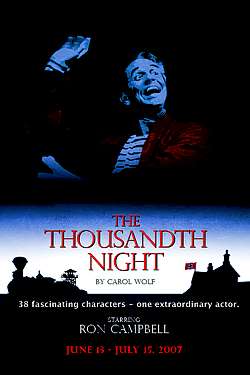
thousandsnightgraphic.jpgI say all this because if you haven’t seen Ron Campbell, you should, and if you’re in southern California and environs you’re going to have a chance very soon. This and next month, Campbell will be performing “The Thousandth Night” at the Colony Theatre in Burbank. The synopsis:
Paris. 1943. A French actor has one chance at freedom before his derailed train to a concentration camp gets moving again. Like Scheherazade before him, this storyteller spins the tales of 1001 Arabian Nights as though his life depends on it — and it does. Solo performer virtuoso Ron Campbell plays 38 roles in this remarkable play written especially for him.

Few deserve the sobriquet “virtuouso.” Ron Campbell does. I’ll be there opening night.

Talkin’ ’bout their generation

Wednesday, June 6th, 2007

What would The Zimmers call The Rolling Stones? How about “young whippersnappers”?

Check out my favorite new band’s great vid, which proves that The Who’s “My Generation” truly is an ageless song.

“Life is pretty damn good…”

Tuesday, June 5th, 2007

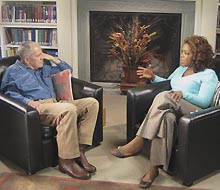
mccarthy-winfrey-cp-3059606.jpg“Life is pretty damn good and we should appreciate it more.”

It shouldn’t be surprising that that is the key takeaway from the author of “The Road,” the novel more than any other in the past year (perhaps in the past 10 years) that I’ve been thinking about, talking about, dwelling on, and recommending to friends, in his interview today by Oprah Winfrey. The bleakness of the post-apocalyptic “Road” is a reminder and an inspiration to recognize the value of what’s here now (and, with luck, to preserve that value). I remember in the immediate weeks after reading it thinking throughout every day that nothing I would face that day could be truly troubling by comparison. And isn’t that the strength of literature: to make you feel life anew?

I should also take a moment to profess my abject love of Oprah. This is probably only the third time I’ve watched her show, but every time I’ve been struck by her obvious genuine interest in the interviewee and the subject. (Want to see the exact opposite? Check out a man named David Letterman.) Some years ago I saw her interviewing a man who had written a book called “No Bad Boys,” about helping troubled youth; this author (and psychologist) was saying that he didn’t believe in “bad boys,” but in boys who needed help. As I watched that profile and his work with some of these boys and Oprah’s questioning, at one point I was reduced to tears. Sentimental? Sure. Heartfelt? Absolutely. I don’t believe in bad boys either, and I was glad to know that someone out there was doing something about that.

Maybe part of my love for Oprah, even given my limited exposure, is her determination to fix little corners of the universe. I too think things are fixable, or at least improvable. Oprah has no room for cynicism, and neither do I. She loves books and wants to talk about them with their authors. In a mainstream way, who has done this since Johnny Carson a long, long, long time ago? No one. It’s fashionably cynical to dismiss Oprah as a sentimentalist, but like her or not, she’s creating new readers for writers like Cormac McCarthy.

In this interview, McCarthy responds in style. He’s not a press hound — this is his first television interview ever, and one of very, very few interviews in his career — and that self-protectiveness may have contributed to his simple, matter-of-fact humility and wisdom, present throughout this interview. With regard to his seemingly odd punctuation style, which some have slammed as an affectation, he says, “I believe in periods and capitals and occasional commas. That’s it.” That style, he says, is “to make it easier to read, not harder.” Disagree if you will, but his books are beautifully written and quickly read.

If you missed the interview, it’s online at Oprah’s website. Here’s the link. If you’d like to see a talented contemporary novelist untrammeled by his recent success and wealth, one who acknowledges debts to forebears remembered (Faulkner, Joyce) and forgotten, watch this. To do so you’ll have to join Oprah’s free online book club (which you can later quit if you like), but is that so much to ask? You can always quit later, and all she’s trying to do is share her love for books she admires. Just like the rest of us.