Lee Wochner: Writer. Director. Writing instructor. Thinker about things.


Blog

Archive for the ‘Comics’ Category

The bottle factory

Friday, April 8th, 2016

More than 30 years ago, I interviewed Denny O’Neil, the foremost writer of Batman comics of the 1970s, the writer who has most influenced the Batman you’ve been seeing in the movies the past 10 years. The interview was for The Comics Journal, and Denny and I got into a heated exchange about low art and high art. He’d once written searing issues-oriented comic-books, taking mainstream comics far far out in new explorations – and now he was writing GI Joe comics.

He defended the GI Joe comics (“Have you read it?” he said. “Basically it’s a superhero comic.”) but I couldn’t imagine how the person who’d tried to address poverty, racism, and drug abuse through the prism of superhero comics could defend writing militaristic toy tie-ins.

Of the entire exchange, and our lunch a week or two later in Manhattan, the thing that made the greatest impression was this: the bottle factory.

I was bemoaning popular low art. (Ironic, for someone writing about comic books, I know.) My lowest-common-denominator example was “Laverne & Shirley.” I don’t know why I hated “Laverne & Shirley” so desperately (nor do I know why my wife’s example later became “Charles in Charge,”), but “Laverne & Shirley” just seemed like the nadir, with its canned laughter and obvious jokes.

Denny’s response to this tirade was this: “Think about the guy at the bottle factory.”

“Huh? What guy at the bottle factory?”

“The poor guy at the bottle factory. He works all day at the bottle factory, he comes off, he wants to take off his shoes, have a beer and watch something simple and entertaining. He doesn’t want to read Tolstoy. It was hard and hot and demanding all day at the bottle factory. He loves ‘Laverne & Shirley.’ It’s what he needs.”

In other words, “Laverne & Shirley” wasn’t for me – but it was certainly for others. A lot of others.

Unfortunately, the choices of those of us who didn’t want “Laverne & Shirley” and its like were severely limited.

At the time, everyone in America was limited to three channels – CBS, NBC, and ABC – and maybe a couple of Ultra High Frequency channels if you could get them (we got 17, and 29, and 48, out of Philadelphia) – and maybe PBS. That was it. And so your choices were: whatever inane original series was on CBS, NBC or ABC; scratchy syndicated shows from an earlier era or old movies; or cheap “it’s good for you” television courtesy of the prim and proper.

For me, watching TV in that era was like working at the bottle factory. With rare exceptions, it was something to be endured.

Now television’s bottle factory has been blown up. It was blown up by cable, which gave creators new freedoms and more opportunities, and the Internet, which did the same and also removed the financial restrictions of needing a studio, and broadcast towers, and expensive cameras and editors and so forth. Now if you’ve got an idea for a show, you can make it yourself and distribute it yourself.

This bonanza of choice has segregated the audience into many little tributes. Today at the airport, a woman near me was excited because a semi-famous contestant from “American Idol” was waiting with us for the same plane. She pointed him out, and showed me his image on her phone as well, but I didn’t know who he was, having never watched “American Idol.” In the 1970s, with so few shows, everyone knew who everyone was.

All of this new choice has also made us pickier. A couple of years ago late at night in some hotel room I fired up Netflix to watch another episode of “Sons of Anarchy” and found myself mostly scrolling through my phone while it was on. Then I realized that not only was I not watching the episode, I’d never watch another one – not just because I didn’t care, but because I had so many choices I didn’t need to settle for this. When the menu is 90 pages long, why order something you don’t want to eat?

A few nights ago, I was watching “Mr. Selfridge” on my DVR and that bottle-factory feeling came over me. The characters I cared about (mostly the women striving to advance in a sexist and classist early 20th century England) were all gone, leaving me entirely at the mercy of Jeremy Piven’s completely ersatz performance. So I deleted it.

In the post-bottle factory age, we have the opposite dilemma. Now that there are an estimated 450 original scripted shows a year, and so many of them are excellent, it would be easy to lose your life to television. I can recommend “Breaking Bad” and “The Wire” and “The Sopranos” and “The Good Wife,” but no, I’m not adding “Orphan Black” or “The Americans” or “Homeland” or, probably, any other show that you’re recommending. I don’t have time. I don’t have the time. Well, specifically, I have just as much time as anyone else alive at the moment – but I’m working harder than ever to guard it for other things.

I read somewhere that when there are too many items on a menu, people are more likely to order less – or to order nothing. The wealth of choices is too daunting, so they lose their hunger. I used to yearn for great TV.

But now that it’s here, I wish a lot of it would go away.

Because I’d like to watch it. Really.

Cosplay banned

Friday, April 1st, 2016

group-cosplay-girl-superman

How dumb are some legislators? This dumb:  State legislators in five states just banned Cosplay  because they thought it meant dosing the drinks of beautiful women and then raping them.


Comical weekend

Sunday, March 27th, 2016

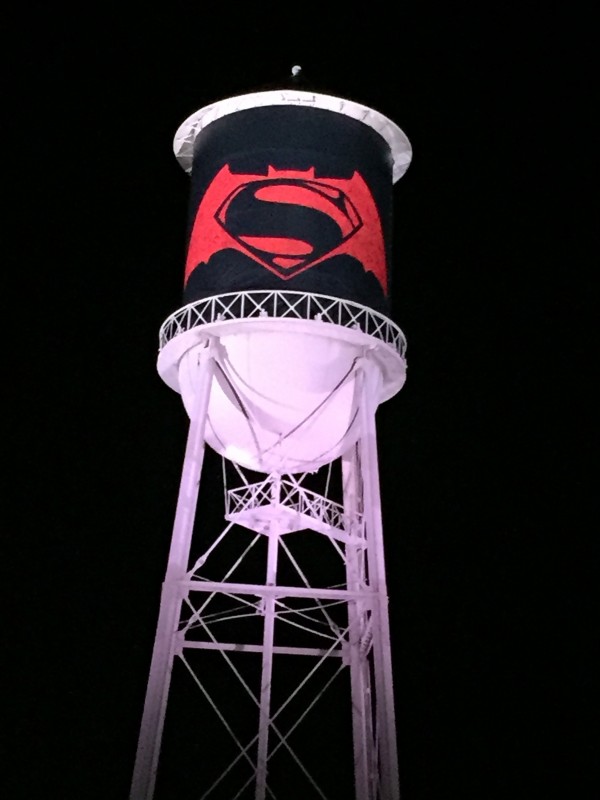
IMG_0800

This is a little bit of graffiti in my neighborhood.

Okay, it’s the Warner Brothers water tower (still in my neighborhood). On Thursday night, the folks at Warners were kind enough to invite a couple hundred of us to a screening of “Batman v. Superman” on the lot. I won’t say that you’re looking at the best part of the movie (that would be Wonder Woman), but I will say that even with a masters in writing and almost 25 years of teaching dramatic writing, and with five decades of reading comic books starring Batman and Superman, I couldn’t make any sense of whole chunks of the film.

The next day, I went to Wonder Con, the baby brother to Comic-Con, with a couple of friends. Wonder Con, which began years ago in San Francisco and has more lately been in Anaheim, was in downtown Los Angeles this year due to scheduling difficulties with the Anaheim Convention Center. I’m now going to show you the absolutely most wondrous thing I’ve ever seen in Los Angeles. Look closely.

IMG_0803

YES, that is my car parked at a white-striped FREE parking spot right on Figueroa Street, immediately across from the Los Angeles Convention Center. You’re going to want to save this photo. Some day, you will tell your grandchildren that you’d once seen a FREE parking spot in downtown LA and they will sneer at you. They will say, “But Gramps, all parking near the Convention Center is $20, or $30, or frequently even 45 bucks! FREE parking? You’re nuts!” But there it is — absolute proof, and unlike Bigfoot photos, obviously not staged or Photoshopped. It exists! At least, it turns out, until 3 p.m., whereupon it becomes a tow-away zone unmarked by signs.  Good thing my good friend the redoubtable Dr. Trek checked for me. Whereupon I moved my car… into $20 parking. But until then, I had this, I had the FREE PARKING! Another grail quest completed!

Wonder Con, as stated, is much like Comic-Con, if Comic-Con were Galactus and Wonder Con were Ant-Man. (You’ll note that unlike Comic-Con, Wonder Con doesn’t even merit a hyphen. That says a lot.) Still, it’s possible to catch up with old friends and have a grand time. Here I am digging in comics boxes looking for a surprisingly hard-to-find copy of From Beyond the Unknown #8, with a couple of old pals.

IMG_0807

Even Spidey-Sense couldn’t help me find that issue. The search continues.

Unlike the San Diego Convention Center (and, indeed, the City of San Diego itself), where the structure is laid out sensibly, the Los Angeles Convention Center is the product of a twisted mind whose architectural style pairs M.C. Escher with the Marquis de Sade. The Center has no center — there are actually two large buildings separated by a street and an enclosed overhead byway that gives no hint that one is crossing between buildings — and is shaped overall like clumps of organic matter with roots growing through them. You know how sometimes you’ll find a section of an airport closed for renovation and you’re shunted down narrow passageways serving as temporary workarounds? At the Los Angeles Convention Center, these claustrophobic corridors are permanent. Someone actually designed them this way. (And I’m not the only one to remark upon the terrible Los Angeles Convention Center. Mark Evanier has been going on about it as well.) Take this example:


IMG_0811

See the people up top? Perhaps you’d like to join them. Now, barring the power of flight, how could you do it. Well, if you back up 20 feet, you find this:

IMG_0812

Yes, that’s a lady in some sort of blue costume. It’s also a stairwell. How do I know it’s a stairwell? I went all the way inside to see what it was. There’s no sign, there’s no window, it’s completely shielded, so there’s no indication that it’s a stairwell — in this case, with a  female Deadpool lying on the steps taking a photo of this lady’s rear end for some reason — but trust me, it’s a stairwell. But then, one shouldn’t be surprised that it’s unmarked:  Most of the interior of the convention center is unmarked. Including access points to the parking garage. It took my friend Larry and me 45 minutes to find my car inside the convention center parking structure on Saturday night, and that was after consulting with a convention center supervisor and a helpful guard who walked us out and still couldn’t find access. (After walking about an hour on our own, Larry and I found it. By luck.)

Even with  the frustrations of parking and navigation, as well as scheduling that left me traversing one end of the convention center back to the other repeatedly over two days during which I burned 550 calories each day just by walking (thanks, iPhone tracker), Wonder Con was great fun. Two added great finds from the Con.

1. I finally got my dream job, and a sense of the benefits.

IMG_0816


2. I finally, actually, really got to see someone dragging toilet paper on his shoe. I guess it isn’t just a classic movie joke.

IMG_0823

With great fame comes great exposure

Tuesday, February 23rd, 2016

When Marilyn Monroe died young, one wag said, “Good career move.”

Bad career move? That might be Stan Lee outliving his legacy.

Put another way: Stan gets plenty of movie cameos… but I haven’t noticed any art shows of his work, or any biographies not authored by himself, or any museum in the making. All of those things are going to Jack Kirby.

Web of confusion

Friday, February 12th, 2016

spiderman_main_duo1a


Who created Spider-Man? Was it, as credited, Stan Lee and Steve Ditko? Or was it Jack Kirby, who claimed authorship of the signature costume? Or was it… Halloween-costume company Ben Cooper? (Steve Ditko says no.)

“New” Batman v. Superman trailer

Thursday, December 3rd, 2015

Batman’s never looked so good as here. Plus, it’s so retro!

Mighty sore

Friday, October 16th, 2015

That’s how you might feel if you strained too hard to pick up Thor’s hammer.

But how would you feel if you found out it was rigged?

Childhood’s end

Monday, September 28th, 2015

When I was in New Jersey recently I had the opportunity to take three of my great-nephews to their local comic-book store. I took some cash out of an ATM because I wanted to buy each of them something, and figured I’d spend about 10 dollars each.

All three of them were excited to be there (as was I, of course). The middle brother (aged 11, I believe) scored eight comics he wanted out of the dollar box; he was especially glad to learn about “Damage Control,” because he’d always wondered who cleaned up the messes left by superheroic battles, and to pick up an entire run of the miniseries for cheap was glorious. The youngest, who turned nine just this week, was interested in a lot of the things in the store, but decided he didn’t actually want anything. (I know:  remarkable wisdom in one so young. One of the things I want most at this point of my life is to be rid of some of the things I own, because it’s feeling like they own me. But it’s taken me decades of adulthood to realize this.) The eldest brother selected a small Transformer in a locked display case, and then said to me something I’ve been thinking about ever since:  “We can say it’s my birthday present.”

I wouldn’t have said that, because I hadn’t known it was going to be his birthday a few days hence. And understandably so:  I see these boys once, or sometimes twice, a year. And I don’t think I’ve ever been there for the birthday of any of them. We’ve got a large extended family — my mother; my brother and his wife and their daughter and their son and their daughter-in-law; my other brother and his husband; my sister and her husband, and their daughter and her husband and their three children, and their son and his girlfriend and their son, and their daughter and her husband and their three children; plus myself and my wife and our three children. That’s 28 of us. This leaves out all the various aunts and uncles and cousins and so forth. Who could possibly remember all these birthdays? My policy is to send children random gifts when least expected, for maximum impact.

So when my great-nephew said, “We can say it’s my birthday present,” well… I hadn’t intended to get him one. But he assumed he was due one. And then I remembered what childhood was like. Childhood is that period of your life when you believe that people owe you something. I certainly felt that way at his age. When I was his age, I spent a month away from my parents staying with relatives in another state, and during that month my birthday came around. I got a card in the mail from my mother with some money in it — but I nevertheless fully expected a full-on birthday party upon my return weeks after the date. Forty years later, it takes no effort at all to conjure the shock I felt at no birthday party at all. I lurked around for two full weeks expecting at any moment for my family to jump out and yell “surprise!” and confront me with a full-tilt birthday party, with streamers and hats and balloons and a mountain of gifts — except I wouldn’t be surprised, because I knew, I just knew, all along that surely such an event would be coming any day now, there was no fooling me. Except it didn’t.

Which leads us to the pain of adulthood:  the slow dawning that no one owes you anything, that, indeed, if you are to get anything in adulthood, you need to get it on your own. Heirs and princesses and landed lords and movie stars and billionaires born with the name Trump don’t need to learn this lesson, but just about everyone else does.

When we got back to my mother’s house from our comic-book-store spree, I saw that the Chinese food my brother had ordered for dinner with our mother had arrived. As I sat down to eat, I fished out a twenty-dollar bill to give to him. “No, that’s okay. It wasn’t much,” he said. “Besides, you bought at the comic-book store.” Spoken like a true adult.

Long live the king

Sunday, August 30th, 2015


One day after what would have been his 98th birthday, I went to the official opening of “Comic Book Apocalypse:  The Graphic World of Jack Kirby,” an exhibit in the CSUN Art Galleries at Cal State Northridge, here in the San Fernando Valley. The show runs through October 10, and if you have any interest in comic-book art — and even if you don’t — I recommend you go.

I say that because you’ll gain a new and greater understanding of an artist whose impact can’t be — shouldn’t be — underestimated. Kirby wasn’t just a great comics artist, wasn’t just a great innovator, he was a brilliant mind who was able to create new myths for our time. Moreso than even Philip K. Dick and H.P. Lovecraft, artists similarly stuck in a creative ghetto whose ideas seeped deep into our collective subconscious, Kirby created whole universes that are now accepted as givens.

While the exhibit covers the length of Kirby’s 50-year career, starting in the 1940s, it dwells on four particular series:  “Fantastic Four,” “Thor,” the New Gods titles (“New Gods,” “Forever People,” “Mister Miracle” and Kirby’s run on “Jimmy Olsen”) and “Kamandi.”

To me, “Fantastic Four” remains the high-water mark; the example of a space-traveling team of science explorers who meet new cultures far and wide while striving to represent us in a noble fashion left an indelible mark upon me. The series also introduced: Black Panther and Wakanda, the Inhumans, the Silver Surfer, Galactus, Ronan the Accuser, the Silver Surfer, the Skrulls, Doctor Doom, and many more. All of these have already been in major motion pictures, or soon will be. All of them were primarily created by Jack Kirby.

(Kirby also co-created almost every important Marvel character from 1958 to 1970, and many, many important DC characters in the five years he was there as well.)

I was thrilled to see so much original artwork, some in pencil but most of it inked by an array of Kirby’s primary inkers (the delightful Joe Sinnott on “Fantastic Four,” Mike Royer on the New Gods titles and “Kamandi,” and the regrettable Vinnie Colletta on “Thor.” Seeing Kirby’s originals inked under different hands gave me the opportunity to discuss the different styles with my daughter Emma and friend Ross, who went with me. The exhibit includes several examples of Colletta having erased some of Kirby’s detail work underneath, so that he could finish the job more quickly.

I also learned some things. “Thor,” which began more as a modern-day Norse fable, transmuted into a trippy science fiction epic that featured the title character meeting embodiments of fate and the universe out in outer space. Few among us would take ancient Norse gods and put them in outer space, but that’s what a mind that worked by leaps and bounds did. What I learned seems obvious in retrospect:  that Kirby’s Fourth World saga was essentially a sequel to “Thor,” in which these gods were dead or dying, and new gods created, against the backdrop of technological advancement. (Kirby may have predicted the iPhone in creating the Mother Box, which is handheld and connects to all knowledge. Judging from the actions of my youngest, it’s impossible to wean someone off it.)

I tried to share with Emma what it felt like, at age 10 or so, to get treasured old “Fantastic Four” comics in the mail from mail-order king Robert Bell in Happauge, NY, comics that I had scrimped and saved and sent away for, how incredibly exciting it was to see a padded envelope waiting for me in the mailbox and knowing what was inside. This was before the internet, of course, before everything was available instantly, before instant gratification. Prying the staples off the outside of a padded mailer and opening its flap was like unsealing Tutankhamun’s tomb (with a similar scent of moldering discovery leaking out).

The dynamism of Kirby’s artwork never fails to impress. But it’s his vision, his wild inventiveness, his restless intellect, his brilliance in predicting and creating all these things that fascinate us (and drive the economy), that’s truly striking. That vision is so large it’s barely containable within the walls of the gallery.


Fantastic television

Wednesday, August 12th, 2015

I’m not sure I feel like seeing that new “Fantastic Four” movie everyone is panning.

What I’d really like to see is the unaired “Fantastic Four” TV series from 1963.