Why it’s great being a playwright
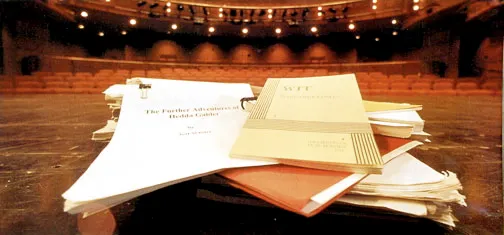
This spring and summer, I’ve carved out more time than I’ve had recently to work on my other job: being a playwright. This weekend is already serving as a wonderful reminder of why it’s great being a playwright. Oh, you’ll get lots of boo hoo hoos from playwrights (Tony Kushner once complained about how poorly playwrights are paid, even as he was loading a new $10,000 couch into his townhouse), but in many ways, it’s a dream job. Or avocation. Or hobby. Take your pick.
Based upon my experience of being a playwright, dating back a long, long time to my first play getting staged when I was 15 and in high school, here are just a handful of the reasons it’s great.
- Nothing beats hearing people laugh at all of your jokes, in the right place and at the right time, without prompting by your friends or lovers. (In my experience, your family does no prompting. More likely they’ll sit there like Easter Island statues, afraid it’s about them.)
- It can be nice to win an award now and then.
- When you don’t, it’s also comforting to know that the judges were wrong.
- Usually, when you fly in to see your play, everyone there will treat you the way you wish everyone everywhere treated you: with respect and reverence, and enormous admiration for your wit. It’s even better than how your dog does it.
- Sometimes you get to be a visiting artist or teacher or judge or lecturer, usually in a bucolic location that couldn’t quite get Suzan Lori-Parks, but they’re happy to make do with you, and they buy you drinks.
- Whether or not they see it, an actual production helps your family understand “what you’re trying to do.” Maybe.
- You get to work with actors. Sure, some of them are as bad at it as you are (or, inconceivably, even worse), but most of the time you get mostly good people, and the surprisingly good people lift your material up to even greater heights, and you get credit. If you saw a play that really wasn’t much of anything, but you enjoyed the hell out of it — that’s what happened: the actors. And, seriously, there are terrific actors everywhere. I’ve had plays produced in a little town in the interior gold-rush area of California, and in the backwoods hilltops of Arkansas, and both times the locals were great. I salute them!
- Also, the small-town people have a greater tolerance for outlandishness than you think. I think they even expect it, like: “Hey, this is an artist, so we shoulda figured on this.” So just have fun.
- Every time you get a production, you’ve set up a little outpost somewhere on the globe. People there now know you, and you know them! (Remembering their names can be a separate matter.)
- Those people in the outposts? Sometimes they’ll let you crash at their place. Even in pricey places like Manhattan. I’ll say no more.
- You make lifelong friendships with some of the actors and directors and designers. (And lifelong enemies with some of the others.)
- If it’s a production where you live, you’ll get to learn who your true friends are: They’re the ones who bought tickets.
- In your mind, you’re communing with Shakespeare, Brecht, Stoppard, and whoever wrote “Bob’s Holiday Office Party.” What could they learn from you? (You’d love to share with Brecht your better ending for “The Good Person of Szechwan.”)
- As a playwright, you will listen more closely to what other people say. Of course, you’ll need to determine for yourself whether or not this is a benefit.
- After you have even a little playwriting income, it can be surprising what’s tax deductible. I’m pretty sure that cigars qualify as office supplies.
- Big benefit: You can swear off drugs. That audience response is your drug.
This is just the starter list. There are many more delights (such as an entree to meeting famous people you’d like to meet), so I could go on. But I think now I’m going to go on to working on my new play, so that maybe I can add more of them in the coming months and years.
July 3rd, 2026 at 9:15 am
❤️💯❗️